Elon Musk: “Unfortunately, tariffs on solar modules are extremely high in the USA”


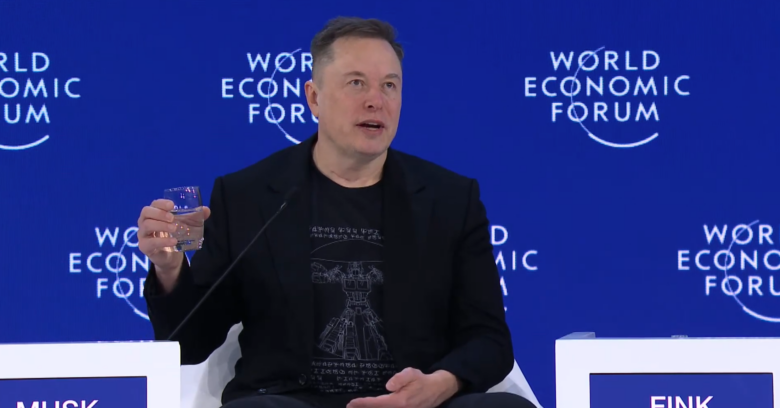


Tesla and SpaceX CEO Elon Musk, who is also CTO of the controversial AI startup xAI, has made far-reaching predictions about the development of artificial intelligence at the World Economic Forum in Davos, while also addressing global energy challenges. In a conversation with BlackRock CEO Larry Fink, Musk sketched a future in which AI and robotics could lead to unprecedented prosperity, but at the same time warned of the risks posed by these technologies.
AI Development: Superintelligence in Five Years
Musk predicted that artificial intelligence would already be more intelligent than any single human by the end of 2025, or at the latest by 2026. His assessment for the medium-term future was even more dramatic: by 2030 or 2031, AI would be more intelligent than all of humanity combined.
“The costs of AI are already falling very rapidly and changing almost from month to month,” Musk explained. Open-source models were only about a year behind proprietary systems.
The entrepreneur emphasized that AI companies naturally wanted to reach as many customers as possible, which would lead to broad availability of the technology. The costs of AI would continue to fall.
Energy as the Decisive Bottleneck
Musk identified the availability of electrical energy as the greatest limiting factor for AI development. While the production of AI chips grows exponentially, global electricity production only increases by three to four percent annually. “The limiting factor for the deployment of AI is essentially electrical energy,” Musk said.
Musk’s central thesis: either this year or by 2026 at the latest, chip production will exceed available energy. With one significant exception: China.
China as an Energy Pioneer
Musk highlighted China’s massive investments in renewable energy and cited impressive figures:
- China is currently building 100 gigawatts of nuclear power
- Solar energy production capacity is 1,500 gigawatts per year
- Over 1,000 gigawatts of solar energy are actually installed annually
- This corresponds to approximately 250 gigawatts of continuous power (in combination with battery storage)
For comparison: average electricity consumption in the USA is 500 gigawatts. China could cover half of US electricity demand with solar energy alone.
“Solar is by far the largest energy source,” Musk emphasized. “The sun makes up 99.8 percent of the mass of the solar system. Even if you teleported three additional Jupiter planets into our solar system and burned them in fusion reactors, the sun’s energy would still round up to 100 percent.”
Solar Energy: Potential for the USA and Europe
Musk explained the enormous but untapped potential of solar energy in Western countries. An area of just 100 by 100 miles (approximately 160 by 160 kilometers) would be sufficient to meet the entire electricity demand of the USA. This would correspond to a small part of states such as Utah, Nevada, or New Mexico.
Similar conditions apply to Europe: relatively sparsely populated areas in Spain or Sicily could meet the entire European electricity demand.
Musk cited extremely high tariffs on solar panels as the main obstacle for the USA. Since China manufactures almost all solar panels, these trade barriers would artificially worsen the economic viability of solar energy.
“Unfortunately, tariffs on solar modules are extremely high in the USA,” Musk said. Musk announced that both SpaceX and Tesla are independently working on large-scale solar production in the USA. Both companies plan to build a production capacity of 100 gigawatts per year each within approximately three years.
Space as the Ultimate Location for AI Data Centers
A particularly forward-looking announcement concerned the combination of space travel, solar energy, and AI. Musk explained that SpaceX would launch solar-powered AI satellites into space within a few years.
The advantages are considerable:
- Solar energy in space is five times more effective than on Earth
- No day-night cycles, no seasons, no weather
- 30 percent more power due to lack of atmospheric dampening
- Extremely efficient cooling through the cold of space (3 Kelvin in shadow)
- Unlimited space without land use conflicts
“Within two, or at most three years, space will be the most cost-effective location for AI data centers,” Musk predicted. As always with Musk, it must be noted that his predictions and promises rarely come true, especially regarding timing.
The prerequisite for this is the complete reusability of rockets, which SpaceX aims to achieve this year with the Starship program. This would reduce the cost of access to space by a factor of 100, to less than 100 dollars per pound of payload.
Vision of a Future of Abundance
Despite his warnings about the risks of AI and robotics, Musk appeared fundamentally optimistic. He predicted a future in which humanoid robots would be more numerous than humans and in which goods and services would be available in abundance.
By the end of 2025, Tesla robots are expected to take on more complex tasks in factories. By the end of 2026, Musk expects to begin selling humanoid robots to the public, once safety and functionality are sufficiently high.
His closing message to the audience in Davos: “I would encourage everyone to be optimistic and excited about the future. For quality of life, it is actually better to be an optimist and be wrong than to be a pessimist and be right.”