Anthropic made about $10 billion in 2025 revenue, according to CEO Dario Amodei

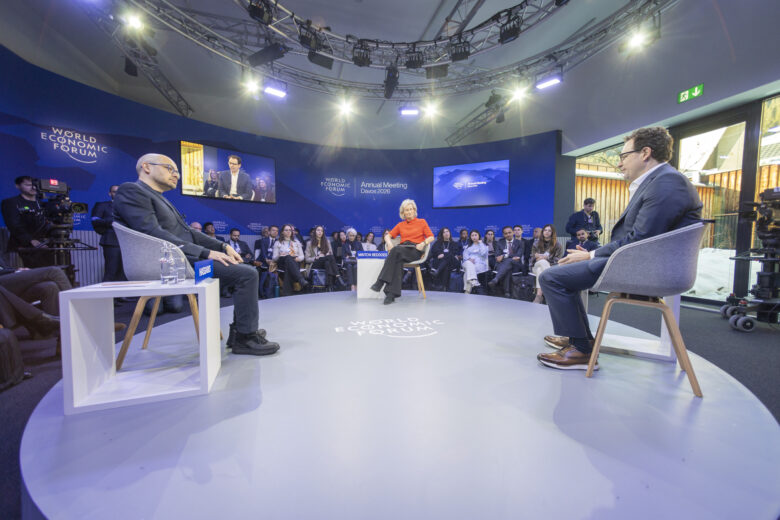


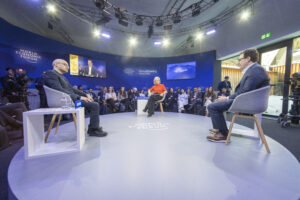
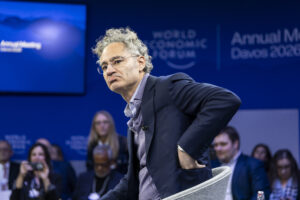
In a high-profile conversation at the World Economic Forum (WEF) in Davos, two heavyweights of the AI industry met: Demis Hassabis, CEO of Google DeepMind, and Dario Amodei, CEO of Anthropic. It was their first public conversation in a year, and the two leading AI researchers discussed timelines, risks, and the fundamental changes that artificial intelligence could mean for humanity.
A brief background: Google and Anthropic are competitors in AI models, but they are also associated behind the scenes – because Google, DeepMind’s parent company, is invested in Anthropic and holds approximately 14 to 15 percent there. So it may not be pure coincidence that precisely these two CEOs are sitting on the same stage rather than representatives from OpenAI or xAI.
When will superintelligent AI arrive?
Both experts agree that transformative AI systems are closer than many think, but they differ in their forecasts. Dario Amodei stands by his prediction that by 2026 or 2027 we will have models that can do everything a human can do at the level of a Nobel Prize winner across many fields of expertise. His reasoning: AI systems are increasingly being deployed in programming and in AI research itself, which could set in motion a self-accelerating development loop.
“I have engineers at Anthropic who say: I don’t write any code anymore. I let the model write the code, I just edit it,” Amodei explained.
Demis Hassabis is somewhat more cautious. He sees a 50 percent chance of systems with all of humanity’s cognitive abilities by the end of the decade. Hassabis emphasizes that areas like mathematics and programming are easier to automate because the results are verifiable. Natural sciences are more complex because experimental verification takes time.
The current state of the race
The power dynamics in the AI race have shifted over the past year. While a year ago OpenAI was considered the leader, Google DeepMind has caught up significantly. Hassabis expressed confidence that his company has returned to the top of the leaderboards, thanks to a broad research base and a renewed startup mentality in the organization.
Anthropic, meanwhile, is experiencing explosive growth. Amodei reported a tenfold increase in revenue over the past three years: from zero to 100 million dollars in 2023, to one billion in 2024, and to a projected ten billion dollars in 2025. These figures are already approaching the scale of the world’s largest companies. For comparison: OpenAI made about twice as much in 2025, approximately 20 billion dollars.
The world of work in upheaval
Both CEOs expect significant impacts on the job market, though with different timeframes. Amodei predicts that half of entry-level office jobs could disappear within the next one to five years. He already sees early signs among software developers and even in his own company.
Hassabis expects normal technological development over the next five years, in which some jobs disappear but new, possibly more valuable jobs are created. His advice to students: become intensively familiar with the new AI tools, which could be more valuable than traditional internships.
“After the arrival of AGI, we are in uncharted territory,” Hassabis warned, pointing to questions about meaning and purpose that go beyond purely economic aspects.
Geopolitical tensions and chip sales
A central topic was the geopolitical dimension of AI development, particularly the relationship between the United States and China. Amodei was critical of current US policy of selling high-performance NVIDIA chips to China. He provocatively compared this to selling nuclear weapons to North Korea and argued that forgoing chip sales would buy more time to handle the technology responsibly.
His logic: without geopolitical competition, the race would not be between nations but between companies like Google DeepMind and Anthropic, which in his view could be better coordinated.
Risks: From bioterrorism to uncontrollable AI
Amodei announced a new essay on AI risks that addresses several areas of danger:
- Control of highly autonomous systems that are more intelligent than humans
- Misuse by individuals, for example in the field of bioterrorism
- Misuse by authoritarian states
- Economic impacts and job displacement
- Unforeseen consequences
Both CEOs distanced themselves from extreme “doomism,” which considers collapse inevitable. Instead, they emphasized that risks can be managed through scientific work and collaboration. Amodei pointed to research on “mechanistic interpretability,” in which one looks inside AI models to understand why they do what they do.
The decisive question: Does the loop close?
Both experts identified self-improving AI as the decisive factor for the coming years. If AI systems are able to independently develop better AI systems, development could accelerate exponentially. Hassabis mentioned additional research areas such as world models and continuous learning as possible breakthroughs if self-improvement alone is not sufficient.
Interestingly, both expressed at the end of the conversation that they would actually prefer if development proceeded somewhat more slowly. This would give society more time to prepare for the fundamental changes that come with superintelligent AI.
Outlook: What will change by next year
When asked what would change by their next meeting, both agreed: progress in AI systems that build AI systems will be the decisive indicator. Hassabis added that robotics could also experience a breakthrough.
The conversation made clear: leading AI researchers see both enormous potential and significant risks. Their message to politics and society is clear: the time to act and prepare for this transformation is running out. Whether humanity survives its “technological adolescence” without self-destruction, as Amodei put it, depends on how the next few years are used.