Bitcoin crashes to $77,000, altcoins plunge by double digits in many cases


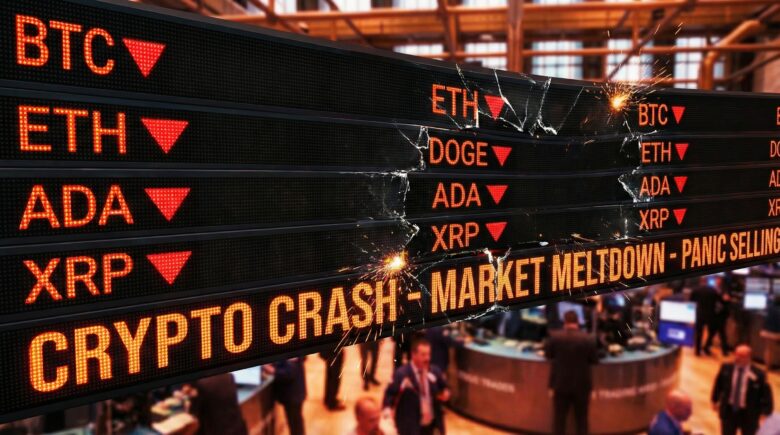


Is this a harbinger of an even tougher week ahead? The Bitcoin price collapsed massively over the weekend, falling temporarily to nearly $75,000 – the lowest level since April 2025. Within a few hours, the cryptocurrency lost more than ten percent of its value as strong selling pressure gripped the markets. The price slid from a 24-hour high of $84,356 to a low of $75,644. The low liquidity during the weekend significantly amplified volatility and accelerated the downtrend. Buyers became active again only in the mid-$70,000 range after several key support levels had been broken.
The selling wave gained momentum after Bitcoin failed to hold support at $82,500. Technical analysts point out that the price broke through an ascending trendline that had existed since late December and also fell below the 50-day exponential moving average at around $90,000.
This level has now turned into resistance. Trading volume expanded significantly during the collapse, indicating forced market exits and margin liquidations. Additionally, Bitcoin lost the so-called realized market value – the aggregated cost basis for the current active BTC supply – which stands at $80,700, for the first time since October 2023.
More dramatic than Bitcoin prices are the rates of altcoins, which also crashed partially double-digit on Saturday evening:
| # | Cryptocurrency | 24 Hours (%) | 7 Days (%) |
| 1 | Bitcoin ($BTC$) | -7.54 | -12.45 |
| 2 | Ethereum ($ETH$) | -12.30 | -11.13 |
| 3 | BNB ($BNB$) | -9.20 | -6.54 |
| 4 | XRP ($XRP$) | -10.55 | -11.89 |
| 5 | Solana ($SOL$) | -13.43 | -9.47 |
| 6 | TRON ($TRX$) | -3.09 | -1.51 |
| 7 | Dogecoin ($DOGE$) | -13.40 | -10.55 |
| 8 | Cardano ($ADA$) | -13.76 | -13.93 |
| 9 | Bitcoin Cash ($BCH$) | -12.35 | -11.80 |
| 10 | Hyperliquid ($HYPE$) | -10.28 | +32.50 |
Massive Liquidations Burden the Market
The sudden price collapse triggered a liquidation wave in the derivatives markets, with positions worth $800 million being unwound. Traders describe the event as a deleveraging phase in which leveraged positions were forced to close. Despite the sharp decline, on-chain data suggests renewed interest from new buyers. The number of newly created Bitcoin addresses reached its highest daily value in almost two months over the past 24 hours. Market observers interpret this as a sign that long-term oriented investors are using the lower prices as an entry point.
Particular attention is being paid to the situation of publicly listed treasury company Strategy, which holds the largest institutional Bitcoin position with over 700,000 Bitcoin. The price decline pushed the value of these holdings below the company’s average cost basis of $76,037, causing the entire position to fall into negative territory for the first time. Strategy’s stock price currently stands at $143 and has fallen by nearly 70 percent from its local high of $455 in July of last year. This development illustrates the impact of Bitcoin volatility on companies with large crypto holdings.
Political Uncertainty and Market Outlook
The price collapse occurred against the backdrop of political uncertainty in the United States, where the government entered a partial shutdown. Congress missed the deadline for passing a complete budget package, leaving several important departments temporarily without funding. The Senate did approve a funding agreement for most agencies through September as well as a two-week interim solution for the Department of Homeland Security, but the measure is still awaiting approval from the House of Representatives. Interestingly, Bitcoin showed relative strength compared to gold during the selloff, which experienced an even steeper decline in the same period.
Daily trading volume reached $75 billion, indicating sustained high market interest. Analysts emphasize that the next important support zone lies in the low to mid-$70,000 range, with the April 2025 low of $74,500 receiving particular attention. As long as Bitcoin does not recapture the area between $82,000 and $84,000, downside risk remains elevated according to traders’ assessments. Some observers also point to the last bull market high from November 2021 at $69,000 as a possible long-term support level.