Digital Fool’s Gold? Bitcoin Underperforms Traditional Assets Over 5 Years




What haven’t we heard over the past few years: Bitcoin is a hedge against inflation. Bitcoin is digital gold. Bitcoin beats every stock. Bitcoin is better money. Bitcoin advocates like Michael Saylor never tired of explaining to us in podcasts and YouTube videos why the cryptocurrency simply changes everything, from saving to geopolitics.
Some even believed that Bitcoin would abandon its previous 4-year cycle (more on that here) and transition into a super-cycle. Driven by demand from institutional investors, from states, ultimately from ever more bitcoiners, BTC would now soon march steadily upward.
At the latest, the past week proved Bitcoin preachers like Michael Saylor wrong again. Because Bitcoin did what it has done so many times before: it crashed hard. Here are the losses in numbers:
- Since the all-time high of 126,000 dollars on October 6, Bitcoin has lost 45% in value, thus nearly halved
- Within the last 30 days, BTC lost 22%
- Within the last 7 days, BTC lost 11%
And this despite the self-proclaimed crypto president Donald Trump being at the helm of the USA, and leaving little untried to do favors one after another for the crypto companies that donated to him generously. Trump has been in power for just over a year and has so far implemented the following:
- GENIUS Act for regulated stablecoins
- Ending the “crypto war” of the SEC, which took place under Biden, against companies like Coinbase, Ripple, etc.
- Enabling deposits of Bitcoin into 401(k) pension accounts
- Pardoning crypto entrepreneurs like Binance founder Changpeng Zhao, who was in US prison for money laundering
- Pushing the CLARITY Act for regulation of crypto assets and crypto companies between the SEC and CFTC (securities vs. commodities)
- A dedicated “Crypto Czar” (sic!) in the White House
Even under these circumstances, Bitcoin actually had a rather poor year in 2025: While there were new all-time highs around Trump actions, BTC ended 2025 worse than it began (93,000 vs. 87,000 dollars) and then continued to decline to around 70,000 dollars, where we stand today. If you compare Bitcoin with other assets over the last 5 years, you quickly see: BTC has actually been a poor investment.
Bitcoin vs. Gold
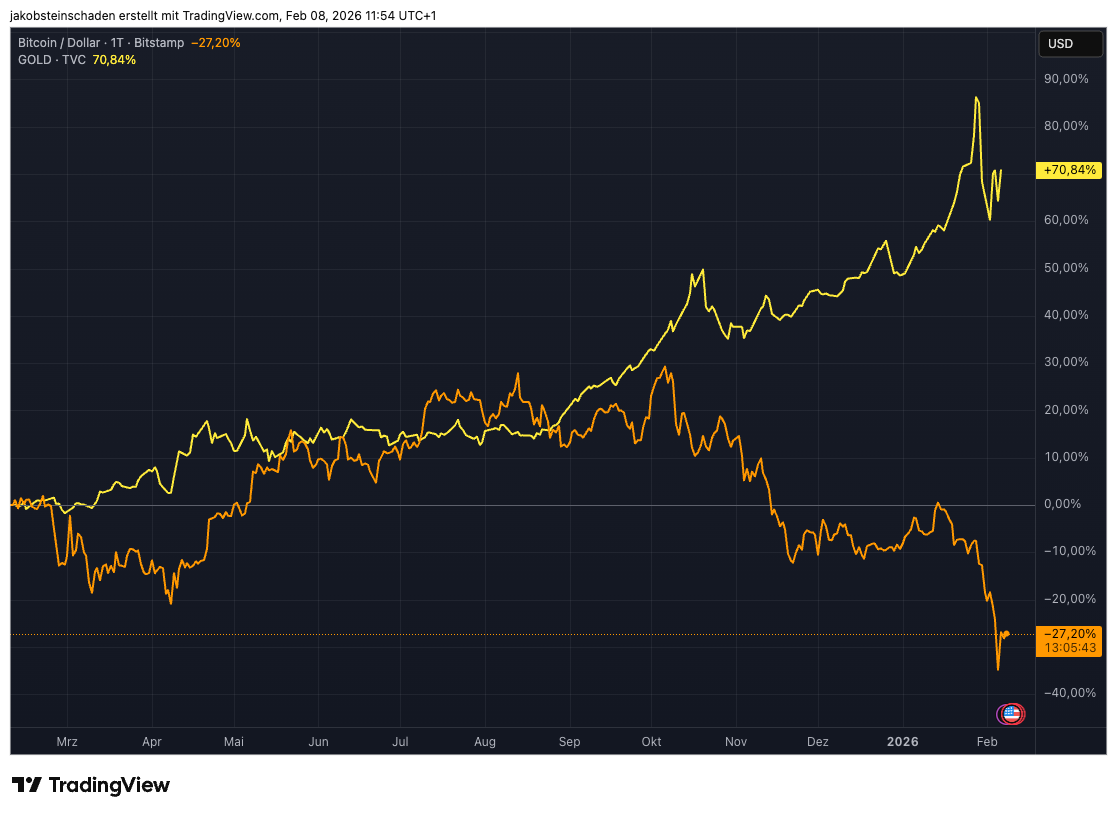
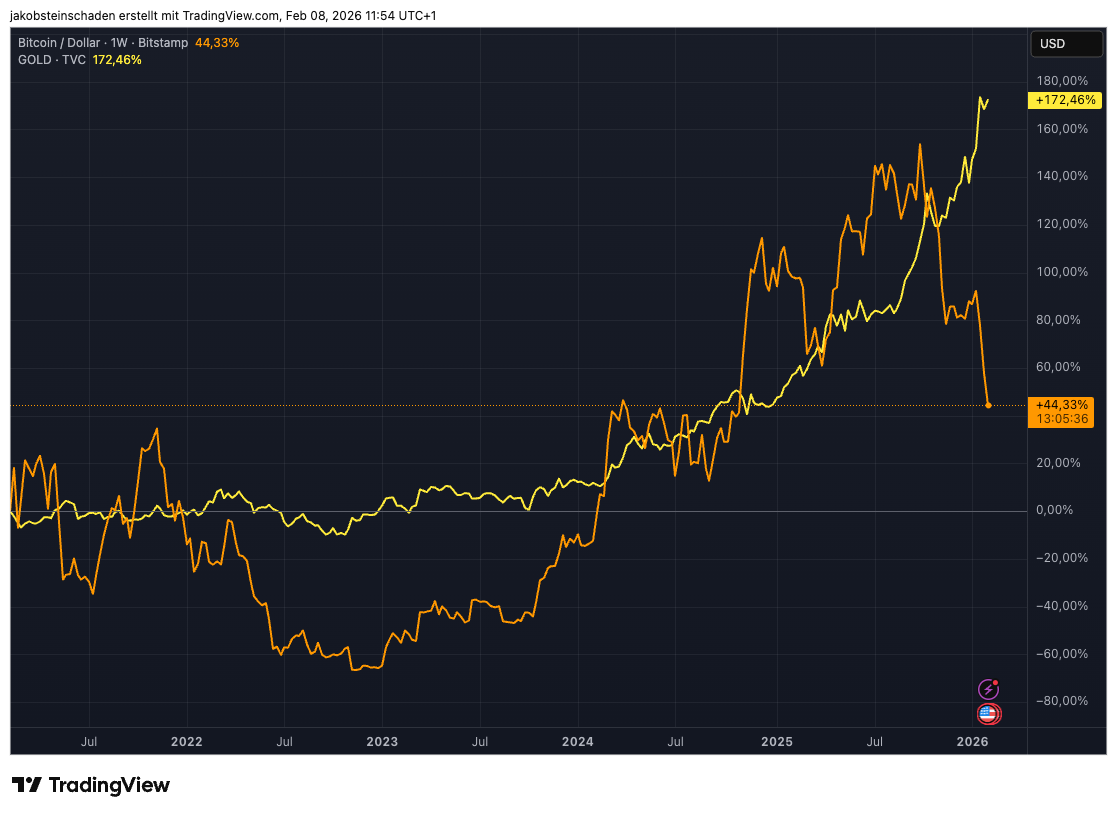
Bitcoin has been and continues to be repeatedly referred to as digital gold because it is limited and through the halving only a certain new amount (and ever less over time) of BTC comes into circulation. This artificial scarcity, so the theory goes, ensures rising prices over time with increasing demand. Compared to gold, however, this has not proven true:
Here are the infographics:
Bitcoin vs Gold over 12 months
Bitcoin vs Gold over 5 years
Bitcoin vs. (Tech) Stocks
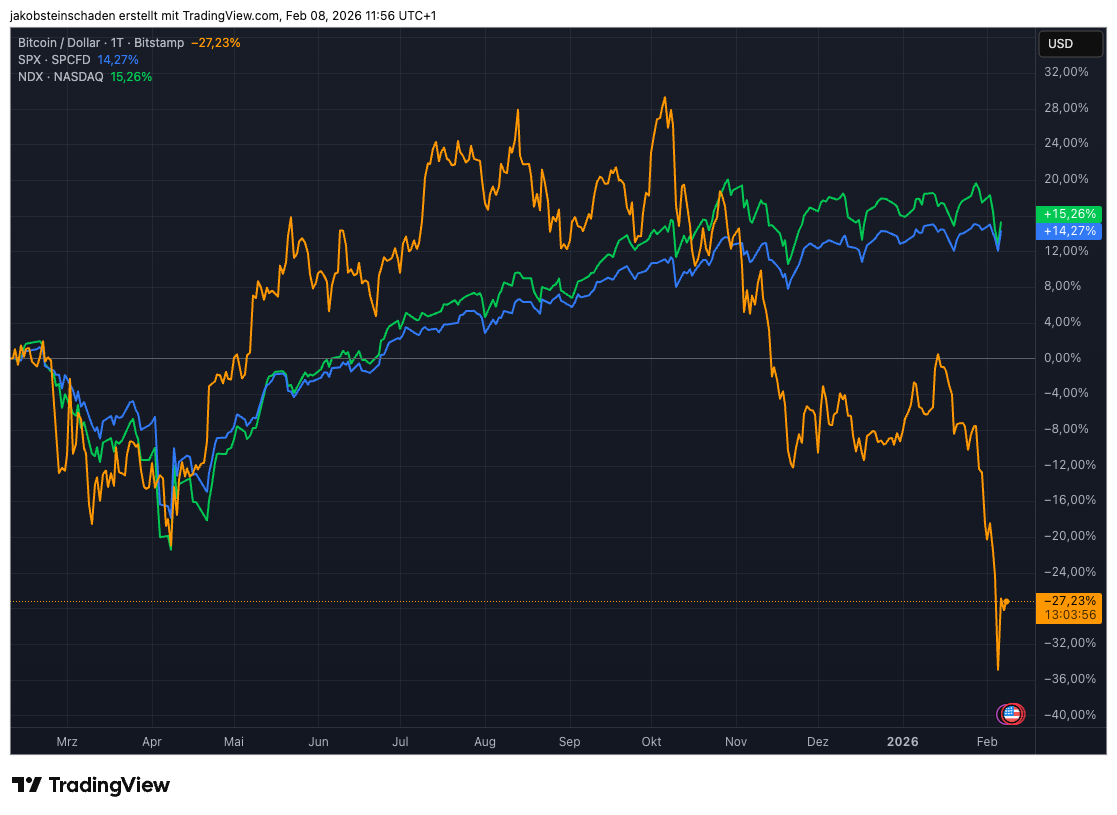
With stocks, bundled in ETFs, things don’t look rosier for Bitcoin either. Instead, it has recently been seen that Bitcoin behaves more like a SaaS stock that drops significantly on bad news.
Bitcoin vs S&P500 and Nasdaq 100 over 12 months
Bitcoin vs S&P500 and Nasdaq 100 over 5 years
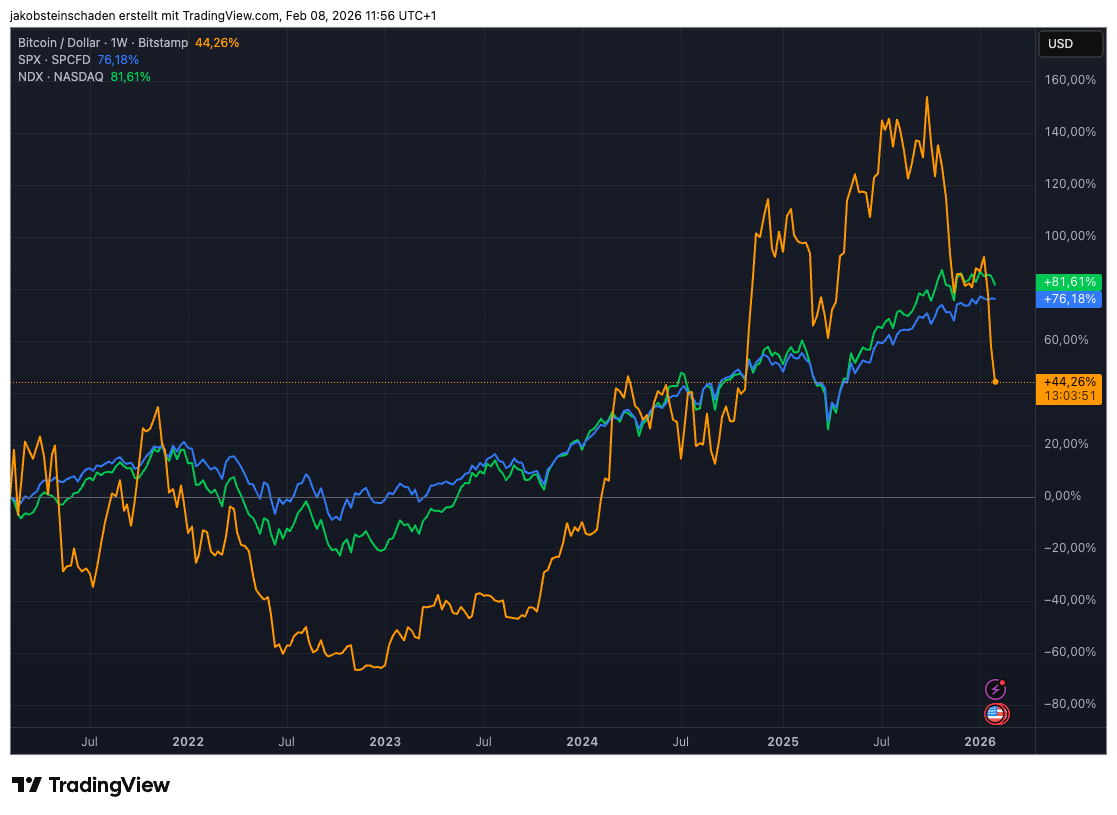
The myth of inflation protection through Bitcoin can no longer be maintained in this way; even over periods of five years, you would have done better with gold or well-known ETFs. Certainly there are long-term hodlers who shrug their shoulders again and say that it has gone up and down so many times and one simply has to endure it. But Bitcoin loses its formerly touted characteristics if it behaves no differently than tech stocks.
At the Financial Times, they are currently even of the opinion that Bitcoin is actually not worth 60,000 or 70,000 dollars, but rather zero. Author Jemima Kelly does not dare predict when BTC will fall to zero. “It is difficult to predict the end of a speculative bubble based solely on beliefs – or more precisely, based on the beliefs of other people – and Bitcoin could still have some highs ahead of it.”
However, what is currently fading away is the most important thing Bitcoin has: the belief of its followers and investors that the price will rise in the future and they can sell their BTC more expensively than today. “This belief is beginning to fade. This week has shown us that the supply of ‘greater fools’ that Bitcoin relies on is running out. The fairy tales that have kept cryptocurrencies afloat are proving to be exactly that: fairy tales. People are beginning to realize that something based on nothing but air has no value.”