Claude Cowork Triggers Tech Stock Selloff as AI Threatens SaaS Business Models


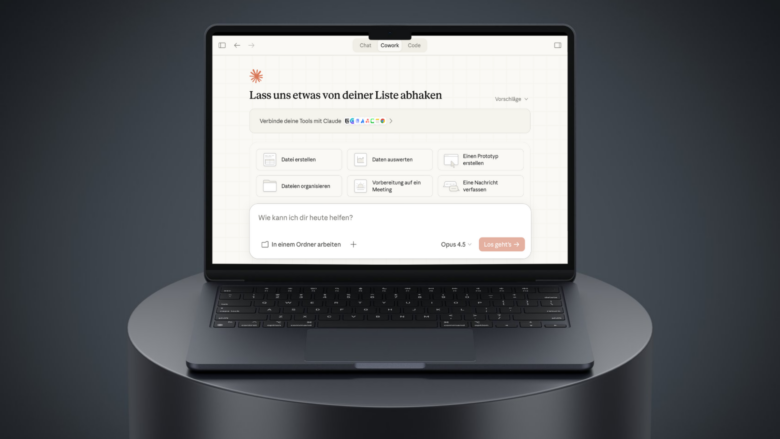


Do we still need software in the future, or is AI sufficient to handle all kinds of tasks on the computer? The latter possibility is becoming increasingly realistic – most recently through the release of Claude Cowork by AI powerhouse Anthropic. Anthropic has introduced Cowork, which is directly connected to its best LLMs of the Claude series, as an AI tool that can not only write or create programs, but should generally take over tedious computer work – from analyzing data to drafting legal documents to preparing for meetings.
And that is now sending shockwaves through the stock markets – particularly affecting shares of SaaS companies that make their money in the work context. Claude Cowork was only presented on January 12, but the effects are already visible. While Wall Street is trading near its highs, even Microsoft is struggling with losses.
The company, long the world’s most valuable corporation, recorded a decline of nine percent since the start of the year in early 2026 and is trading 21 percent below its annual high of 555 dollars. The ranking of the most valuable companies has shifted: Microsoft now ranks only fourth behind Nvidia, Google, and Apple. At the same time, the major US indices fell sharply – the technology-heavy Nasdaq Composite lost 1.4 percent, while the broader S&P 500 fell 0.8 percent.
The trigger for the latest sell-off can be found in a product announcement by AI company Anthropic. The company has presented Claude Cowork, a platform that provides AI agents for specific business tasks – including a tool for legal work that automates contract reviews, compliance workflows, and legal summaries.
The market reaction was severe: Analysis companies like Gartner and S&P Global plummeted 21 and 11 percent respectively, while Intuit and Equifax each lost more than 10 percent. A JPMorgan index for US software stocks dropped 7 percent in a single day and has now accumulated losses of 18 percent for the current year. The entire software aristocracy – Oracle, Adobe, Salesforce, ServiceNow, DocuSign, Workday, and SAP – is in free fall. Germany’s most valuable company SAP has lost more than a third of its value compared to its highs a year ago.
Business Model in Crisis
The logic behind the stock losses becomes clear from the structure of the classic Software-as-a-Service model. For years, revenues were based on user-dependent licenses: more employees meant more workplaces and thus more revenue. This system worked perfectly until AI systems began to replace human work or at least compress it massively. If autonomous AI agents take over tasks in the future that previously required entire company departments, the question arises about the need for dozens of Salesforce or Workday licenses.
If AI reviews, drafts, and concludes contracts, the need for DocuSign subscriptions decreases. And if generative image and design models deliver in seconds what teams of graphic designers were needed for, the number of required Adobe licenses is reduced. Investors fear an explosive increase in productivity coupled with a collapse in revenue for software providers. The market hates uncertainty, and a possible shift from user-dependent models to results-based pricing could change the entire revenue logic of the industry. Analysts from Mizuho Securities state that many institutional investors currently see no reason to hold software stocks – regardless of valuation levels or previous losses.
Advertising companies also came under pressure as Anthropic also offers marketing automation: Publicis fell 9 percent, WPP nearly 12 percent, and Omnicom more than 11 percent. Even exchange operator LSEG, which generates substantial revenue from its data and news platform Workspace, recorded a decline of 12.8 percent – its worst daily performance in five years. Private equity firms, which have invested heavily in software in recent years, also suffered significant losses: Ares Management and KKR each fell 10 percent, Apollo 4.8 percent.
Valuations at Ten-Year Lows
The current situation presents itself as contradictory: software stocks are trading at price-to-earnings ratios at ten-year lows, while their fundamental metrics remain exceptionally strong. Fund managers from Arvy express bewilderment at the discrepancy between excellent fundamentals and catastrophic price performance – a phenomenon rarely observed in this form.
Many investors have already reduced their positions in software stocks in recent months, which increases vulnerability to further sales on new developments. Analysts from Irving Investors report that positioning is at multi-year lows, while risks have reached multi-year highs. Observers from Jones Trading point to second-round effects: if software companies as customers of hyperscalers like Amazon, Microsoft, and Alphabet are disrupted by AI, this also impacts demand for cloud computing power.
The truth likely lies between the extremes. The software sector may be going through its biggest transformation phase since the cloud revolution. AI will not immediately replace software, but is likely to redefine it. The major providers have extensive datasets, deep customer relationships, and critical infrastructure. Companies like Microsoft, SAP, or Salesforce also generate sufficiently high revenues outside their classic software business.
SaaS or Rather SaaS?
That software might have a difficult future in the AI era was already evident in 2024 and 2025. For example, Klarna had communicated loudly that it would dispense with Salesforce’s CRM cloud and in the future also Workday, a cloud provider for accounting, human resources management, and enterprise planning (more on this here).
Similar statements came from the world’s largest business software provider: Charles Lamanna, Corporate Vice President for Business Applications and Platforms at Microsoft, predicted that traditional business applications would be obsolete by 2030. Instead, AI-powered „business agents“ are supposed to take the lead (more on this here). Now, with the introduction of Cowork, the first effects of this trend are becoming visible on the stock market.
A new catchword has emerged in this context: Service as a Software. Activities that were traditionally performed by humans as a service are being automated by AI software and „packaged“. Instead of hiring an accountant, translator, or customer service employee, one uses an AI agent that performs this service independently. The focus is not on the tool, but on the result – you essentially buy the outcome of work, not a tool.