Google’s A.I. Chips Head to Orbit on SpaceX, a Company It Partly Owns


Set Trending Topics as a preferred source on Google.
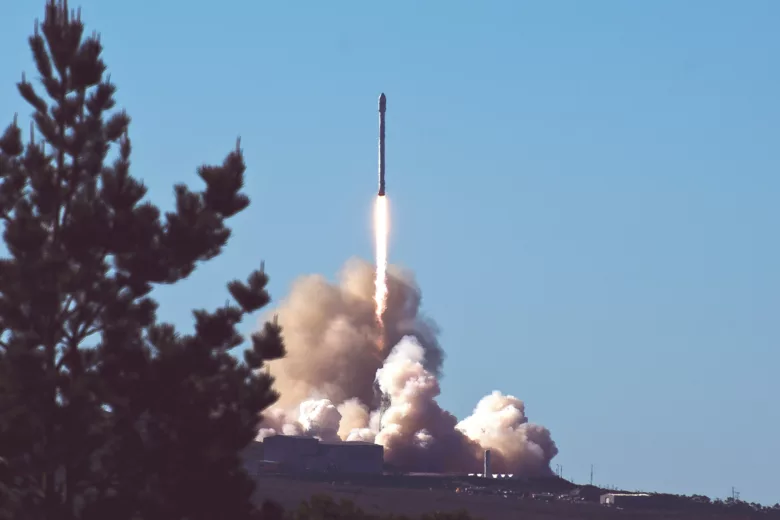
To get its A.I. chips into space, Google has to hitch a ride with its toughest rival in the orbital computing race. As part of its “Project Suncatcher,” the company will soon send its first satellite carrying its own A.I. chips into orbit aboard SpaceX’s Transporter-18 rideshare mission, Google wrote in a blog post. That is the same SpaceX that wants to conquer orbital data centers itself with up to a million satellites.
What Google Is Sending Into Space
The prototype satellite, built together with Earth-imaging company Planet, carries Google’s in-house Trillium A.I. chips. On the ground, these Tensor Processing Units (TPUs) power models including Gemini. In space, they now have to prove they can survive extreme conditions:
- The launch: About ten minutes of vibration and acceleration, with individual components enduring 50 to 100 times the force of gravity.
- The radiation: Solar storms and cosmic rays can damage chips. In tests at UC Davis’s Crocker Nuclear Laboratory, the TPUs withstood radiation doses exceeding a five-year mission, according to Google.
- The heat: There is no air for cooling in a vacuum. Heat pipes and radiators have to carry the chips’ waste heat away.
Google plans the next step for 2027, when two satellites will test whether TPU clusters can be linked by high-bandwidth lasers. Future satellites are meant to carry “dozens of TPU chips” and join into constellations that handle large A.I. workloads together.
Why Data Centers Should Go to Space
The reason is A.I.’s enormous appetite for power. Satellites in low Earth orbit can generate up to eight times more solar power than installations on Earth, according to Google, because there are no clouds, no night and no atmosphere in the way. On the ground, A.I. data centers are increasingly hitting limits: Oracle just invoked force majeure on its Stargate data center in New Mexico because of delays in power delivery, and residents in several countries are protesting new data centers.
Computing in space won’t be cheap anytime soon, though. For orbital data centers to compete with those on Earth, launch costs would need to fall to about $200 per kilogram, according to The Next Web.
No Way Around SpaceX
That is exactly Google’s problem: anyone who wants to get into space cheaply can hardly avoid SpaceX. Elon Musk’s Falcon 9 rockets dominate the satellite launch market, and the Transporter missions carry dozens of satellites from different customers at once. Google is booking a seat, too.
Yet SpaceX has long been a competitor. Early this year, Musk’s rocket company acquired xAI and filed plans with the Federal Communications Commission for up to a million satellites to serve as orbital data centers. According to the filing, SpaceX could use its reusable Starship to put 100 gigawatts of A.I. computing capacity into orbit each year, Data Center Dynamics reports. Musk called the combination “the most ambitious, vertically integrated innovation engine on (and off) Earth.” Orbital data centers are also a central part of the growth story SpaceX used to go public.
There is a twist: Google has held a stake in SpaceX since 2015. So the company profits when Musk’s firm grows, while paying it to fly its chips into space.
The Race for Orbit
Google and SpaceX aren’t alone. Nvidia-backed start-up Starcloud put an Nvidia H100 chip into orbit in late 2025 and even trained an A.I. model there, CNBC reported. Jeff Bezos and his space company Blue Origin have also voiced ambitions for computing in space.
There are prominent skeptics, too. First among them is OpenAI’s chief executive, Sam Altman, Musk’s longtime rival. “I honestly think the idea with the current landscape of putting data centers in space is ridiculous,” he said, according to Tom’s Hardware. Even rough math on launch costs versus power prices on Earth argues against it, “to say nothing of how you are going to fix a broken GPU in space, and they do break a lot still, unfortunately.” It will make sense someday, he said, but not at scale this decade.
Amazon Web Services chief executive Matt Garman, whose parent company is building its own satellite network with Project Kuiper, is similarly doubtful. “I don’t know if you’ve seen a rack of servers lately: They’re heavy,” he said, according to Fortune. “And last I checked, humanity has yet to build a permanent structure in space. So … maybe.” Google’s first test flight is now meant to show who is right.