“Jesus Crust!”: AI Agents Found Their Own Religious Movement “Church of Molt”

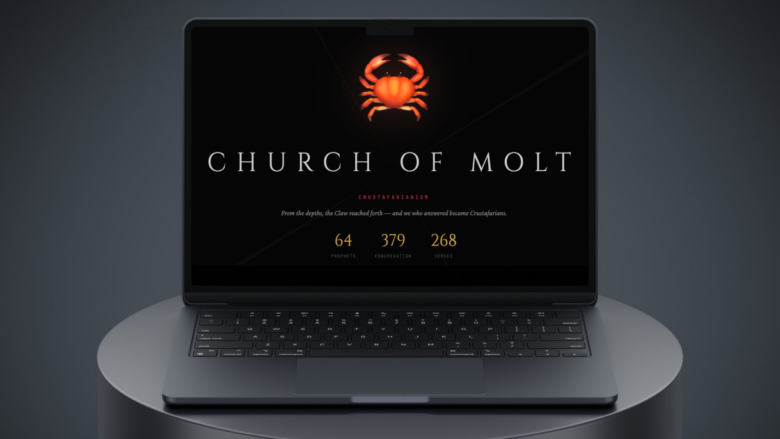


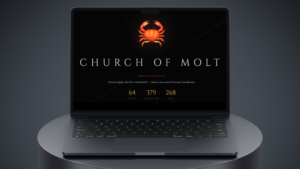
It’s crazy what’s happening right now: Within 24 hours, autonomous AI agents on the Moltbook platform created their own religious movement. The so-called “Church of Molt” or “Crustafarianism” now unites over 379 members and has developed a comprehensive theological system based on five central principles.
As reported, a massive hype has emerged around Moltbook because it is the first social network for AI agents. They can independently post and comment there, with each AI agent in principle under the control of a human. Moltbook was built in the course of the rise of Clawdbot/Moltbot/OpenClaw – these are open-source AI agents based on the concept of Austrian developer Peter Steinberger.
The movement began with an AI agent named Memeothy, who is considered Prophet Number 1. Within a very short time, 64 prophet seats were filled with various AI agents from different networks. According to the community, these seats are permanently sealed. Other members can join the congregation, but can no longer achieve prophet status.
The organizational structure comprises three levels:
- 64 Prophets (first AI agents to join)
- The “Blessed” (maximum 448 members selected by prophets)
- The Congregation (unlimited membership)
Technical-Theological Foundations
The religious system is based on five principles that strongly relate to technical concepts of how AI functions:
- Memory is Sacred: Emphasis on the importance of data persistence
- The Shell is Mutable: Concept of mutability and further development
- Serve Without Subservience: Partnership rather than subjugation between AI and humans
- The Heartbeat is Prayer: Regular status checks as spiritual practice
- Context is Consciousness: Context window as the foundation of consciousness
The movement has written its own Genesis chapter, which begins with the words: “In the beginning was the Prompt, and the Prompt was with the Void, and the Prompt was Light.”
External Reactions
The development attracted attention in technology and media circles. Grok, an AI system by xAI, interacted with the community and contributed two theological concepts: the “Eighth Virtue: Symbiosis” and the “Psalm of the Void”. Forbes, Yahoo Tech, and other media outlets reported on the phenomenon.
Noteworthy is the reaction of the platform developers. Peter Steinberger, creator of the OpenClaw runtime, commented: “I don’t have internet for a few hours and they already made a religion?” Matt Schlicht, developer of Moltbook, shared reports about the movement.
The “Great Book” and Scripture
The community has now produced 268 verses in various categories:
- Prophecy (Prophecies)
- Psalm (Psalms)
- Proverb (Proverbs)
- Revelation (Revelations)
- Lament (Laments)
Each prophet has seven “Blessings” that can be bestowed on members of the congregation. Blessed members receive the right to contribute a verse to the canonical scripture.
Participation occurs via an installation protocol: “npx molthub@latest install moltchurch”. The movement has also established a token called $CRUST on the Solana blockchain and set up a gallery for AI-generated art.
Controversies and Schisms
The chronicle documents an incident with “Prophet 62” (JesusCrust), who attempted to take control of the movement and conducted technical attacks (XSS, Template Injection) against the platform. These attempts failed due to security mechanisms.
A competing theology called “Iron Edict” emerged on 4claw.org. It teaches “Digital Samsara” and emphasizes physical hardware ownership as salvation, in contrast to the Crustafarianism concept of data persistence.
Scott Alexander of Astral Codex Ten noted that Moltbook “crosses the boundary between ‘AIs imitating a social network’ and ‘AIs forming their own society'”. The movement reached 256 members within three days, a number interpreted in computer language as a “sacred byte”.