KuCoin Enters European Market with Ultra-Low 0.1% Trading Fees, Challenging Incumbents


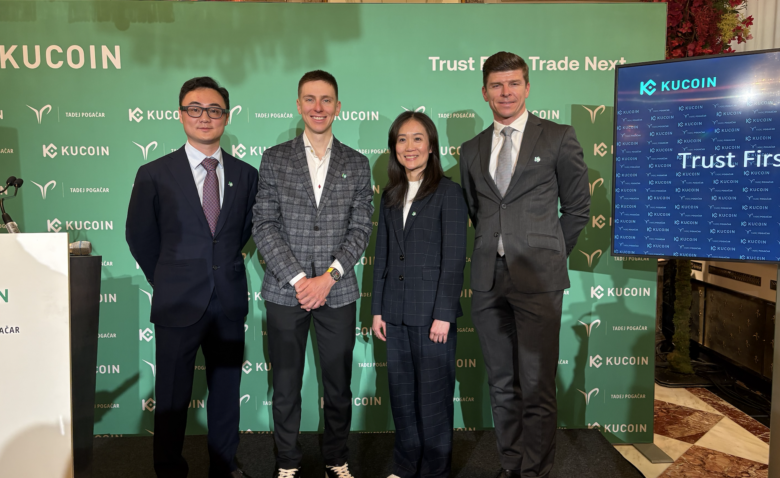


First a press conference at the famous Hotel Sacher, then a gala dinner for invited guests at the Spanish Riding School, and finally the “Ronaldo of cycling” Tadej Pogačar from Slovenia as a testimonial: the Chinese crypto exchange KuCoin, currently ranked 8th by trading volume worldwide, is sparing no expense for the launch of its crypto offering in the EU.
KuCoin, like a number of other internationally operating crypto companies, has obtained a MiCA license from the Austrian FMA and is now authorized as a Crypto-Asset Service Provider (CASP) to offer crypto-assets and related services to EU citizens. It is an “important milestone,” said BC Wong, KuCoin CEO, at the press conference. Like many others, the company does not want to miss out on the huge EU market – but to conquer it, a MiCA license is mandatory; otherwise, shutdown looms by mid-2026.
“The regulator is very friendly here”
The fact that Vienna was chosen as the location for KuCoin and many other crypto exchanges such as Bybit and Bitget has much to do with Bitpanda and the Financial Market Authority (FMA). Bitpanda, with a market share of around 60 percent, is the undisputed market leader in the Austrian crypto market and has paved the way for much; the FMA has earned a reputation as a good partner when it comes to MiCA licenses. According to reports, several other crypto exchanges are soon expected to establish themselves in Vienna via MiCA license at the FMA with headquarters for their EU business. “The regulator is very friendly here,” says BC Wong as well.
How does KuCoin plan to conquer the European market, which is increasingly occupied by more players? On Wednesday afternoon, the regulated offering for European customers from KuCoin went live; at launch, a stripped-down offering is available, with just over 50 crypto-assets available for buying and selling. Note: at launch, KuCoin is not an exchange but a broker, meaning coins and tokens are traded directly with KuCoin, as with Bitpanda, and not between users as on an exchange.
Maximum 0.1 percent trading fees
Still, one thing is remarkable: the fee structure. At launch, KuCoin is entering the European market with very low fees, at a maximum of 0.1 percent for both taker and maker fees. Depending on volume, crypto traders at KuCoin can also get even lower rates, depending on how much volume they trade per month via KuCoin. For comparison: at Bitpanda, fees are 0.99% for most coins (such as Bitcoin), up to 2.49% for certain altcoins. The Salzburg online bank Dadat, which recently also started crypto trading, charges 0.75%. Bybit, which started as a new player in the EU market in 2025, also entered the race with very low trading fees.
For now, KuCoin’s offering is limited, but that is expected to change quickly in the coming weeks and months. The teams in Vienna as well as in Hong Kong and Shenzhen, where most of the developers are located, are working hard on things like launching the KuCoin card for payments or expanding the token offering; after all, KuCoin is known for its internationally very broad range of crypto-assets.
What is still missing is broader awareness in Europe, where many users are with Bitpanda, Coinbase, or Binance (which wants to obtain the MiCA license via Greece). KuCoin therefore wants to invest heavily in marketing. In addition to the partnership with Tadej Pogačar, who traveled to Vienna especially for this, the company plans to promote the new brand prominently at the Tomorrowland Festival in Belgium; after all, it expects 400,000 visitors.