19 Million Euros From the EIB: Reactive Technologies Measures How Stable Europe’s Power Grids Really Are


Set Trending Topics as a preferred source on Google.
A power grid is a machine that can never sleep, and fewer and fewer grid operators know in real time how much reserve it has left. That is the gap Reactive Technologies wants to close. The European Investment Bank (EIB) is providing the grid-tech company, headquartered in London with a research center in Oulu, Finland, with 19 million euros in venture debt, the EIB says. Up to 7 million euros will go into research in Oulu and 12 million into deployment across the EU.
Inertia as an Early Warning System
Reactive Technologies’ product is called GridVerix, and it measures in real time how much inertia a power grid has. Inertia is the kinetic energy stored in the spinning generators of conventional power plants, which cushions the grid against sudden disturbances. The more wind and solar power flows into the grid, the less of that rotating mass there is, and the more vulnerable the system becomes to frequency swings. The platform also captures voltage stability in individual sections of the grid.
Until now, grid operators have mostly estimated these values with models. Reactive Technologies measures them directly by sending tiny pulses through the grid and analyzing the response. The benefits, according to the EIB:
- Spotting weak points: Operators see where the grid is vulnerable before something happens.
- Connecting more renewables: Knowing the actual reserve allows more wind and solar to be fed in without compromising security.
- Less curtailment: Renewables have to be throttled less often, which lowers costs for consumers.
- Integrating large consumers: New data centers can be connected more easily too.
“GridVerix can help operators keep the system secure, operate more efficiently and reduce costs,” says CEO and co-founder Marc Borrett. The company was founded in 2010 by Mr. Borrett and Heikki Huomo and operates in the United States, the United Arab Emirates and Australia in addition to Europe.
Part of the TechEU Push
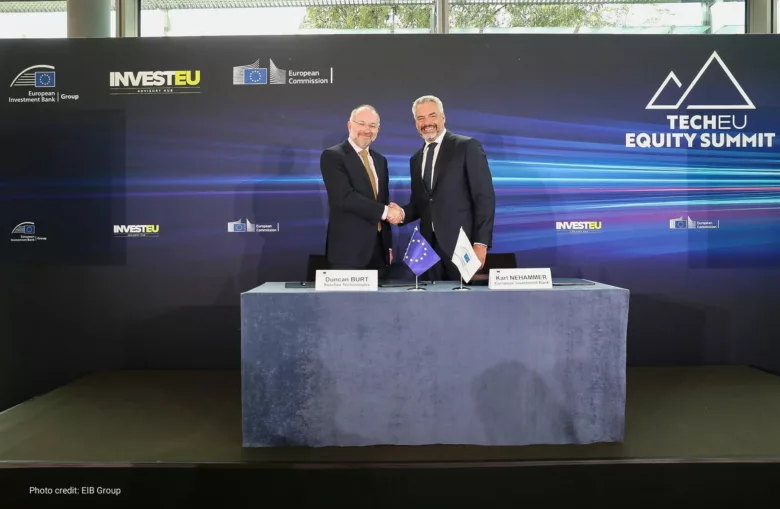
The financing runs through the InvestEU programme and counts toward TechEU, the EIB Group’s initiative to promote strategic technologies in Europe. On the EIB side, Vice-President Karl Nehammer, the former Austrian chancellor, is responsible for the transaction. Venture debt means Reactive Technologies receives the money as a loan and gives up no equity, a model the EIB is increasingly using for deep-tech companies.
The topic is timely: the blackout on the Iberian Peninsula in the spring of 2025 showed how vulnerable grids with a high share of renewables are when inertia is lacking. And as we recently reported, A.I. data centers are adding a new class of large consumers for which exactly this kind of grid data is needed. In grid monitoring, Reactive Technologies competes with established players such as Siemens Energy and Hitachi Energy as well as with startups developing similar measurement methods.