These Are the 100 Regions in Europe Most at Risk From the Climate Crisis


Set Trending Topics as a preferred source on Google.
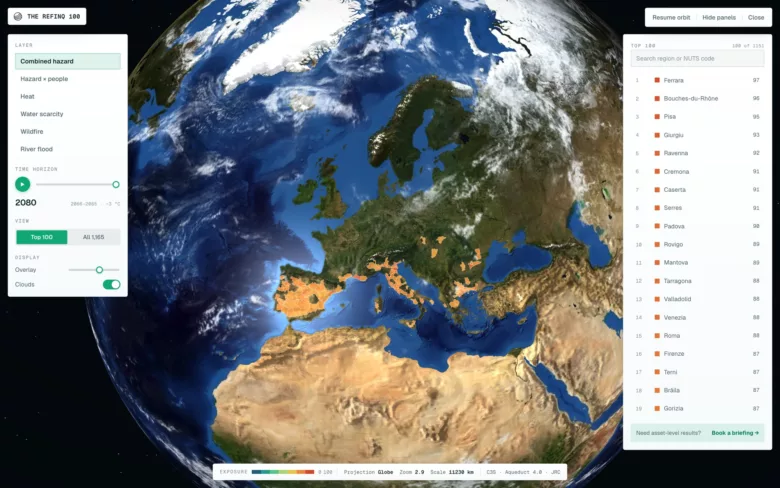
Before Brussels publishes its list, Vienna already has one. The climate risk startup refinq has just released “The refinq 100,” a ranking of all 1,165 NUTS-3 regions in the EU by physical climate exposure, the company says in a press release. The trigger was the State of the Union address, in which Commission President Ursula von der Leyen announced a climate resilience framework for October, including a list of the 100 most at-risk areas in Europe. Refinq is beating the Commission to it by several weeks.
Italy Dominates the List
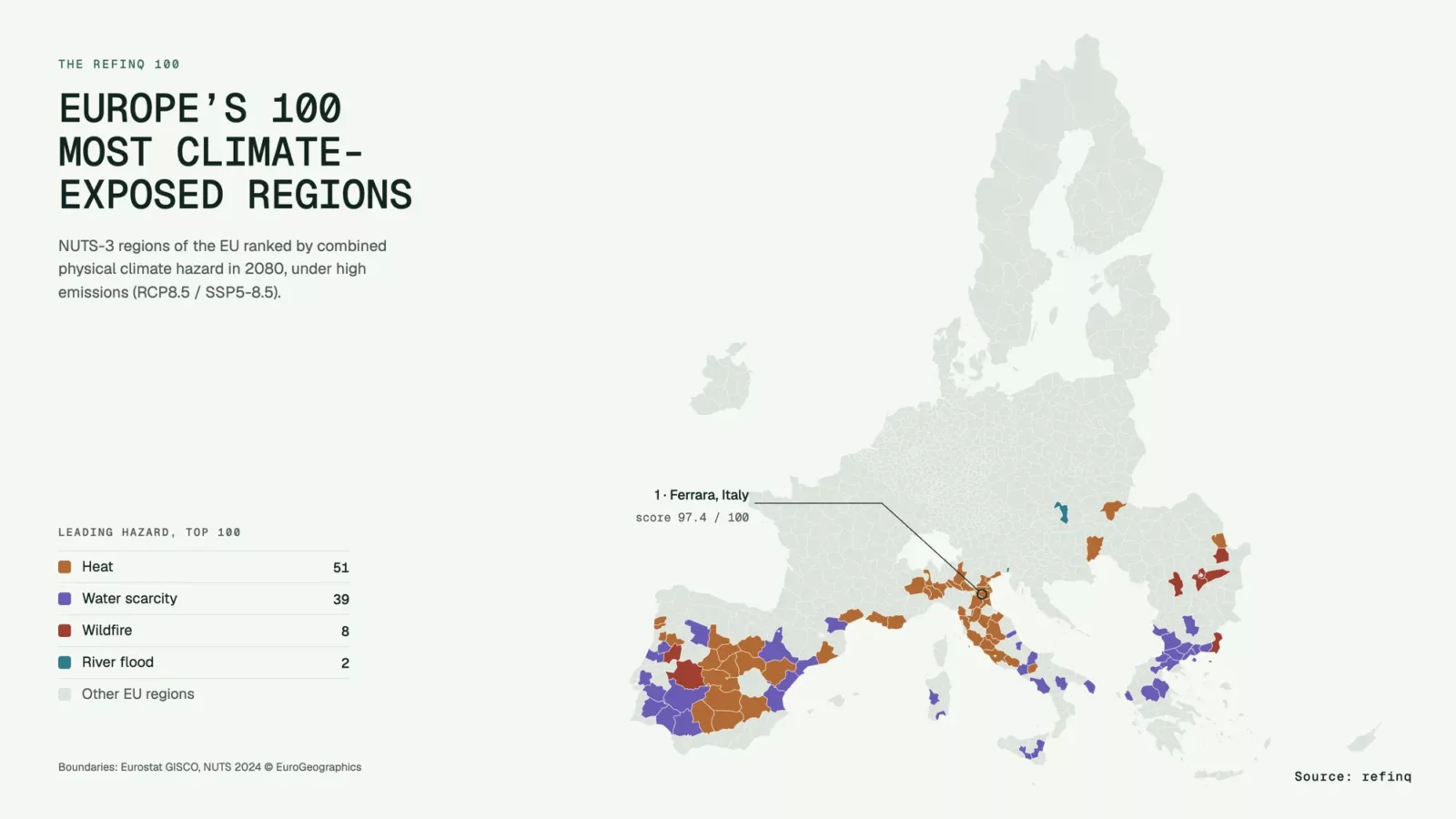
Three countries account for three quarters of the top 100: Italy with 40 regions, Spain with 22 and Greece with 12. The remaining 26 spots are spread across six other member states, and 18 of the 27 EU countries do not appear in the top 100 at all. The ten most exposed regions (combined score for 2080 under a high-emissions scenario, scale 0 to 100):
- Ferrara, Italy: 97.4 (heat)
- Bouches-du-Rhône, France: 95.6 (heat)
- Pisa, Italy: 94.6 (heat)
- Giurgiu, Romania: 92.7 (wildfire)
- Ravenna, Italy: 91.6 (heat)
- Cremona, Italy: 91.2 (heat)
- Caserta, Italy: 90.8 (water scarcity)
- Serres, Greece: 90.7 (water scarcity)
- Padova, Italy: 89.7 (heat)
- Rovigo, Italy: 89.4 (heat)
Heat is the leading hazard in 51 of the 100 regions, water scarcity in 39, wildfire in 8 and flooding in 2. None of the regions has just one problem: each scores high on at least two hazards at once.
Austria at 294, Germany From 105
Neither Austria nor Germany places a region in the top 100. Austria’s highest-ranked region is the Weinviertel north of Vienna at 294 out of 1,165. In Germany, the city of Aschaffenburg sits at 105, just outside the top 100.
“The Commission will say which areas are at risk. Our map shows what is physically at stake there. Those are two different questions, and Europe needs an answer to both,” says Franziska Walde, managing director of refinq. Her co-managing director Lukas Fischer adds: “We are publishing the full ranking and the method behind it, not just the top 100. Anyone can look up where their own region stands.” An interactive map lets users pull up any region, with a slider from today to 2080.
Exposure Is Not Vulnerability
Four hazards are assessed: heat, water scarcity, wildfire and river flooding. The data come from the Copernicus Climate Change Service, the World Resources Institute’s Aqueduct 4.0 dataset and the European Commission’s Joint Research Centre. The combined score is the unweighted average of the four hazards for the year 2080 under the high-emissions pathway RCP8.5, measured against the 2006 to 2025 baseline.
Refinq itself stresses an important caveat: the ranking measures how strongly climate hazards act on what is built in a region. It does not measure how well that region is prepared, funded or protected. The Commission’s upcoming assessment targets vulnerability and factors exactly those things in. A region can rank high with refinq and still be well protected.
The Startup Behind It
Founded in Vienna in 2023, refinq offers companies and banks a platform that quantifies climate, nature and transition risks at the level of individual assets and portfolios and turns them into reports for regulations such as the CSRD and the EU taxonomy. Earlier this year, the startup closed a 2.2 million euro seed round led by aws Gründungsfonds and Symbia VC. With the ranking, refinq is positioning itself in a field where large providers such as MSCI, Moody’s and Munich Re sell climate risk data, and doing so with a dataset that is deliberately open to everyone.