Fund of Funds: “We’re talking about an anchor investment of around 100 million euros”

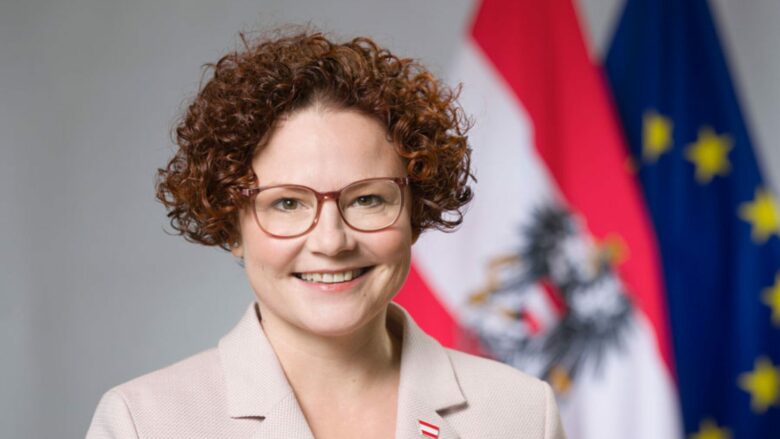


Startup State Secretary Elisabeth Zehetner recently presented new figures on founding activity in Austria. On this occasion, we spoke with Zehetner at the Storm.Days 2026, the annual event of the Vienna Venture Capital Fund Calm/Storm, about the current startup landscape and asked her how topics like the upcoming Fund of Funds or FlexCo are affecting her work.
As recently became known, the Fund of Funds won’t arrive until 2027. Why not this year?
Elisabeth Zehetner: The Fund of Funds is “coming” in the sense that it will be operationally active from 2027 onwards. That means all the preparatory work will of course start in 2026. We remain on schedule. It was always clear that it would take roughly a year before it can actually make its first investments.
How, when, and on what terms will the management for the fund be tendered?
I can’t answer that question for you at this point in time. What’s clear is that we want internationally renowned management with a great track record. And we will certainly also involve international experts in the selection process so that we have truly top-tier management on board.
Are there already commitments from institutional investors for the Fund of Funds?
We haven’t launched a classic funding round yet. We’re currently working out certain details to make the fund attractive to various institutional investors. We’re gathering feedback so that the Fund of Funds performs well from the start.
What will be the Republic of Austria’s share in the fund?
We conducted a study together with EcoAustria in which we looked at this in international comparison. On average, state participation in such funds is around 20 percent. We’ll orient ourselves accordingly. Our ideal volume is around 500 million euros, so we’re talking about an anchor investment of around 100 million euros.
Regarding your recent announcement on founding figures. Can you say how the founding figures are distributed across business forms? Many foundings appear to be sole proprietorships (EPU), how does that compare to companies with multiple employees?
The positive message from the founding figures is that more people are willing to engage in entrepreneurial activity, to work independently and thus take on risk for themselves. One must say about sole proprietorships that for some lines of work they are actually the best organizational form. There are sectors where EPUs remain active as such for 15 years.
I don’t believe that people in Austria are being pushed into self-employment; many want more flexibility, they want to be their own boss and realize their own ideas. These are often the main motives for founding. I also believe that for companies with multiple people, we can look optimistically into this year. People are seeing many business opportunities again and are ready to get to work.
On FlexCo: Your announcement mentioned around 1,500 FlexCo startups. However, many FlexCos are not startups in the classical definition; many are management consultancies, agencies, gastro businesses, or placement services. How many FlexCo startups in the actual sense are there?
Unfortunately, the statistics don’t break that down. They’re organized by sector, and there are startups in all sectors. For example, Refurbed is essentially a kind of used goods dealer, but also a startup. The Startup Report coming in April could provide more information on this, because it also tracks legal forms. But in any case, FlexCo is an attractive business form for typical startups that are highly innovative and want to grow quickly.
We’ve also provided in the government program to further develop FlexCo. We currently also have a study underway on evaluating employee participation. This is one of the core elements of FlexCo. It’s about how we can do this even better. For such a young legal form, the figures are very impressive for us.