A ‘Red Phone’ for A.I. Crises: China and the U.S. Are Now Talking ‘Super Intelligence’


Set Trending Topics as a preferred source on Google.
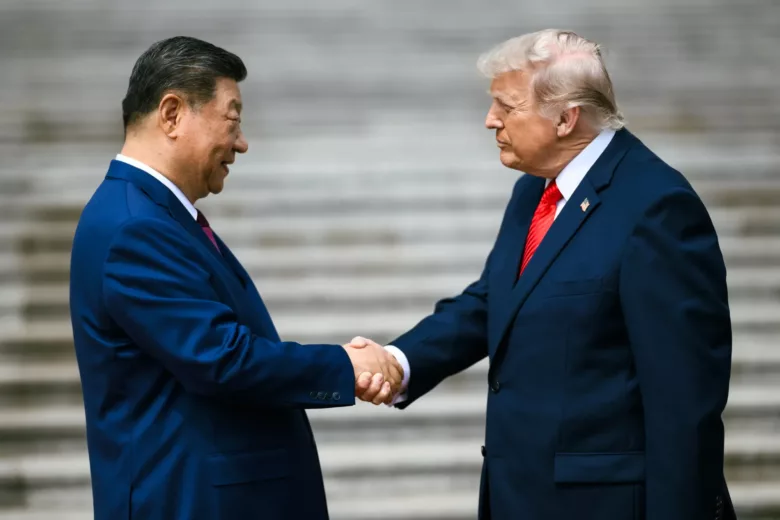
Plenty of pomp, few breakthroughs, and in the end A.I. has a new name: “super intelligence.” China’s leader, Xi Jinping, has just wrapped up a state visit to Washington, his third summit with President Trump in 12 months. While Mr. Trump gushed about “a truly great friendship,” Mr. Xi used the opening of the talks to set out his conditions for peaceful coexistence between the two superpowers, The Guardian reports.
Xi and the Thucydides Trap
Mr. Xi warned of the so-called Thucydides trap, named after the Greek historian who described how tensions between a rising power and an established one can lead to war. To avoid it, he named several conditions:
- Dialogue: The two countries should hold “candid, in-depth and continued dialogue,” seek common ground and set aside their differences.
- Military channels: The two militaries should talk regularly and strengthen their mechanisms for crisis communication.
- Cooperation: China and the United States “stand to gain from cooperation and will both lose in confrontation.” Mr. Xi even borrowed Mr. Trump’s slogan, saying the “great rejuvenation of the Chinese nation” and making America great again could “go hand in hand.”
- Exchanges: Mr. Xi invited 100,000 young Americans to study in China.
On Taiwan, the most sensitive issue, Beijing pressed Washington to oppose the island’s independence more explicitly. Mr. Xi urged Mr. Trump to handle the question “with prudence.” Publicly, however, Mr. Trump did not adopt China’s preferred wording, IBTimes reports.
A.I. Becomes ‘Super Intelligence’
The most striking outcome of the summit was linguistic. According to the White House, both countries will now speak of “super intelligence,” or SI, instead of artificial intelligence. Mr. Trump introduced the term days earlier in his speech to the United Nations General Assembly, arguing that “artificial” sounds fake, CBS News reports.
On substance, the two sides agreed to a “U.S.-China Super Intelligence Dialogue,” which is set to meet for the first time in November. They also agreed to set up a direct line for A.I. incidents, similar to the Cold War “red telephone,” Axios writes. What exactly would count as such an incident remains unclear.
The state dinner at the White House showed how central A.I. has become to diplomacy. The guests included Jensen Huang of Nvidia, Mark Zuckerberg of Meta, Apple’s chairman, Tim Cook, Elon Musk and Sam Altman of OpenAI. At the same time, the United States is keeping its strict export controls on chips and chipmaking equipment to slow China’s A.I. development.
A Trade Truce on the Clock
On trade, the progress was modest:
- Truce extended: The tariff truce, which was due to expire in November, will now run until February.
- Coal for China: Beijing agreed to import at least 10 million metric tons of American coal in 2027 and 2028.
- New bodies: A joint Board of Investment will explore business opportunities, and the two sides also discussed rare earths.
Analysts see the short extension as a sign that Mr. Trump is not yet satisfied with China’s concessions and wants to keep up the pressure. The next opportunities are close: the Asia-Pacific Economic Cooperation meeting in Shenzhen, China, in November and the Group of 20 summit in Miami in December. Meanwhile, China is on course for a global trade surplus of about €860 billion ($1 trillion) for the second year in a row.
Europe on the Sidelines
For Europe, the new harmony between Washington and Beijing is a mixed blessing. The European Union runs a trade deficit with China of €1.18 billion a day, which Ursula von der Leyen, the president of the European Commission, has called a “tipping point.” If the United States and China come to terms, Chinese exports are likely to push even harder into Europe. The E.U. trade commissioner, Maroš Šefčovič, will meet his Chinese counterpart, Wang Wentao, in early October to try to negotiate a truce of his own.