ByteDance Prepares China’s Next AI Shock




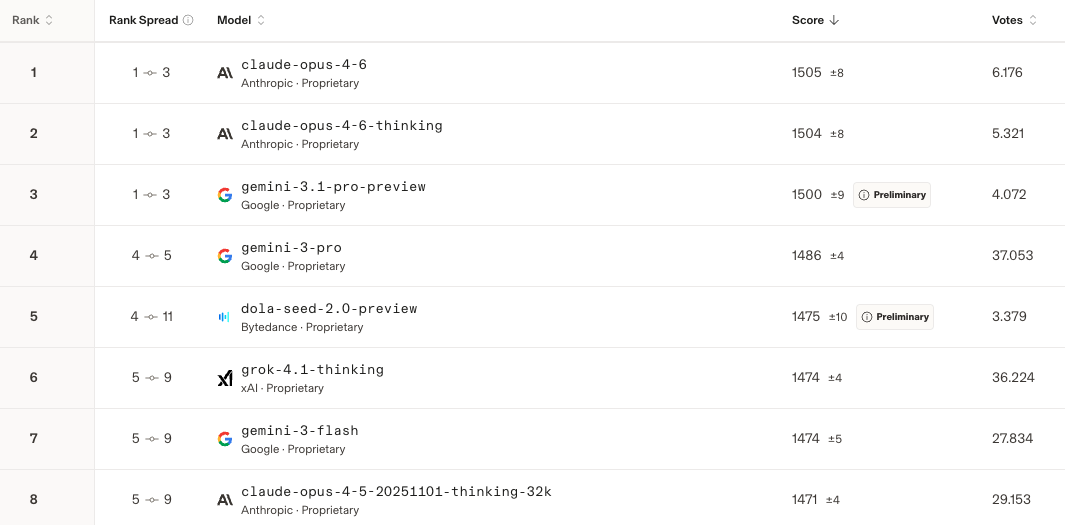
Is the next China shock already brewing in the AI industry following the impacts of DeepSeek, Moonshot AI, and Manus? Initial data now published on the LLM comparison platform Arena.ai suggest so. The new AI model Dola-Seed-2.0 has entered the ranking very high in a preview version and even ranks ahead of the current top model from xAI (Grok-4.1) from Elon Musk’s company or ahead of LLMs like Gemini 3 or Claude Opus 4.5, which were class leaders not so long ago.
According to initial test runs, Dola-Seed-2.0 should perform particularly well in areas such as software, mathematics, or coding. In the preliminary preview, it does not reach the current top LLMs from Anthropic and Google, but it is also not significantly behind them. As reported multiple times, Arena.ai’s ranking is based on user ratings that evaluate LLM outputs in blind tests (which has already been criticized). It remains to be seen how Dola-Seed-2.0 performs in benchmarks compared to the AI creations of major US providers.
What is interesting about Dola-Seed-2.0 is that it is a proprietary AI model – in contrast to many other Chinese LLMs such as those from Moonshot AI, Zhipu AI, or MiniMax, which are released as open source under the MIT license. However, it can be assumed that Dola-Seed-2.0, once it comes to market, will likely be pushed into the market via API at competitive prices.
Behind Dola-Seed-2.0 is TikTok’s parent company ByteDance
The question of who is behind the new AI model is quickly answered: it is TikTok’s parent company ByteDance from China, which has already developed a whole range of AI models. These not only provide foundational LLMs but are also active in the areas of image, audio, and video, where they actually compete with all other AI providers. It is clear that ByteDance has access to a vast amount of video and audio material through TikTok (or Douyin in China) for training LLMs. ByteDance is also active in the robotics field with AI models.
Dola-Seed-2.0, which as mentioned is available in a preview variant, is to be further improved, according to ByteDance. “Dola-Seed-2.0-Preview is one of our latest multimodal general-purpose models,” the company states. “We are currently experimenting with this model before finalizing it, and we look forward to the community trying it out.”
The new LLM, which can demonstrate strong results on Arena.ai, is part of a larger series of AI models that ByteDance wants to release to the world. ByteDance introduced the new Seed 2.0 model series in mid-February 2026, which was specifically developed for use in demanding production environments. The release comes at a time when large language models have already reached hundreds of millions of users and are increasingly being used in complex workflows. The company is consistently aligning the further development of its AI systems with real-world usage scenarios identified through analysis of MaaS services.
The developers found that users frequently have knowledge-intensive content processed from unstructured sources – including complex diagrams, tables, and documents. Companies increasingly expect models to have the ability to capture extensive information and handle multi-step workflows. Seed 2.0 includes four variants of different sizes: Pro, Lite, and Mini for general applications, as well as a specialized code model. The models are available via the Doubao app, TRAE, and as an API via Volcano Engine.
Enhanced multimodal processing
In visual processing, Seed 2.0 achieves industry-leading results in numerous benchmarks. The Pro model achieves top scores in mathematical and visual reasoning tests such as MathVista, MathVision, and MathCanvas, as well as in logical tasks in LogicVista and VisuLogic. Perception capabilities were strengthened through improvements in VLMsAreBiased, VLMsAreBlind, and BabyVision. In document processing, there is a clear improvement over Seed 1.8, particularly in ChartQAPro and OmniDocBench 1.5. The system processes long contexts with high precision and achieves top results in DUDE and MMLongBench. In video analysis, Seed 2.0 demonstrates improved capabilities in temporal sequencing and motion perception, with performance in EgoTempo exceeding human levels. The model efficiently processes hours-long videos and can perform real-time analysis for applications such as fitness coaching.
In the area of agent capabilities, Seed 2.0 addresses two central challenges: executing long-term, multi-step tasks and processing specialized domain knowledge. The system achieves higher scores than GPT-5.2 in SuperGPQA and reaches a level comparable to Gemini 3 Pro in scientific benchmarks. In STEM tests such as FrontierSci, it surpasses GPT-5.2 in some scenarios. The model achieved gold medal results in ICPC, IMO, and CMO tests. In practical tasks with direct economic value, Seed 2.0 demonstrates consistent performance in customer service, information extraction, and problem-solving. In complex professional benchmarks such as GDPVal-Diamond and XPert Bench, it achieves competitive results. In scientific research scenarios, the system leads in AInstein Bench and demonstrates hypothesis-driven reasoning capabilities.
Meanwhile, with the video generation model Seedance 2.0, TikTok has run into problems with Hollywood – the reason is copyright complaints. In the future, Seedance 2.0 will no longer be able to be used to generate videos featuring copyrighted characters and prominent people.
Cost efficiency and scientific applications in focus
ByteDance positions Seed 2.0 as a cost-effective alternative to leading language models. Token prices are approximately an order of magnitude lower than comparable systems, which is particularly relevant for complex tasks with extensive reasoning performance and long generation chains. The system can create scientific experimental plans that go beyond strategic considerations and include detailed, executable experimental procedures – for example, in Golgi protein analysis with integration of genetic engineering, mouse models, and multi-omics analysis.
The developers have built an evaluation system that reflects real enterprise requirements and serves as the basis for model development. Seed 2.0 improves multimodal comprehension capabilities and addresses challenges in specialized knowledge and complex instructions. The company acknowledges that there is still room for improvement in some demanding benchmarks compared to global leading models. ByteDance announces that it will continue to align the Seed model series with real-world application scenarios and continuously increase performance.