Microsoft Wants to Capitalize on Anthropic’s Success, Integrates Cowork into Copilot

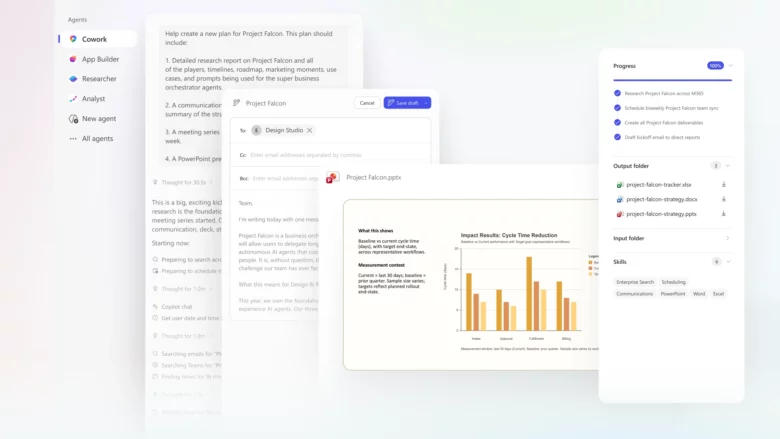


Microsoft’s shift away from OpenAI and toward Anthropic continues: the software giant, still a major investor in OpenAI, has announced Copilot Cowork, a step toward autonomous AI work assistance. The new feature, developed in collaboration with Anthropic, is designed not only to answer questions or create text, but to independently complete tasks, execute workflows, and coordinate complex work processes.
Cowork is the Anthropic software that sent shockwaves through the software industry in early 2026 and also took a toll on Microsoft’s stock price.
From Conversation to Action
Charles Lamanna, President of Business Applications & Agents at Microsoft, describes Copilot Cowork as a fundamental paradigm shift: “Copilot Cowork is built to take action, not just to chat.” The platform enables users to delegate tasks while the system automatically accesses emails, meetings, messages, files, and data. Cowork leverages signals from Outlook, Teams, Excel, and the entire Microsoft 365 ecosystem.
When users hand off a task to Cowork, the system creates a plan and executes it in the background. There are clear checkpoints where users can review progress, make changes, or pause execution. Cowork asks for clarification when needed and displays recommended actions before they are implemented. Examples include calendar-based appointment management, meeting preparation through presentation creation, research, and competitive analysis.
Enterprise Security and Multi-Model Strategy
Copilot Cowork operates within the security and governance boundaries of Microsoft 365. Identity, permissions, and compliance policies apply by default, and actions and outputs are traceable. Cowork runs in a protected, sandboxed cloud environment, allowing tasks to continue securely as users switch between devices.
What is particularly noteworthy is that Microsoft follows a multi-model approach. Cowork will not exclusively use Claude from Anthropic; rather, the system should be able to select the best AI model for each task—including those from OpenAI, for example. Copilot Cowork is currently being tested with a limited number of customers in Research Preview and will be more broadly available by the end of March 2026 as part of the Frontier program.
Background: How Claude Cowork Shook the Software Industry
Microsoft’s announcement follows a seismic event in the software industry. In early January 2026, Anthropic introduced Claude Cowork, an AI tool that can not only write or code, but generally take on tedious computer work: from data analysis to setting up legal documents to meeting preparation.
Even Microsoft, long the world’s most valuable company, saw its stock price decline in early 2026. The entire software aristocracy was thrown into turmoil: Oracle, Adobe, Salesforce, ServiceNow, DocuSign, Workday, and SAP were in free fall. Germany’s most valuable company, SAP, lost more than a third of its value compared to its highs a year earlier.
The logic behind the stock losses stems from the structure of the classic Software-as-a-Service model. For years, revenues were based on per-user licenses: more employees meant more workplaces and thus more revenue. This system worked perfectly until AI systems began to replace or at least dramatically compress human labor.
If autonomous AI agents take on tasks in the future that previously required entire corporate departments, the question arises about the need for dozens of Salesforce or Workday licenses. If AI reviews, drafts, and concludes contracts, the demand for DocuSign subscriptions declines. And if generative image and design models deliver in seconds what teams of graphic designers were once needed for, the number of required Adobe licenses shrinks.
From SaaS to Service as a Software
The industry is facing a fundamental transformation. A new buzzword has emerged: Service as a Software. Activities traditionally performed by humans as a service are being automated and “packaged” by AI software. Instead of hiring an accountant, translator, or customer service representative, one uses an AI agent that performs this service independently.
The focus is no longer on the tool, but on the result. You buy the outcome of work, not a tool. This shift could change the entire revenue logic of the industry. Analysts at Mizuho Securities note that many institutional investors currently see no reason to hold software stocks, regardless of valuation level or previous price declines.
Outlook: Transformation Rather Than Disruption
The truth likely lies between the extremes. The software sector may be undergoing its greatest transformation phase since the cloud revolution. AI will probably not immediately replace software, but is likely to redefine it. Major providers have extensive datasets, deep customer relationships, and critical infrastructure.
Companies like Microsoft, SAP, or Salesforce also generate sufficiently high revenues outside their classic software business. With the integration of Claude Cowork into Microsoft 365 Copilot, Microsoft shows that established players are not standing idly by, but actively want to shape the AI revolution.