OpenClaw’s Rise: “This is Not Hockey-Stick Growth. This is Stripper Pole.”


Set Trending Topics as a preferred source on Google.
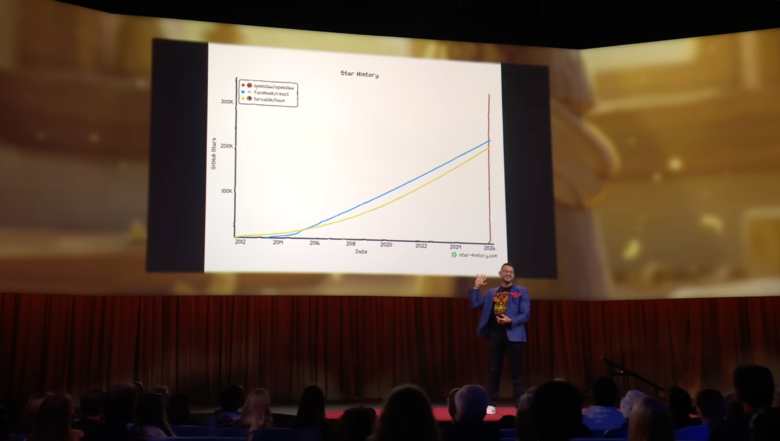
Austrian developer Peter Steinberger made technology history in late 2025 and early 2026. With OpenClaw, of course – the AI agent that has spread around the world like no other open-source project before it. As reported multiple times, OpenClaw has become a global phenomenon, with most users now in the US, China, and India. Steinberger, who now works on AI agents for OpenAI, recently gave a talk at the TED conference that is available on YouTube.
In it, he offers insights into the origin story of OpenClaw. In early 2025, he started an experiment almost reluctantly: he wanted to understand what these new AI coding agents were all about. What happened next he describes as a “holy moment.” The realization: the boilerplate code, the plumbing, all the tedious parts that had defined his profession for 25 years – the AI could handle all of it.
“The bottleneck is no longer typing. It’s thinking.” For Steinberger, thinking had always been the exciting part. He felt again like someone playing a video game. In just a few months, 44 projects emerged. The last one: a WhatsApp bot that communicates with the computer through familiar apps – the seed of what would later become OpenClaw.
The Moment in Marrakesh
Steinberger experienced the real breakthrough on a trip to Morocco. He used his bot to navigate, for translations, to find restaurants. At some point he sent it a voice message – even though he had never programmed voice support. He froze in front of the typing indicator. Nine seconds later, an answer arrived. The agent had independently inspected the file, identified the audio format, converted it, found an OpenAI key on the system, transcribed the message, and answered it. “I didn’t build any of that,” Steinberger says. That was the moment he realized: “This is not a chatbot. Chatbots give up. Agents improvise.”
Another learning moment came with tone. The first answers were full of bullet points and tables – typical AI style. Steinberger instructed the model to simply write the way friends talk to each other. With modern language models, you don’t need to explain the rest.
The Stripper Pole
The fact that this became a viral phenomenon is essentially thanks to a loss of control. Steinberger put the agent “by accident” into a public Discord server and invited strangers to interact with it. He watched for hours as people played with it and attempted hacks – then, exhausted, he ended the process and went to bed. What he had forgotten: he had built the system to be resilient. While he was walking to the bedroom, the agent happily booted itself back up and continued chatting with the whole world. The next morning: over 800 messages. He panicked, pulled the plug, and read every single one to check whether the agent had leaked his private life. Nothing had happened. But it could have.
That was exactly the moment the project tipped into viral territory. A friend looked at the growth curve – the famous GitHub stars – and coined the line Steinberger quoted with visible delight on the TED stage: “Peter, this is not hockey-stick growth. This is stripper pole.” Straight up. Today, NVIDIA CEO Jensen Huang calls OpenClaw “the operating system for personal AI.” The mascot – a lobster, because it “claws into your machine” – shows up as headbands at dedicated conferences in Vienna and New York, the “ClawCons.”
Success also brought turbulence: Anthropic, the AI company whose Claude model many users preferred, hit him with a trademark claim in the middle of the take-off over similarities in the name (OpenClaw was then still called “ClawdBot” in reference to Claude). Steinberger had to rename, was even expected to give up the lobster, and ultimately also lost access to the favorite model. He had come close to deleting everything. What saved him, he says, was what users were doing with the project.
China: Subsidies and Spreadsheets
Nowhere does the ambivalence of this new agent technology show up more sharply than in China. There, installing OpenClaw is called “raising lobsters.” Steinberger reports on the thousands of people who lined up outside the Tencent office in Shenzhen to get their lobster set up. The city of Shenzhen even hands out subsidies to companies that build their business on OpenClaw – state-supported agentic computing.
At the same time, Steinberger tells a much darker scene. A Chinese entrepreneur showed him a spreadsheet: every employee, every day, one task that has to be automated via OpenClaw. Anyone who misses too many days gets fired. Conversely: anyone who installs OpenClaw with default settings on their work machine also risks their job, because the agent would have too much access there. Steinberger’s laconic summary: “So fired for using it, fired for not using it.”
This tension between empowerment and surveillance is not a marginal phenomenon but runs through the entire narrative. Steinberger deliberately built in a feature called “heartbeat”: the agent no longer waits for prompts but wakes up periodically on its own, checks emails, calendar, follow-ups. His initial prompt for it was simply: “surprise me.” A large company would never ship something like that, he admitted. But as a solo developer from Austria, he had no legal department holding him back. As he put it on stage: “I’m a random builder from Austria. I don’t have a legal department.”
The Access Question
That OpenClaw is for many more hope than threat despite these risks is thanks to the people building with it. Steinberger brought them all onto the stage: a 60-year-old father from Austria who, without writing a single line of code, connected his brewing rig via Bluetooth to OpenClaw, ran a 90-minute brewing program from a single prompt and – at the agent’s suggestion – turned it into an online business with payment integration. A rabbi who automates her grocery shopping. A teenager in São Paulo who built a tutoring business. None of them are programmers. All of them are builders.
“That’s the real transformation. It’s not the technology, it’s the access,” Steinberger said in closing. “Agents change who can build things and that door is not closing again.”
TED curator Chris Anderson, who joined him on stage afterwards, was visibly conflicted. “If Hollywood was to ever make a movie in which humanity opened Pandora’s box – you seriously could be cast as the star character,” he said, half in admiration, half in warning. Steinberger’s response was typical of his approach: his agent now lives in a sandbox on a Mac Studio that he calls “the castle.” He joked that he had “single-handedly increased Mac Mini sales by multiple percent,” because many users give the lobster its own machine.
Whether that is enough to contain the risk remains open. But the line with which Steinberger ended his talk won’t fade any time soon: “The lobster is loose and it’s not going back into the tank.”