Blue Origin: Bezos’ Space Company Raises $10 Billion Shortly After SpaceX’s IPO


Set Trending Topics as a preferred source on Google.
For the first time in its 26-year history, Blue Origin is opening up to external backers: According to matching reports by the New York Times and CNBC, Jeff Bezos’ space company is raising around $10 billion at a pre-money valuation of $130 billion. It is the first external funding round for the company founded in 2000, which Bezos has so far financed out of his own pocket – primarily through sales of his Amazon shares.
The round is led by tech investor Coatue Management, which is expected to contribute around $4 billion. Bezos himself is adding another $2 billion, with the remaining $4 billion set to come from several large institutional investors – demand is reportedly high, according to CNBC. Blue Origin did not immediately comment.
Capital Injection After a Major Setback
The funding round comes at a delicate moment: In late May, a New Glenn rocket exploded during a ground engine test, severely damaging the launch pad at Cape Canaveral – the only one capable of supporting the heavy-lift rocket. Repairs are underway, and launches are expected to resume before the end of the year. The cause of the explosion had not yet been conclusively determined.
Bezos had signaled even before the incident that the time had come for outside investors. “We finally have enough visibility into our future and our financial success,” he told CNBC in May. The external valuation now establishes a market price for the company for the first time – and reduces its dependence on Bezos’ Amazon stock sales.
David vs. Goliath: $130 Billion vs. $2 Trillion
The comparison with its big rival SpaceX shows the scale of the gap: Elon Musk’s space giant went public just weeks ago and is currently valued at close to $2 trillion – more than fifteen times Blue Origin’s valuation. However, SpaceX shares have recently come under pressure, at times falling below their IPO price.
Two Business Models, Two Philosophies
Even though both companies compete in the same markets – heavy-lift rockets, lunar landers, satellite internet – their business models differ significantly:
SpaceX conquered the global orbital launch market with the Falcon 9 and continues to dominate it today. But the real revenue backbone is Starlink: the satellite internet network with tens of thousands of satellites primarily serves consumers and is broadly positioned across all market segments – from direct-to-device to consumer internet to government customers. The vertical integration of in-house rockets and in-house satellite operations is considered a key competitive advantage. Add to that NASA contracts (crew transport, Starship as the lunar lander for Artemis III) and military launch contracts.
Blue Origin pursues a different, long-ridiculed approach under the company motto “Gradatim Ferociter” (step by step, ferociously). The portfolio:
- New Shepard: Suborbital tourist flights to the edge of space – the company’s best-known but economically smallest business.
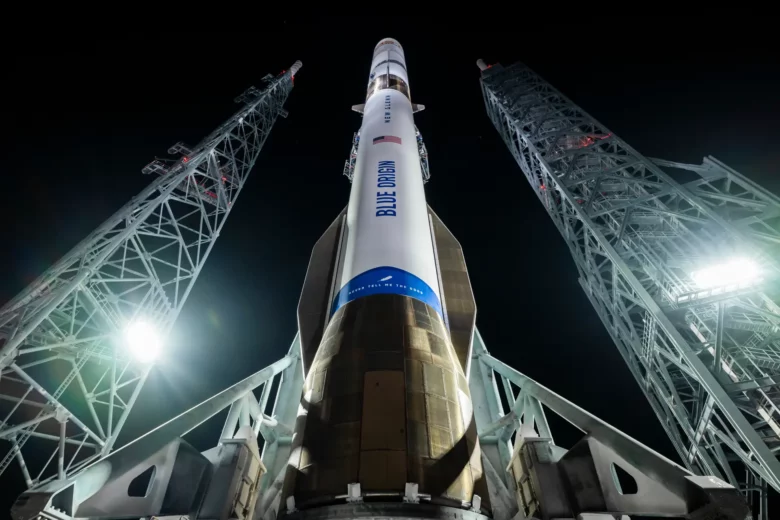
- New Glenn: The partially reusable heavy-lift rocket (up to 45 tons of payload to low Earth orbit) launched for the first time in January 2025; the first-stage landing succeeded in November 2025. A more powerful “9×4” variant with nine engines is in development. Blue Origin also holds US military launch contracts worth billions.
- Blue Moon: The lunar lander makes Blue Origin a central NASA partner in the Artemis program – as the second provider alongside SpaceX.
- TeraWave: The satellite network announced in January, comprising 5,408 satellites in low and medium Earth orbits, targets – unlike Starlink – not consumers but enterprises, data centers, and government institutions. The rollout is set to begin in late 2027. According to the NYT, prospective investors in the funding round are particularly interested in TeraWave.
- Project Sunrise: In the long term, Blue Origin plans data centers in orbit – a constellation of up to 51,600 satellites designed to run AI compute workloads powered by continuous solar energy.
A curious twist: Bezos is partly competing with himself. Amazon is building its own consumer satellite internet service with “Leo” – while Blue Origin’s TeraWave addresses the enterprise segment. Blue Origin is also expected to launch Amazon Leo satellites into orbit in the future.
With around 11,000 employees, sites in Washington, Alabama, and Florida, and the fresh capital injection, Blue Origin is positioning itself as the “enterprise play” of the new space economy – against a competitor that has already captured the mass market.