John Ternus Succeeds Tim Cook: Head of Hardware Becomes Apple’s CEO in an AI-Dominated World

Set Trending Topics as a preferred source on Google.
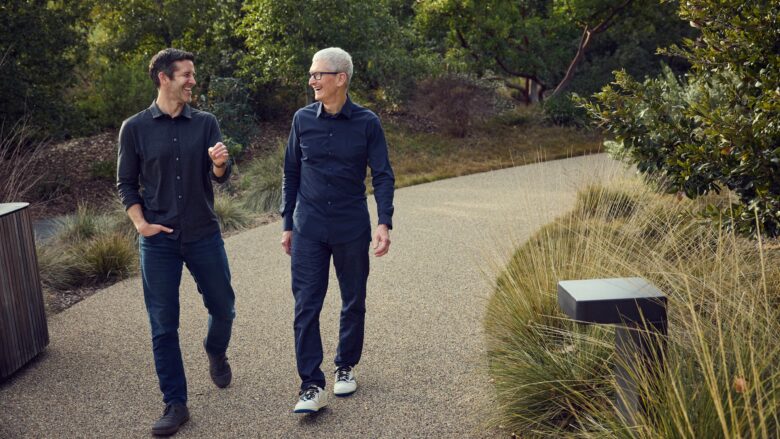
Apple is executing a leadership transition on September 1, 2026, one that had already been signaled: Tim Cook is stepping down as Chief Executive Officer and taking on the role of Executive Chairman. His successor will be John Ternus, previously Senior Vice President of Hardware Engineering. The decision was made unanimously by the Board of Directors and is the result of a long-term succession process.
Tim Cook remains Apple’s most important political liaison
Even as Cook relinquishes the top operational role, he retains a central responsibility: cultivating political relationships worldwide and domestically, particularly with the Trump administration. Apple phrased it deliberately in broad terms in the official press release, but observers read the wording clearly. As Executive Chairman, Cook will “support certain aspects of the company, including engagement with policymakers around the world.”
What this refers to above all is the sensitive relationship with U.S. President Donald Trump. Cook has navigated Apple through a political minefield in recent years: he accompanied Trump through a factory in Texas in 2019, during which Trump falsely claimed Apple was building a new production facility there. He presented the president with a symbolic piece of American glass, gilded in 24-karat gold, from Apple supplier Corning. And he attended a film screening at the White House that drew public criticism.
For Apple, these steps have paid off so far. With the transition to the Chairman role, Cook remains as institutional memory and political buffer, while Ternus can focus on day-to-day operations.
“As Executive Chairman, Cook will support certain aspects of the company, including engagement with policymakers around the world.” (Apple, official press release)
Why Apple is betting on a hardware chief
The choice of John Ternus is surprising at first glance: at a time when technology companies are investing billions in artificial intelligence, Apple is placing a man at the helm whose career has been defined by physical products. Ternus joined the product design team in 2001, became Vice President of Hardware Engineering in 2013, and has been a member of the Executive Team since 2021. He played a key role in the introduction of the iPad, AirPods, several iPhone generations, and the Apple Watch.
Analysts, however, see this as a deliberate strategic decision. Gil Luria of the research firm D.A. Davidson told CNBC that the path forward runs through hardware innovation: “Glasses, pins, foldable phones. At some point, a more affordable virtual reality device than Vision Pro. That is Apple’s territory.”
Indeed, hardware recently accounted for around 80 percent of Apple’s quarterly revenue of $143.8 billion. Software, the App Store, and cloud services — areas significantly expanded under Cook — contributed the remaining 20 percent. The message behind the personnel decision is clear: Apple does not intend to win the AI era through its own models, but through superior devices.
Apple’s AI strategy: partnership over in-house development
Unlike Amazon, Microsoft, Google, or Meta, Apple is not investing hundreds of billions in the development of language models. Instead, the company has entered into a partnership with OpenAI and integrated ChatGPT into its devices, marketed under the label “Apple Intelligence.” Google Gemini will soon also be working on the iPhone.
The strategy carries risks, however. Dan Ives of Wedbush Securities pointed out that Ternus faces considerable pressure, particularly to deliver results quickly in the AI space. Patrick Moorhead, CEO of technology research firm Moor Insights and Strategy, does not expect Ternus to be a risk-taking visionary, but rather someone focused on “tight operational execution, margin management, and incremental product development.”
Cook’s legacy and Ternus’s task
Tim Cook succeeded Steve Jobs in 2011. Under his leadership, Apple’s market capitalization grew from approximately $350 billion to $4 trillion, and annual revenue rose from $108 billion to over $416 billion. The services business developed into a segment generating more than $100 billion in annual revenue.
Ternus is taking over a company with an installed base of more than 2.5 billion devices worldwide and over 500 retail stores in more than 200 countries. His task is to extend Apple’s hardware leadership into an era in which AI capabilities are increasingly determining the value of a device.
“John Ternus has the mind of an engineer, the soul of an innovator, and the heart to lead with integrity and dignity.” (Tim Cook)
Ternus himself emphasized his connection to the company and its values: “I promise to lead with the values and vision that have made this special place what it is for half a century.” The formal transition is planned for September 1, 2026.