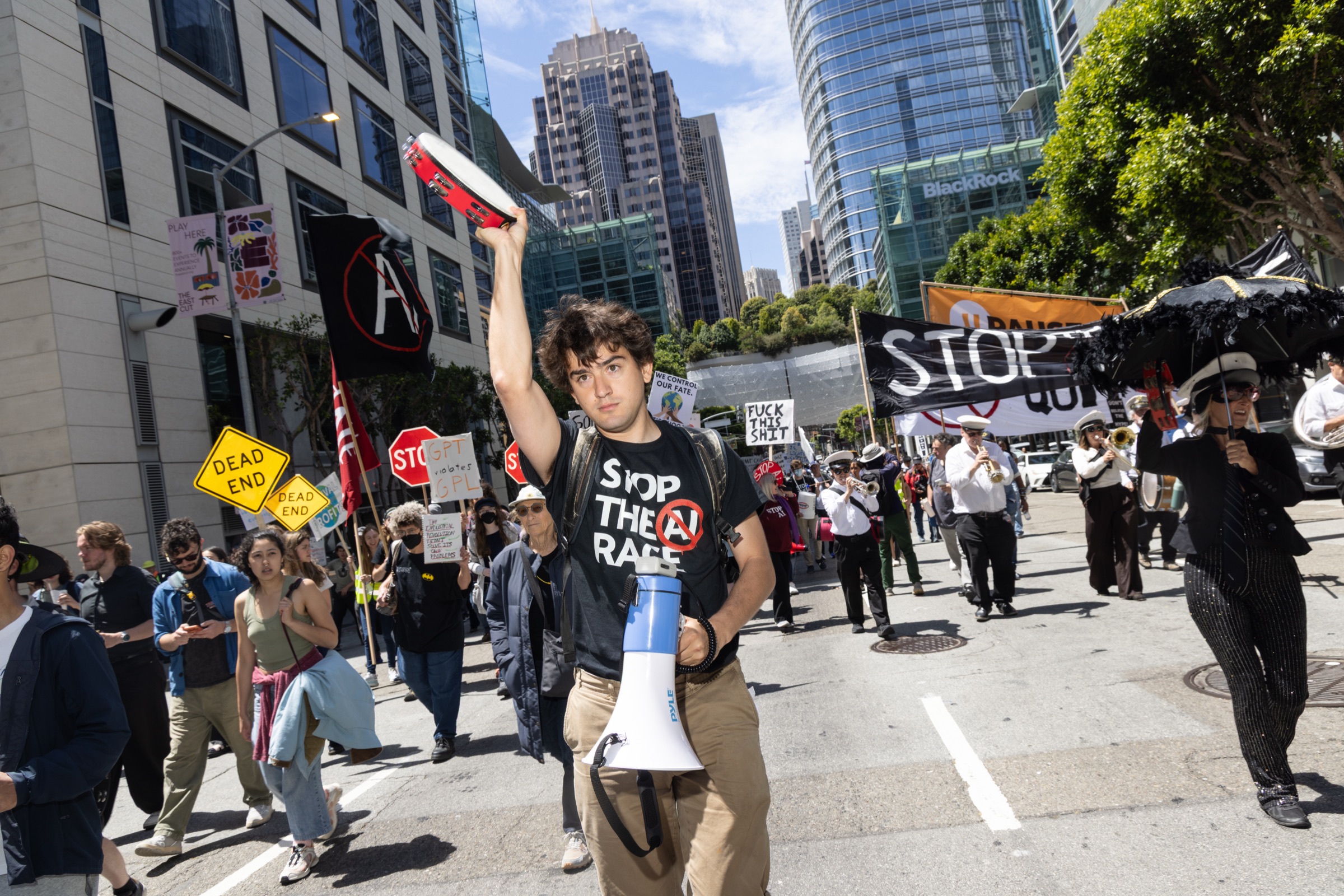
“Stop the AI Race”: Hundreds March Against OpenAI, Anthropic and Google DeepMind in San Francisco



Set Trending Topics as a preferred source on Google.
On Saturday, July 11, around 400 people took to the streets of San Francisco to protest against the leading AI companies. The march, held under the banner “Stop the AI Race”, led from OpenAI’s headquarters on 3rd Street past Anthropic’s offices on Howard Street to Google DeepMind’s location at Rincon Park, with rallies and speeches at each stop. The organizers emphasize that this was a peaceful assembly of “concerned citizens, families, and researchers” – and that employees of the companies in question were explicitly invited to join.
The Central Demand: A Conditional Pause on Development
The movement has a single, clearly defined demand: every CEO of a major AI lab should publicly commit to pausing the development of frontier models – on the condition that every other major lab in the world credibly does the same. This is not a call for a unilateral stop, but for a conditional pledge along the lines of: “If the others pause, I will too.”
In practice, according to the organizers, such a pause would mean: no new training runs for larger or more general frontier models. Teams currently working on advancing the capabilities of these models would instead shift to narrow AI applications or alignment research. Existing models would remain available, and narrow AI applications would still be permitted. As a technical blueprint, the movement points to a paper by the MIRI Technical Governance Team that outlines an international agreement led by the US and China – including verification mechanisms such as AI chip tracking and compute thresholds (FLOP caps).

The Warnings: “The Architects Know the Race Is Reckless”
The protesters argue that the leaders of the AI companies themselves have repeatedly warned about the existential risks of their technology – for instance in public statements on AI risk signed by numerous industry figures. At the same time, they say, each lab justifies its pace by claiming it must beat the competition and geopolitical rivals. It is precisely this race that the activists want to break. Asked about China, they respond that any agreement would of course have to include all major AI labs worldwide – but public commitments from Western CEOs are the first step toward the kind of international coordination that would make this possible.
The movement has a history: in September 2025, an 18-day hunger strike outside Google DeepMind’s London offices made international headlines. DeepMind CEO Demis Hassabis responded at the time and signaled openness to a conditional pause, but named international coordination as the key bottleneck. In February 2026, from the activists’ perspective, Anthropic removed the commitment to pause development if its own AI became too dangerous from the third version of its Responsible Scaling Policy – prompting a first march on Anthropic, OpenAI and xAI on March 21. Since then, Anthropic has written that it expects it “would slow down or temporarily pause” development if other labs verifiably did the same, and OpenAI stated in a strategy paper that coordination, including slowing frontier development, is expected to become more important. For the organizers, this is not enough: “expects” is not a commitment – what is needed, they say, are binding pledges along with a concrete verification regime.

Background: Attacks on Sam Altman’s Home
The protests are taking place in an increasingly heated climate. In April 2026, the San Francisco home of OpenAI CEO Sam Altman was targeted twice within a matter of days: first, a 20-year-old from Texas threw a Molotov cocktail at the property and subsequently threatened to burn down OpenAI’s headquarters. According to prosecutors, the man was driven by hatred of AI technology, traveled to San Francisco with the intent to kill, and was carrying a manifesto containing the names and addresses of other AI executives and investors. He was charged with, among other things, attempted murder. Just two days later, shots were fired at Altman’s house from a car; two people were arrested, though it remains unclear whether the attack was deliberately aimed at the property. No one was injured in either incident.
Altman himself responded with a blog post in which he shared a photo of his family and called for de-escalation: fear about AI is justified, he wrote, and criticism of the industry welcome – but rhetoric and tactics need to be dialed down. The “Stop the AI Race” organizers, for their part, clearly distance themselves from violence and are committed to peaceful protest.
Background: Resistance to AI Data Centers Across the US
In parallel, resistance to the massive buildout of AI data centers is growing across the United States. According to a report by Data Center Watch, projects worth around 130 billion US dollars were blocked or delayed in the first quarter of 2026 alone – at least 75 projects, the highest figure since tracking began in 2023. In the first six weeks of the year, lawmakers from both parties introduced more than 300 data center bills, and 14 states proposed construction moratoriums.
So far, opponents have had the greatest success at the local level: more than 100 municipalities across the US have imposed construction pauses – including Denver with a one-year moratorium, Oklahoma City and Tulsa, several communities in Illinois and Georgia, and around 20 municipalities in Michigan. At the state level, Maine narrowly missed becoming the first state in US history to enact a statewide moratorium in April, when Governor Janet Mills vetoed the bill. In New York, the legislature passed a one-year moratorium on AI data centers in June, which is currently awaiting Governor Kathy Hochul’s signature. At the federal level, Senator Bernie Sanders and Representative Alexandria Ocasio-Cortez introduced the Artificial Intelligence Data Center Moratorium Act in March, which would halt the construction of new data centers of 20 megawatts or more until national safeguards are in place. According to a Gallup poll, roughly seven in ten Americans oppose the construction of AI data centers near their homes.
The “Stop the AI Race” movement, meanwhile, is announcing further actions. As its website puts it: protest marches are “just the start”.