Kimi K3 Is the China Shocker That Lifts Open-Weight Models to Frontier Level


Set Trending Topics as a preferred source on Google.
The next China shocker has arrived: Moonshot AI has released Kimi K3, its most capable AI model to date – setting a new bar for open-weight models. With 2.8 trillion parameters, Kimi K3 is the first open model in the 3-trillion class, equipped with native vision capabilities and a context window of one million tokens. The full model weights are set to be released by July 27, 2026 – after which practically anyone who wants to (and is able to) can help themselves to the open-weight model.
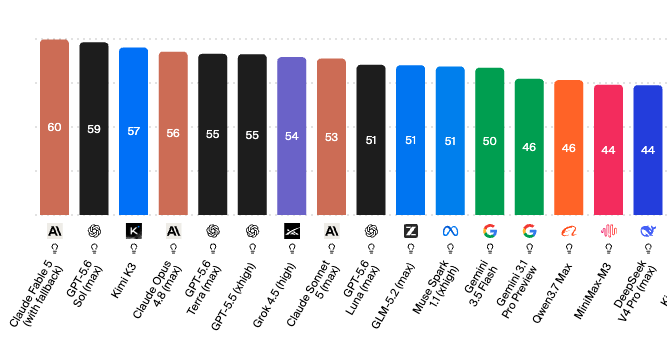
For the established proprietary providers, the launch is a shot across the bow: According to the independent benchmark portal Artificial Analysis, Kimi K3 debuts at 57 points on the Intelligence Index – putting it ahead of Anthropic’s Claude Opus 4.8 (around 56 points), ahead of OpenAI’s GPT-5.6 Terra (55 points), and on par with Google’s Gemini 3.1 Pro. Only the absolute top models, Claude Fable 5 (around 60 points) and GPT-5.6 Sol (59 points), remain in front – a gap of just two to three points. Moonshot itself concedes as much: In its own announcement, the company states that overall performance still trails Fable 5 and GPT-5.6 Sol, but that K3 consistently beats all other tested models in its own evaluation suite.
Open Weights Now on Par With Frontier AI
What is particularly worth bearing in mind: Kimi K3 is now almost as capable as those AI models from Anthropic and OpenAI that were blocked by the US government over safety concerns a few weeks and months ago, respectively, and were then only allowed to be (partially) released under conditions. Moonshot AI, by contrast, plans to bring Kimi K3 to market as an open-weight model – accessible to practically anyone.
For context: A year ago, many points still separated the leading open and proprietary models; the rule of thumb was that open models lagged the US frontier models by six to twelve months. The fact that a freely available model now overtakes several proprietary flagships and is hot on the heels of the absolute frontier duo (Fable 4 and GPT-5.6 Sol) significantly intensifies the pricing pressure on Anthropic, OpenAI, and Google – and also calls into question how dominant the US can remain in AI going forward. Here is the new Artificial Analysis ranking:
New Architecture: 2.5x Scaling Efficiency
Technically, Kimi K3 is built on two architectural innovations: Kimi Delta Attention (KDA) is designed to make information flow more efficiently across long sequences, while Attention Residuals (AttnRes) improve how representations are passed along across model depth. On top of that comes a heavily sparsified Mixture-of-Experts structure: Of 896 experts, only 16 are effectively active per request. Combined with revised training and data recipes, Moonshot claims this yields roughly 2.5 times higher scaling efficiency compared to its predecessor Kimi K2 – meaning the model extracts significantly more intelligence from the same amount of compute.
From the SFT stage onward, the model was trained quantization-aware with MXFP4 weights and MXFP8 activations, which is meant to ease deployment across a broad range of hardware. For serving, Moonshot recommends supernode configurations with at least 64 accelerators; the company has contributed a prefix-caching implementation for KDA to the vLLM community.
What the Model Can Do
Moonshot positions Kimi K3 primarily for long-running, agentic tasks. In the case studies published by the company, the model optimized GPU kernels in a 15-hour autonomous run, more than halving compute time in the process; built a compact Triton-like GPU compiler called MiniTriton from scratch; and even designed a functional chip in a 48-hour run using open-source EDA tools. In research, K3 reproduced an astrophysics analysis in about two hours that, according to Moonshot, would take experienced researchers one to two weeks – including the review of more than 20 papers and over 3,000 lines of Python code.
Thanks to native multimodality – text, images, and video all run within the same model – K3 is also suited for game development with “vision in the loop” (the model iterates between code and live screenshots), for motion design, and even video editing: The model cut its own teaser video from 56 source clips. In the productivity suite Kimi Work, two new features are being added with Widgets and Dashboards, enabling interactive components and persistent, personalized views.
Availability and Pricing
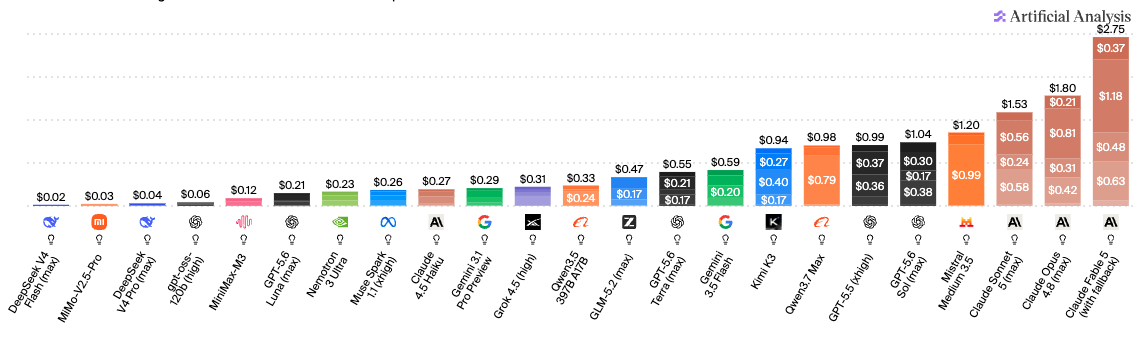
Kimi K3 is available now on Kimi.com, in Kimi Work, Kimi Code, and via the Kimi API. API pricing sits at 0.30 US dollars per million input tokens on cache hits, 3 dollars on cache misses, and 15 dollars per million output tokens – well below the rates of Western frontier models (Claude Fable 5, for example, costs 10/50 dollars). At launch, K3 runs at maximum “thinking effort” by default; more economical modes are set to follow.
Calculated as cost per task, Kimi K3 is (naturally) more expensive than quite a few other AI models, but cheaper by multiples than Anthropic’s top model, Fable 5:
Limitations
Moonshot itself names several limitations: K3 reacts sensitively when agent harnesses fail to pass back the full thinking history, and tends to make decisions on its own when instructions are ambiguous – anyone who needs tight guardrails should anchor them explicitly in the system prompt. And when it comes to user experience, the company still sees a “noticeable gap” to Claude Fable 5 and GPT-5.6 Sol.
The message of the launch is clear nonetheless: The gap between open and closed models has shrunk to just a few points – and Moonshot once again holds the upper bound of open model sizes. The technical report and model weights will follow in the coming days. Here are the benchmarks Moonshot AI itself has published: