QClaw: Tencent Rides OpenClaw Wave With Consumer-Friendly Global AI Agent


Set Trending Topics as a preferred source on Google.
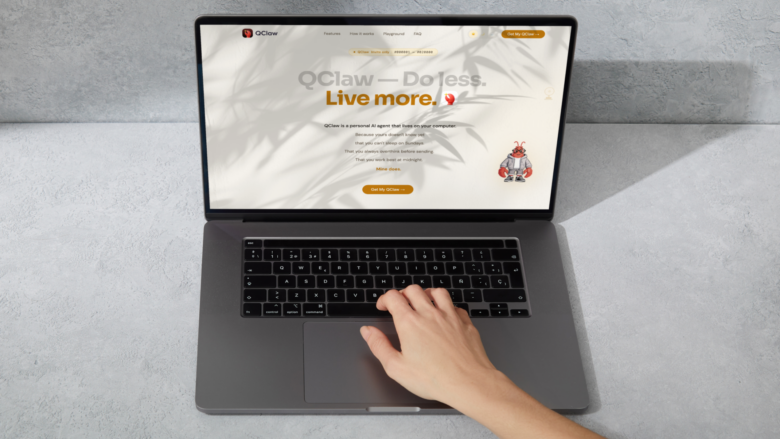
Chinese internet giant Tencent has launched an international beta version of its AI agent product QClaw. The timing is no coincidence: the company is deliberately positioning itself in the slipstream of growing interest in the open-source framework OpenClaw, on which QClaw is technically built. The software is initially available to 20,000 users in the markets of Canada, Japan, Singapore, South Korea, and the United States.
Tencent was one of those Chinese companies that quickly found itself at the center of the OpenClaw hype at home. Images of queues of people getting help from Tencent employees with installing the AI agent went around the world. “Raising Lobsters” became a buzzword in China for jumping on the AI hype.
What is QClaw?
QClaw is an AI agent that runs on Windows and macOS devices and allows users to execute tasks on their computer via messaging services such as WhatsApp or Telegram. The product is explicitly aimed at non-technical users. According to Tencent, neither terminal commands nor API configurations are required: after downloading, registering, and scanning a QR code, the application is said to be ready to use within three minutes.
QClaw is based on the OpenClaw framework, an open-source project that has recently attracted considerable attention in the AI community. Tencent states that it has extended the framework with a consumer-friendly layer in order to lower the barriers to entry.
Rapid Development, High Pace
Tencent emphasizes the unusually short development time of the international version: the company states that it completed the international release in five days, with 99 percent of the code having been generated autonomously by QClaw itself. This claim is formulated for marketing effect and cannot be independently verified from the outside.
The Chinese version of the product, which launched in March 2026, reportedly reached more than one million users within the first ten days, according to Tencent. Over 80 feature iterations were reportedly delivered within a month.
Three Use Cases in Focus
Tencent has built QClaw around three preconfigured usage scenarios:
- QClaw It: Automation of recurring tasks such as travel planning, tax returns, or ticket purchases
- QClaw Daily: Creation of and reminders for daily routines in the areas of fitness, sleep, and health
- QClaw Up: Boosting work productivity, for example in marketing, social media management, or job application processes
Security and Privacy
QClaw includes a security module called “Claw Gateway,” which is designed to monitor AI activities in real time and check for malicious instructions as well as so-called skill poisoning risks. Tencent states that tasks are processed locally on the user’s device. However, the FAQ notes with a caveat that input and output data may be temporarily stored on company servers for up to 24 hours for quality assurance purposes.
International Beta Launch with Limited Spots
The international beta version is currently free of charge and limited to 20,000 user spots. Interested parties can register via the official website. Tencent has not yet provided any information on future pricing models.
The product is available for macOS (Apple Silicon and Intel) as well as Windows 10 and 11. Supported messaging platforms include WhatsApp and Telegram, as well as WeChat, QQ, Feishu, and DingTalk.