Helsing Nears $1.2B Raise That Would Crown It Germany’s Most Valuable Startup


Set Trending Topics as a preferred source on Google.
Munich-based AI defense startup Helsing is reportedly close to a $1.2 billion funding round, according to a report by the Financial Times. The round is being led by US investor Dragoneer Investment Group, which holds stakes in OpenAI and Uber, among others, together with existing investor Lightspeed Venture Partners. This would push the valuation to around $18 billion – making Helsing once again Germany’s most valuable startup. The round has not yet been confirmed.
It would, however, be the largest funding round ever raised by a German startup. For comparison: Celonis reached one billion dollars in 2021, N26 $900 million in the same year. The current valuation would be around 30 percent above the €12 billion at which Helsing was last valued in June 2025 following a Series D led by Daniel Ek’s Prima Materia. Despite the US leadership of the round, Helsing is said to remain approximately 80 percent in European hands – a point the company emphasizes with regard to its positioning as a sovereign European alternative to US providers such as Anduril. Existing investors include Accel, Plural, General Catalyst, Greenoaks, Swedish defense group Saab, and BDT & MSD Partners.
From Software Provider to Drone and Combat Jet Manufacturer
Founded in 2021, the company started with AI software for analyzing battlefield data and improving military decision-making processes, and has since significantly expanded its portfolio. Helsing now produces the kamikaze drone HX-2, a 12-kilogram munition with a range of around 100 kilometers that can operate in GPS-denied environments and engage targets using onboard AI. In February 2026, the Bundestag’s budget committee approved an initial contract worth €269 million for HX-2 loitering munitions, with a framework volume that can grow to up to €1.46 billion over seven years. Autonomous underwater vehicles have also been added, as well as – through the acquisition of Spanish robotics company Keybotic in January 2026 – ground-based autonomous inspection systems. In parallel, Helsing has forged partnerships with established European defense groups, including the Swedish Saab group.
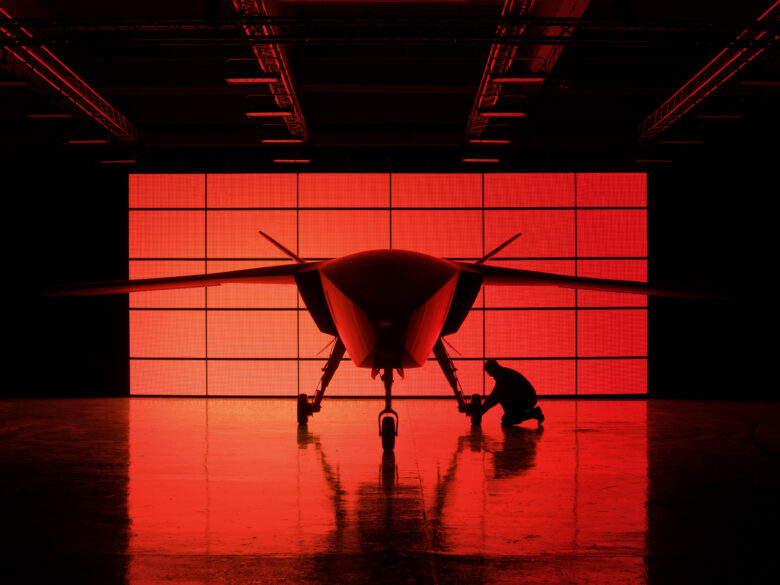
The flagship project is the unmanned combat aircraft CA-1 Europa, unveiled near Munich in September 2025 and scheduled for its first flight in 2027. It is designed as a companion for manned combat jets. For precisely this purpose, Helsing has now secured a prominent German industrial partner: HENSOLDT. The sensor specialist and Helsing today announced a strategic partnership under which the CA-1 Europa is to be equipped with HENSOLDT technologies in the areas of radar, optronics, self-protection, and electronic warfare. Via the software suite MDOcore (Multi-Domain Operations Core), the sensor systems are to be linked with Helsing’s AI agent Centaur, which can autonomously control the drone and process data across domains.
“The sovereignty and superiority of our armed forces depend on our systems being able to be further developed and produced by national industry champions,” said Helsing co-founder and Co-CEO Gundbert Scherf on the partnership. HENSOLDT CEO Oliver Dörre spoke of a contribution to “Europe’s ability to act in matters of security policy.” Helsing, HENSOLDT, and Norwegian group Kongsberg are also already working together on a European satellite constellation for reconnaissance, surveillance, and target acquisition, which is set to be operational by 2029.
Booming Sector – and Bubble Warnings
The Helsing round fits into a boom in the European defense sector. Private capital has been flowing increasingly into defense since Russia’s full-scale invasion of Ukraine in 2022, driven by the prospect of higher defense spending by European governments. Alongside Helsing, drone manufacturers Quantum Systems and Portuguese company Tekever are among Europe’s defense tech unicorns. In Germany, Helsing also competes against Berlin-based startup Stark, backed by US investor Peter Thiel.
Not everyone shares the enthusiasm. Rheinmetall CEO Armin Papperger has warned of a “bubble” in the sector given the billions flowing into drone developers. Other voices argue, by contrast, that European governments continue to spend too much money on “legacy” technology such as conventional tanks and combat jets – and too little on unmanned systems and new technologies. Helsing thus positions itself between traditional defense groups such as Rheinmetall and Airbus on one side, and US competitors such as Anduril on the other. Anduril is currently in negotiations over a round that would value the company at over $60 billion.
The contrast between valuation hype and operational reality remains a sensitive one. The first kamikaze drone HF-1, developed jointly with a Ukrainian partner, had faced criticism in Ukraine over performance and price. Regarding the successor HX-2 as well, Politico reported in early 2026, citing an internal briefing from the German Ministry of Defense, that the system had hit its target only five times in 14 missions in the Donbas. Helsing disputed this and pointed to intensive Russian electronic warfare as well as successful strikes against a tank, a logistics truck, and two howitzers. Most recently, Oleksandr Kamyshin, adviser to President Volodymyr Zelensky on strategic industries, had explicitly praised Helsing’s work in Ukraine. The Bundestag nonetheless imposed additional reporting obligations as part of its HX-2 order and capped the combined framework volume with competitor Stark Defence at €2 billion.
The upcoming billion-dollar round thus also becomes a bet that Europe’s AI defense champion can deliver operationally across the board – from loitering munitions to autonomous combat aircraft.