“Magnificent Seven” Lost $2.3 Trillion in Market Value This June


Set Trending Topics as a preferred source on Google.
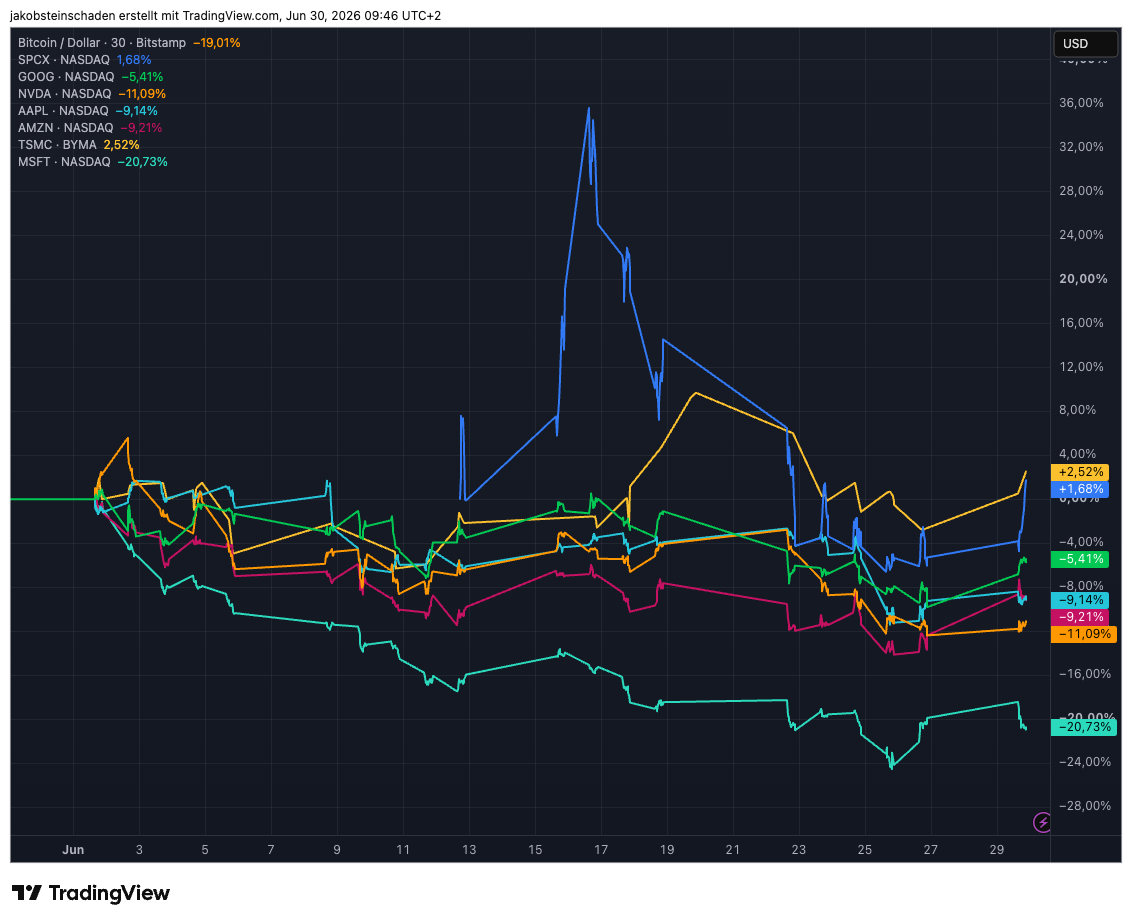
A significant shift is currently occurring in the tech industry on Wall Street. The group known as the “Magnificent Seven”—Nvidia, Meta, Apple, Microsoft, Alphabet, Amazon, and Tesla—has lost more than $2.3 trillion in market value this June. As a result, the group is heading toward its worst month in over a year and is down a total of three percent for the first half of 2026.
Doubts About AI Monetization
The decline in share prices is primarily due to growing investor skepticism. The central question is whether the enormous capital expenditures of the so-called “hyperscalers”—particularly Meta, Amazon, Microsoft, and Alphabet—will soon translate into sufficient profits to justify the massive stock price gains of recent years.
While these companies are investing hundreds of billions of dollars in the development of AI infrastructure, uncertainty is growing regarding how and when these investments can be converted into scalable revenue. Furthermore, the profit margins of these corporations are under pressure as the costs for essential components, such as memory chips and electrical equipment, are rising significantly.
Beneficiaries of Hardware Demand
In contrast to the software- and internet-heavy heavyweights, hardware and semiconductor manufacturers are benefiting massively from the current market situation. The Philadelphia Semiconductor Index, which tracks US chipmakers, has risen by 93 percent in the first half of the year. This represents the strongest growth since the peak of the dot-com boom in 1999.
Investors are increasingly betting on companies that provide the physical infrastructure for the AI revolution. Winners include:
- Semiconductor manufacturers: Companies such as TSMC (Taiwan Semiconductor Manufacturing Company) recorded a gain of around 50 percent, while equipment supplier ASML rose by 60 percent.
- Memory technology: Companies like Micron, Intel, Western Digital, and Seagate Technology were able to more than triple their share prices.
Experts describe the current situation as a “shift in market leadership.” While the “Magnificent Seven” act as the primary spenders of capital, suppliers are benefiting from the unrelenting demand for hardware and the limited availability of components.
Rising Costs Burden Supply Chains
The costs for expanding data centers to support AI demand are continuously rising. In this context, US hyperscalers plan to spend nearly one trillion dollars. A major issue is the drastic increase in prices for memory chips.
This cost pressure is already reaching end consumers: Apple has raised prices for MacBooks and iPads by approximately 20 percent due to rising memory prices. Microsoft has also increased prices for Xbox consoles and warned that the costs for memory components could double again by the end of 2027.
Despite the current correction, the long-term goal of the major tech corporations remains: to expand capacities for AI demand, which currently exceeds supply. Whether the promised era of AI profits justifies the massive upfront investments remains to be seen.