Bitcoin Tops $80,000 as a Short Squeeze Meets Fresh ETF Money



Set Trending Topics as a preferred source on Google.
The crypto market has staged a rally over the past few days that almost nobody saw coming. Bitcoin has climbed back above $80,000 for the first time since spring and currently trades around $79,300, leaving it roughly 24 percent higher over the week. At the start of the previous week it was still changing hands near $64,000.
The move has long since spread beyond the largest cryptocurrency. Ethereum sits at about $2,480, some 31 percent above where it stood a week ago. XRP has gained even more ground with a jump of 49 percent, Solana is up 31 percent and Hyperliquid 35 percent. The standout among the larger tokens is Zcash, which has surged nearly 67 percent to around $840.
The Major Coins at a Glance
| Coin | Price | 24 Hours | 7 Days |
|---|---|---|---|
| Bitcoin (BTC) | $79,345 | +2.00% | +23.71% |
| Ethereum (ETH) | $2,481 | +0.56% | +30.88% |
| BNB (BNB) | $699.72 | −0.04% | +16.48% |
| XRP (XRP) | $1.48 | +0.11% | +49.16% |
| Solana (SOL) | $99.65 | +5.09% | +31.47% |
| TRON (TRX) | $0.3426 | −0.26% | +3.02% |
| Hyperliquid (HYPE) | $81.03 | +2.91% | +35.49% |
| Dogecoin (DOGE) | $0.09063 | −0.57% | +29.72% |
| Zcash (ZEC) | $841.69 | −0.05% | +66.66% |
| Chainlink (LINK) | $11.57 | +0.03% | +22.10% |
| UNUS SED LEO (LEO) | $9.37 | +0.40% | −0.90% |
The Trigger Came Out of Washington
The spark came from the U.S. Treasury. Late last week, Treasury Secretary Scott Bessent announced that buybacks of longer-dated government bonds would be expanded, doubling the maximum volume of those operations to at least $4 billion. He also hinted that even larger purchases were possible.
Markets read the move as a sign that Washington keeps postponing genuine fiscal consolidation and is treating the symptoms instead. Yields at the long end of the U.S. curve eased and the dollar slid to a multi-month low. Investors responded by rotating into alternative assets, which lifted gold along with the crypto market. Politics added a further tailwind: President Trump urged the Senate to finally pass the Clarity Act, the contested crypto regulation bill, and the Securities and Exchange Commission had shortly before published its proposal for a dedicated “Regulation Crypto Assets.”
What a Short Squeeze Is, and Why It Matters Here
The sheer speed of the advance, though, comes down to the mechanics of the derivatives market. After the weak months that preceded it, plenty of traders were betting on further declines by building short positions. Going short means selling borrowed coins in the expectation of buying them back more cheaply later. If the price rises instead, the loss is theoretically unlimited, and beyond a certain point the exchange closes the position automatically.
That forced exit amounts to a purchase. The more positions get liquidated, the more demand builds, which pushes the price higher and sets off the next wave of liquidations. This self-reinforcing spiral is what traders call a short squeeze.
The scale of this one shows up in the numbers. Over the course of the rally, more than $4.3 billion in short positions were liquidated. On a single day, bearish bets racked up a record $2.7 billion in losses, with roughly $243 million wiped out within one hour. A substantial share of the price jump therefore rests on forced buying rather than voluntary demand, which is why many market watchers are treating the move with caution. Once the positioning has been cleaned out, that driver disappears.
Wall Street Is Buying Again
The other half of the story argues for more substance. U.S. spot bitcoin ETFs have now recorded seven consecutive trading days of net inflows, totaling more than $2.5 billion in a single week, the strongest weekly figure in about ten months. Assets under management in those products climbed from roughly $78.7 billion to $98.6 billion over the same stretch.
Other crypto ETFs are drawing money as well. On the most recent trading day, some $337 million flowed into bitcoin products, about $115 million into ether funds, roughly $33 million into Solana vehicles and just under $14 million into XRP ones. Inflows of that kind reflect genuine spot demand, and they come predominantly from institutional buyers. Geoff Kendrick of Standard Chartered now considers his year-end target of $100,000 too conservative as a result.
Sentiment Is the Strongest in Years
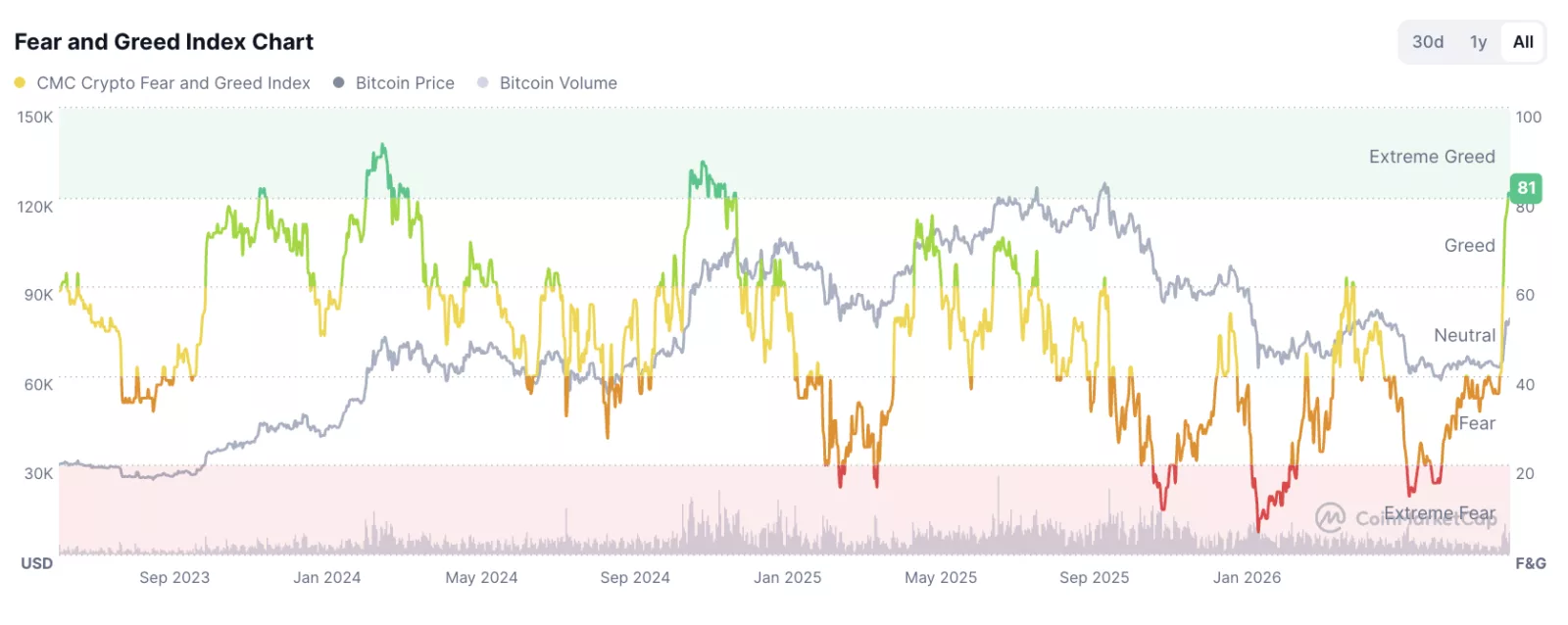
How quickly the mood has turned is visible in the Crypto Fear and Greed Index. The gauge, which condenses price action, volatility, derivatives data, stablecoin ratios and search volumes into a single reading between 0 and 100, stands at 81 and sits squarely in “extreme greed” territory. It was last that elevated in December 2024. Only days earlier it was still hovering in neutral ground.
Historically that cuts both ways. Extreme greed has often coincided with local tops, because such phases tend to invite profit taking. And on its own the index carries limited predictive value anyway.
What Happens Next
With the push above $80,000, bitcoin has also reclaimed its 200-day moving average, which many participants use as a marker for the longer-term trend. The decisive question now is whether the price can hold that level once the forced buying in the futures market has worked its way through. Should ETF inflows persist, the recovery could broaden into a more durable uptrend. Should they dry up, the jump may end up remembered as a brief, technically driven episode.