German DeepTech CMBlu Becomes a Unicorn – With a Lithium-Free Battery for AI Data Centers


Set Trending Topics as a preferred source on Google.
While the tech world debates chips, models, and data centers, the future of AI is increasingly being decided somewhere else entirely: at the power outlet. This is exactly where German DeepTech company CMBlu Energy comes in – and the firm has now joined the unicorn club. With a first close of its Series C round at €50 million, the battery startup from Alzenau in Lower Franconia has crossed the €1 billion valuation threshold. Leading the round as a high-profile new investor is Samsung Ventures, the venture arm of the South Korean tech conglomerate. All existing investors are also doubling down, most notably Austrian construction and technology group STRABAG SE.
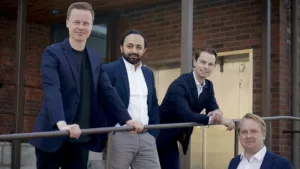
CMBlu was founded in 2014 by Peter Geigle and grew out of one of Europe’s largest research labs for lithium-free batteries. Since 2024, the company has been led by Constantin Eis, the former Lichtblick and Home24 manager and Casper co-founder. According to industry sources, around €250 million has been invested in CMBlu to date – STRABAG alone put in €100 million back in 2023. Today, the company employs more than 250 people, including over 150 scientists and engineers.
SolidFlow: A battery that can’t catch fire
At the heart of CMBlu lies a technology called SolidFlow – and this is where things get technically interesting. Conventional lithium-ion batteries dominate the market today, but they have several weaknesses when it comes to stationary large-scale storage: fire risk (the dreaded thermal runaway), dependence on critical raw materials such as lithium and cobalt, and therefore reliance on supply chains from geopolitically sensitive regions.
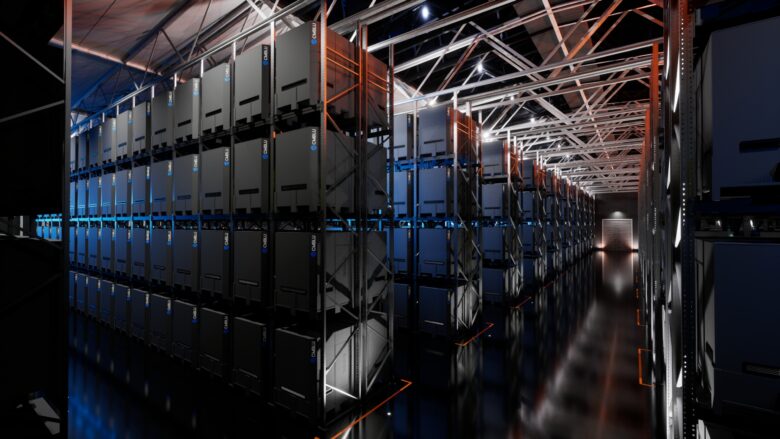
SolidFlow takes a fundamentally different approach. The system combines the architecture of a flow battery – in which energy is stored in liquid electrolytes – with proprietary solid energy storage materials. The electrolytes are water-based and non-flammable. This has several consequences:
Safety: No thermal runaway, no fire load – this significantly streamlines permitting for large-scale installations. Scalability: Power (kW) and energy capacity (kWh) are decoupled. If you want to store more, you simply enlarge the tanks. Supply chain: The raw materials used are abundant and recyclable. CMBlu emphasizes that it operates without materials from FEOC sources (Foreign Entities of Concern) – a criterion that carries particular regulatory weight in the United States under the Inflation Reduction Act. Duration: SolidFlow is engineered for ten hours or more of dispatchable energy – exactly what the industry calls Long Duration Energy Storage (LDES).
Production takes place at an automated gigafactory in Alzenau, with additional sites planned in the United States and Greece.
The AI power demand problem
The timing of the round is no coincidence. The exploding energy demand of AI data centers has shifted within just a few years from a theoretical concern to an acute bottleneck. Hyperscalers such as Microsoft, Google, Amazon, and Meta are planning gigawatt-scale campus projects – power volumes equivalent to entire major cities. At the same time, grid expansion is failing to keep pace.
The catch: solar and wind power are cheap, but volatile. Data centers run 24/7. Anyone trying to bridge the gap between midday sun and the nighttime load peak needs multi-hour, dispatchable storage capacity – precisely the gap that lithium-ion batteries struggle to close economically, given their typical 2-to-4-hour duration and safety requirements.
A sample calculation from CMBlu makes this tangible: a 5 GWh storage system can power a 1 GW data center for five hours – or carry a 500 MW data center fully through the solar-free night. CMBlu has already signed exactly such a 5 GWh framework agreement with European energy group Uniper. According to industry reports, the customer list also includes Mercedes-Benz and the US utility Salt River Project in Arizona, where the major “Desert Blume” project is being built.
Why Samsung and STRABAG?
The investor lineup is telling. Samsung Ventures invests globally in hardware and energy technologies – and Samsung itself is both a heavy energy consumer (semiconductor fabs are among the most power-intensive industrial facilities in the world) and a potential industrial partner. Its entry signals that Asian capital views German energy technology as a strategic asset – not merely a financial bet.
STRABAG, in turn, is an unusual investor with a clear logic: the publicly listed Austrian construction group increasingly needs energy storage as an integral component of its large construction sites and industrial and infrastructure projects. With the original €100 million investment from 2023 and its follow-on in the Series C, STRABAG effectively secures privileged access to a key technology for its own value chain. Eis sums it up: “speed to power,” paired with locally anchored supply chains, has become the decisive competitive factor for industrial customers.
What the fresh funding will do
The capital raised will flow into expanding production capacity and accelerating early commercial deployments in Europe and the United States. A full closing of the Series C is still pending according to market observers – the €50 million represents an initial close, with further tranches expected.
This positions CMBlu in a market segment so far dominated mainly by US providers such as Form Energy (iron-air batteries) and ESS Inc. (iron flow) – but with one decisive geographic advantage: a German gigafactory, a European investor base, and an anchor customer like Uniper make CMBlu the most prominent European player in the LDES race today.