Hyperliquid: The Rapid Rise of a Decentralized Crypto Exchange Between the U.S. and North Korea



Set Trending Topics as a preferred source on Google.
A decentralized crypto exchange run by eleven people in Singapore has become the most important venue for crypto derivatives outside the large centralized players. Hyperliquid has processed more than $5 trillion in cumulative perpetual futures volume since launch, including roughly $205 billion in the past 30 days alone, according to DefiLlama. Open interest currently sits at about $13.3 billion. At the same time, the platform is drawing attention from two directions at once: North Korean hackers are moving funds through it, and the U.S. government is working to bring it into the regulated American financial system.
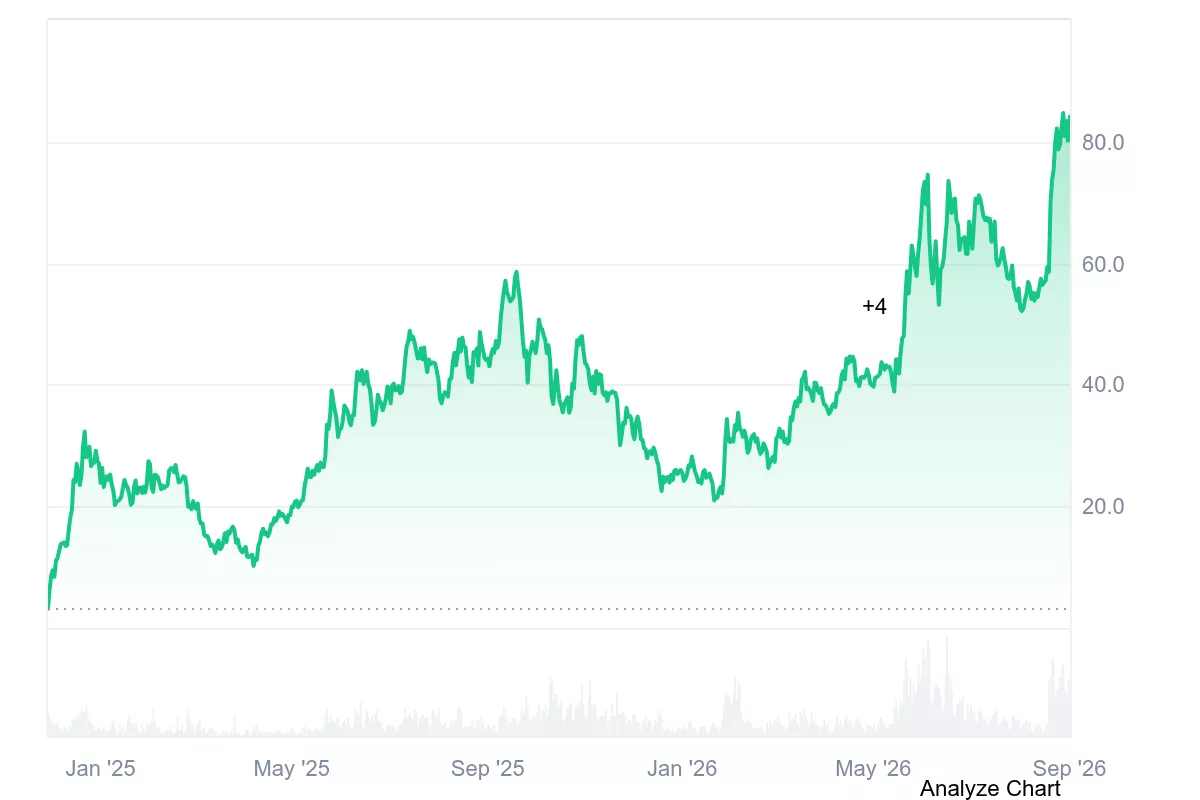
The platform’s own token tells the same story. HYPE recently set a fresh all-time high at around $86.70, giving it a market capitalization of roughly $20 billion and a spot among the ten largest crypto projects. Buybacks and burns are a big part of the reason. The so-called Assistance Fund has purchased more than $1.3 billion worth of tokens on the open market, and industry data credit Hyperliquid with about 46 percent of all token buybacks across the crypto sector last year. Validators have also voted to treat roughly 37 million HYPE held in that fund as permanently burned, worth about $920 million at the time. Around 222 million of a maximum one billion tokens are currently in circulation.
What Makes Hyperliquid Different
Hyperliquid is a decentralized exchange (DEX) for perpetual futures, derivatives that let traders speculate on price moves without ever owning the underlying asset and without an expiry date. In crypto, that market is six to eight times larger than trading the assets themselves, and until recently it ran almost entirely through centralized exchanges such as Binance.
The technical foundation is a purpose-built layer-1 blockchain running the HyperBFT consensus mechanism, which is based on the HotStuff algorithm. According to the project, it handles up to 200,000 transactions per second with sub-second latency. The centerpiece is a central limit order book operated fully on-chain (HyperCore), while many other DEXs rely on automated market makers. HyperEVM later added an Ethereum-compatible environment where developers can deploy existing smart contracts without modification. We covered the details in our analysis of the HYPE token.
For users, the practical difference is this: they connect a wallet directly to the platform instead of opening an account. There is no traditional know-your-customer check. Leverage of up to 40x is available.
Why the Platform Grew So Fast
Several factors explain the ascent. The first is performance. The order book design comes close to what centralized exchanges offer, while users keep custody of their own funds.
The second is the refusal of venture capital. One fund reportedly offered the team $100 million, and founder Jeffrey Yan turned it down. Instead, 31 percent of the HYPE supply went out by airdrop to roughly 94,000 early users, with no vesting and no conditions attached. At the opening price that was worth more than $1 billion, and at all-time highs around $16 billion.
The third is the decision to open the platform up. Under the HIP-3 upgrade, anyone who stakes 500,000 HYPE can launch their own perp markets, set the parameters, and keep half the trading fees. The most active of these independent deployers, Trade[XYZ], has launched markets for silver, crude oil and the S&P 500, the last of them officially licensed by S&P Dow Jones Indices. These markets run around the clock, weekends included, when traditional futures exchanges are closed.
When the United States and Israel began bombing Iran on a Saturday this spring, daily volume in the crude oil perp jumped from $21 million to $3.7 billion. Markets created by outside deployers now account for roughly half of Hyperliquid’s total volume, and a further upgrade is set to open the platform to options and prediction markets.
The fourth factor is token economics. About 99 percent of protocol revenue is automatically converted into HYPE and burned. The team itself takes no fees.
Who Is Behind the Platform
The core development company is Singapore-based Hyperliquid Labs. The central figure is Jeffrey Yan, 31, who grew up as the son of Chinese immigrants in Redwood Shores near San Francisco. As a teenager he won gold at the International Physics Olympiad, then studied mathematics and computer science at Harvard and worked at high-frequency trading firm Hudson River Trading. After a failed prediction-market startup, he built the anonymous trading firm Chameleon Trading from Puerto Rico, and shut it down after the collapse of FTX to start Hyperliquid.
The team remains small: eleven people, recruited largely from the world of international mathematics and informatics olympiads, most of them working under pseudonyms. Last year the company generated more than $900 million in profit, according to an extensive profile in Colossus magazine, making it one of the most profitable businesses per employee anywhere. Yan has lived with personal security since an incident at his apartment building, in a period when violent attacks on wealthy crypto holders have risen sharply. The office sits deliberately outside the financial district.
The rise has come with setbacks. Last spring a trader manipulated the price of the JELLY token and caused a loss of roughly $12 million in HLP, the community liquidity vault. Validators voted to delist the token and settle at the pre-manipulation price, which triggered a debate over how decentralized a system can be when two dozen validators are able to override a market price. Bitget CEO Gracy Chen called the move “immature and unprofessional” at the time.
North Korea’s Hackers Are Using the Platform
North Korean hackers have sold more than $30 million worth of bitcoin through Hyperliquid over the past three weeks, CoinDesk reports, citing data from analytics firm Arkham. The wallets involved are attributed to the state-sponsored Lazarus Group and were originally identified by blockchain investigator ZachXBT. The proceeds were used to buy ether and solana, which were then transferred to centralized exchanges including Kraken, LBank and KuCoin.
Who owns the receiving accounts, and whether the exchanges knew where the funds came from, remains open. Kraken points to a compliance program built with blockchain analytics providers that is designed to block assets tied to sanctioned wallets. LBank stresses that risks in an industry operating across platforms, chains and jurisdictions can rarely be identified by any single provider on its own. KuCoin notes that public on-chain data show asset movements while leaving out the compliance measures a platform may take internally. Hyperliquid did not respond to a request for comment.
The phenomenon is familiar. MetaMask security researcher Taylor Monahan identified wallets in late 2024 that were suspected of being controlled by North Korean hackers and had been trading on the platform for months. Net outflows reached roughly $250 million in a single day, and the exchange emphasized that there had been no exploit and no user losses.
Asset manager Bitwise flags the sanctions risk explicitly in a filing for its HYPE ETF: developers and operators cannot compel users who interact directly with the blockchain to undergo KYC, anti-money-laundering or sanctions screening. U.S. authorities accuse the Lazarus Group of stealing and laundering billions of dollars in crypto assets to generate revenue for Pyongyang and its weapons programs, and OFAC sanctioned the group years ago. According to Chainalysis, the value received by sanctioned entities rose 694 percent last year.
Why Trump Wants the Exchange in the U.S.
In parallel, the U.S. government is working to bring Hyperliquid into the regulated financial system. At a White House event, Donald Trump said recently that CFTC Chairman Mike Selig was working on a pathway to bring the platform to the United States “in a fully compliant and legal fashion.” That fits the administration’s broader push to make the country the center of the global crypto industry and to bring historically offshore businesses under U.S. oversight. HYPE rose by a double-digit percentage after the comments.
The background: Americans are currently locked out, because the Dodd-Frank Act passed after the financial crisis requires derivatives transactions to flow through a regulated intermediary. No legal path yet exists for a decentralized protocol. Onshoring would mean meeting rules on derivatives exchanges, customer protection and market surveillance while also addressing the sanctions and money-laundering risks that arise when people trade straight from a wallet. Kraken parent Payward is in advanced talks with Hyperliquid Labs about making the perpetual futures available to U.S. traders, Bloomberg reported.
Resistance is coming from established competitors. CME Group and ICE both urged U.S. officials to scrutinize Hyperliquid, warning that the platform could facilitate market manipulation and sanctions evasion. CME is currently suing the CFTC in an effort to block the regulator’s push to allow crypto perps on U.S. trading venues. ICE CEO Jeffrey Sprecher, for his part, called Hyperliquid “bigger than Nasdaq” by trading activity. Hyperliquid has outsourced its policy work in Washington to the independent Hyperliquid Policy Center (HPC), led by crypto lawyer Jake Chervinsky and funded with one million HYPE from the Hyper Foundation. The HPC has been working through the agencies methodically ever since: it files comments with the CFTC on a rolling basis, argued recently that perpetual contracts belong at the center of the agency’s innovation agenda, and has petitioned alongside Trade[XYZ] for energy perps to be allowed in U.S. markets. It has also filed on prediction markets, on recognition of onchain market infrastructure, and has urged the CFTC and the SEC to adopt a harmonized framework for perpetuals.