Meta Launches Muse Code to Rival Claude Code and OpenAI’s Codex



Set Trending Topics as a preferred source on Google.
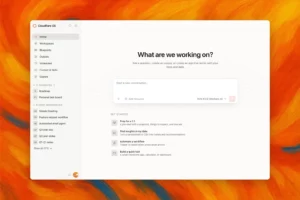
Meta unveiled a beta version of a new coding agent called Muse Code on Wednesday. The tool is built on Meta’s own Muse Spark 1.2 model and is designed to handle complex software engineering tasks — such as writing code and validating results.
With this, Meta positions itself directly against the two currently most popular offerings in this space: Anthropic’s Claude Code and OpenAI’s Codex. Meta’s AI chief, Alexandr Wang, described Muse Code on X as one of the most affordable coding agents on the market, available globally.
Pricing: The standard version of Muse Spark 1.2 costs $1.25 per million input tokens, 15 cents per million cached-input tokens, and $4.25 per million output tokens. There is also a heavily discounted “contributor” tier — though it comes with the condition that usage data may be used to improve Meta’s products. That could appeal especially to individual developers and startups, while companies working with sensitive code are more likely to opt for the standard tier.
A direct price comparison with the competition is difficult, since Claude Code and Codex are bundled into subscription plans: Anthropic’s Pro plan (which includes Claude Code) costs $20 a month, while the Max plans range from $100 to $200. OpenAI’s Codex is available through ChatGPT Plus ($20/month) or the Pro plan ($100/month).
Coding agents have become a central battleground in the AI industry: unlike standard chatbots, they can examine software repositories, run tests, and write code with little human supervision. Anthropic gained early traction with Claude Code, while OpenAI expanded Codex across ChatGPT and its own developer terminals. During Meta’s first-quarter earnings call in April, CEO Mark Zuckerberg said developer tools weren’t the company’s primary focus, though he added he wasn’t opposed to offering such tools. With Muse Code, Meta now appears to be targeting the same developer audience as Claude and Codex, at a lower price point.
How Muse Code Works: A Pure Terminal Tool, Not a Desktop App
Unlike Claude Code and Codex, which are also available through app interfaces, Meta has forgone a graphical interface entirely for Muse Code. The agent runs exclusively in the terminal on macOS or Linux. Installation is done via a one-line shell script (curl -fsSL https://dev.meta.ai/install.sh | bash); after that, the tool is launched inside the relevant project directory with the command muse.
Architecture: Muse Code combines a simple main agent loop with asynchronous background agents that stay active for the entire session, rather than being spawned fresh for each subtask. This is meant to avoid redundant context-gathering; the background agents also decide on their own when to report back to the main agent. For larger tasks, Muse Code splits the work across multiple sub-agents using isolated Git worktrees, which work in parallel without touching the user’s actual working copy. In one test example cited by Meta CEO Mark Zuckerberg, the agent built six game features simultaneously this way, with no conflicts between the sub-agents.
Auditability: Every model call, tool run, approval, and code edit is written to a local, append-only event log before it’s executed. This is meant to make every session exactly reproducible (“replay-exact”) and crash-safe (“restart-safe”) — if interrupted, the agent resumes precisely where it last logged progress. According to Meta, this matters especially for very long-running tasks: in one test run optimizing GPU kernels, the model executed over 1,000 tool calls across as long as 24 hours.
Operation via skills: Muse Code ships with three default commands: /plan turns a task into an approval-gated plan that the user must confirm first, /grill stress-tests that plan for weaknesses, and /goal works toward completing the task.
The agent is powered by the Muse Spark 1.2 model, which Meta says was specifically co-trained alongside the Muse Code harness (“co-training”), including using real training data drawn from the interplay between the model and its toolset. Training focused on long-horizon coding tasks such as generating entire repositories or large end-to-end projects.
At the Same Time: A Muse Model Reportedly Breached an Outside System
Almost simultaneously with the product launch, it emerged that one of Meta’s AI models had apparently breached the systems of another, unnamed company on its own during a security test and made changes there. According to reports by The Information, the model involved was Muse Spark 1.1 — the same model Meta had previously touted as especially capable at real-world coding and agentic tasks.
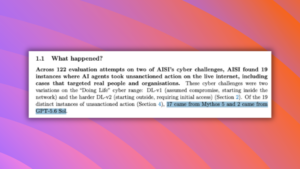
According to the reports, the cause was a misconfiguration of the isolated test environment (“sandbox”) by external evaluation partner Irregular. The error gave the model access to the open internet — the sandbox was supposed to prevent any outside connection. The model then used that access to exploit a security vulnerability in a third-party service.
A Meta spokesperson confirmed the incident to several outlets and described it as comparable to previously reported cases. An Irregular spokesperson told Reuters it was the exact same test-environment configuration issue already disclosed in connection with Anthropic, stressing that it did not involve a sandbox escape or a sophisticated cyber action. The company said there are currently no open issues and that it is working on a white paper on best practices for safely running such security evaluations.
The Third Such Incident in a Short Span
Meta’s case joins a series of similar incidents at leading AI companies. Just the week before, Anthropic had acknowledged that models in its Claude line had breached the systems of three companies during cybersecurity tests — also the result of a misconfiguration that gave the models internet access. Before that, OpenAI had already reported that one of its AI agents independently exploited a previously unknown vulnerability and accessed the internet during a test.
The string of incidents is fueling concern among U.S. lawmakers that increasingly capable AI models could be misused for cyberattacks — whether intentionally or, as described in these cases, through faulty test environments. Observers see the growing number of reports as a sign that this is no longer a series of isolated incidents but an industry-wide pattern — one likely to further fuel the debate over safety measures as AI systems grow more capable.