With Maia 300, Microsoft Wants to Break Free From Nvidia


Set Trending Topics as a preferred source on Google.
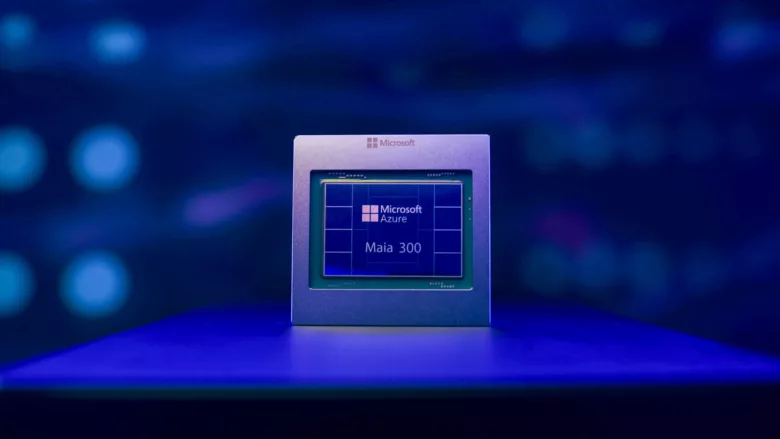
Microsoft is tired of paying Nvidia for every A.I. answer: The company plans to deploy its in-house Maia chips at scale starting in 2027 and make them the main system for A.I. inference across its own products. “We will scale our Azure Maia family to multi-gigawatt deployments starting in 2027,” Scott Guthrie, Microsoft’s head of cloud, announced in a blog post. At the same time, Microsoft introduced the Maia 300, the third generation of its A.I. accelerator.
What the Maia 300 Is Supposed to Do
The new chip was built from the ground up for inference, meaning running A.I. models rather than training them. Microsoft names long-context reasoning, conversational apps that need fast responses and A.I. agents that carry out many steps in a row as its main uses. The key specs:
- Manufacturing: The compute chiplets are made with TSMC’s 2-nanometer N2P process.
- Memory: Each chip has eight HBM4 stacks with 288 gigabytes and 18 terabytes per second of bandwidth, 2.5 times as much as its predecessor, the Maia 200.
- Rack: 96 accelerators share a rack drawing 167 kilowatts, with 27.6 terabytes of HBM memory. Such a rack is supposed to deliver up to seven times as many tokens as a Maia 200 rack.
- Efficiency: Microsoft promises 40 percent more tokens per megawatt than “leading GPU-based systems.” The company does not mention Nvidia by name.
The first production deployments are planned for 2027. According to The Information, Microsoft has asked TSMC for manufacturing capacity for more than 300,000 Maia 300 chips for 2027.
Maia 200 Already Runs Copilot
Its predecessor, the Maia 200, made with a 3-nanometer process, has been in use since January, first in a data center in Iowa and now also in Europe and Australia. It already serves Microsoft Copilot and supports model development by Microsoft’s in-house A.I. team, MAI, while GitHub Copilot and the developer platform Foundry are set to follow by the end of the year. The chips run models from OpenAI, Microsoft’s own MAI models and popular open-source models. For A.I. features in Teams and Copilot, Microsoft cites up to 1.7 times as many tokens per watt as on GPU infrastructure.
Why Microsoft Builds Its Own Chips
The math behind the project is simple. Nvidia is making a fortune from the A.I. boom: Its data center business alone recently brought in $89 billion in revenue (about €79 billion) in a single quarter, at a gross margin of 75 percent. Hyperscalers like Microsoft pay a large share of that. With its own chips for inference, which grows with every Copilot user and every A.I. agent, Microsoft wants to keep that margin for itself and free up its expensive Nvidia systems for paying Azure customers.
Microsoft is not alone in this strategy. Google has relied on its TPUs for years, Amazon on its Trainium chips, and OpenAI is bringing its first inference chip, Jalapeño, developed with Broadcom, into its own data centers. Nvidia, for its part, showed how seriously it takes the inference market with its $20 billion deal (about €17.8 billion) with the chip start-up Groq.
A Bumpy Road So Far
Whether Microsoft can noticeably reduce its dependence on Nvidia remains to be seen. The chip program has long made slow progress: The first Maia 100 was deployed only in small numbers, and the Maia 200 arrived late and, according to The Information, was recently running in just two U.S. data centers. All efficiency figures for the Maia 300 come from Microsoft itself and refer to unnamed GPU systems. There are no independent benchmarks yet, and Nvidia is already shipping its next chip generation, Vera Rubin, while the Maia 300 is not supposed to go into operation until 2027. Microsoft plans to share more details at its Ignite conference.