Navigating El Niño: from weather shock to uneven EM risks
Set Trending Topics as a preferred source on Google.
Guillaume Tresca is a Senior Emerging Market Strategist, Paolo Zanghieri is a Senior Economist at Generali Investments. In this guest article, they examine the potential impact of a strong El Niño episode on economic growth and inflation in emerging markets.
EM assets have weathered recent geopolitical shocks well, helped by solid fundamentals and a more contained inflation backdrop than in previous cycles. A strong El Niño episode would test that resilience through a different channel. It could disrupt crops, lift food prices and complicate disinflation across emerging economies, especially where high food weights in CPI baskets, fragile supply chains and limited fiscal room leave policymakers with fewer buffers. This note assesses the likely food- price impact, identifies the EMs most exposed, and draws the implications for central banks, fiscal policy and EM fixed income.
A strong El Niño is taking shape
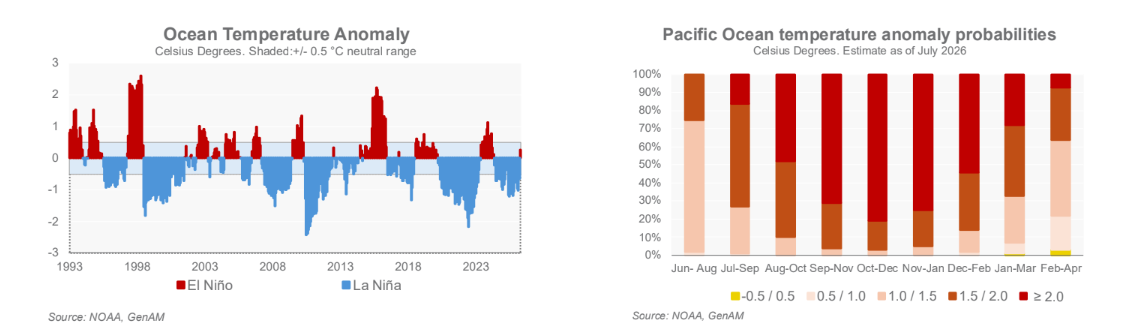
The US National Oceanic and Atmospheric Administration (NOAA) warned that a very strong El Niño episode has already started and is highly likely to last until early spring 2027.
El Niño forms when changes in wind patterns allow unusually warm waters to spread across the central and eastern tropical Pacific. It typically lifts global temperatures and raises the risk of extreme weather, with the impact varying widely across regions. The Pacific was still under the reverse regime, a La Niña influence in winter 2025, with cooler-than-average tropical waters. A rapid shift from that cool phase to a potentially very strong El Niño in less than a year would be unusual and has raised concerns, as it could amplify weather disruptions that can damage crops. The latest El Niño episode, in 2023-24, was only moderate to strong but still contributed to disruptions in several regions. Even if the current episode proves less severe than feared, it could still matter because it would interact with an already warmer climate backdrop.
From weather shock to food-price pressure
One of the main concerns is the impact on global food prices, which are already under pressure from higher agricultural input costs. The Iran conflict and disruptions around the Strait of Hormuz have contributed to a price spike in key inputs such as fuel and fertilisers.
This may take time to abate, even if traffic through the Strait of Hormuz normalises. Another weather-related shock could therefore lead to a larger and more persistent increase in food prices, with important repercussions for inflation. This would matter greatly for emerging markets, where food has a greater weight in the consumption basket than in advanced economies. A key question is therefore whether an additional food-price shock could erode some of the resilience EMs have shown so far to the oil-price spike.
To estimate the impact of a rise in Pacific Ocean temperatures on food prices, we start from the approach recently used by the ECB to track over time the changes in food prices associated with a 1°C increase in Pacific Ocean temperatures. We try to account for nonlinearities and estimate a slightly different model. Combining the results of the linear and nonlinear models we find that, once we account for the global business cycle and oil and fertiliser prices, a one-off 1°C temperature rise could lift global food prices by as much as 10% within 16 months.
We estimate that the impact would be particularly strong for coffee, rice and soybeans. Assuming a relatively strong phenomenon, with Pacific Ocean temperatures rising by 2°C by the end of the year (the lower bound of the most likely year-end outcome according to NOAA projections), this would imply a roughly 20% cumulative rise in global food prices, peaking in Q1 2028, with effects visible for another couple of quarters.
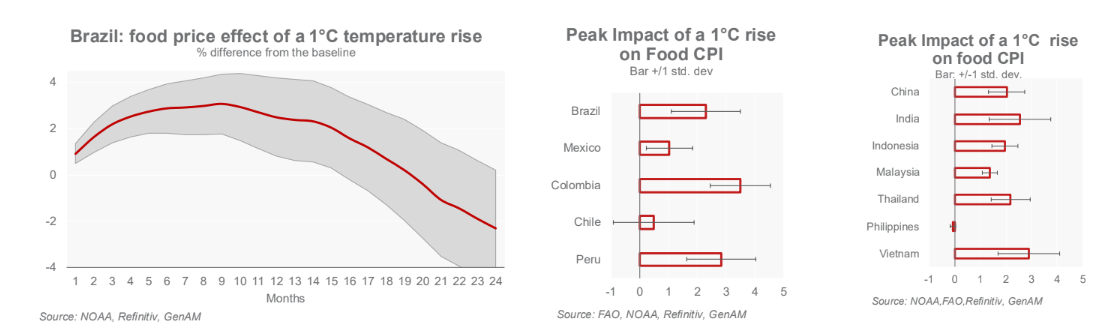
We estimate that the impact on DM headline inflation would be around 0.4pp, peaking by Q2 2028 and fading by Q4. The muted effect, despite the size of the assumed global food-price shock, reflects limited pass-through to domestic consumer food prices, the relatively low weight of food in DM CPI baskets, and the fact that European and North American agricultural production should not be meaningfully affected by El Niño. That on EMs would be larger and more differentiated. We gauge, using the nonlinear specification employed for commodity prices, the impact on domestic food prices for several EMs. As the charts below show, there is significant heterogeneity across countries, depending on the composition of the food basket and where food is sourced. EM foodprice inflation could be lifted by up to 7pp, with the peak effect occurring earlier than for global prices, roughly after 6 to 8 months after the temperature peak.
Combining the sensitivity of food prices to sea temperatures with the weight of food in CPI, Asian countries such as Thailand and India appear particularly vulnerable because food has a large share in the overall index, while Brazil and Colombia look exposed mainly through the high estimated price response. The earlier impact on EM prices has several causes. The initial weather shock directly reduces agricultural output in affected countries, leading to local shortages and higher domestic food inflation within a few months
Global commodity markets, by contrast, are initially cushioned by inventories, existing trade flows and alternative sources of supply. Only after stocks begin to decline and exportable surpluses are reduced does the shock become more visible in international prices. Several globally traded commodities (e.g. palm oil, coffee and sugar) also have long biological production lags; the largest supply losses then often materialise in subsequent harvest cycles rather than immediately after the weather event.
The stronger response of global food prices reflects the fact that international agricultural markets are determined by marginal export supplies rather than total production. El Niño tends to affect a small number of countries that account for an outsized share of global exports of key commodities such as rice, palm oil, sugar and coffee. Consequently, a moderate decline in production can translate into a much larger reduction in internationally traded volumes. Since only a fraction of global agricultural output is traded across borders, relatively small supply disruptions can generate disproportionate increases in world prices. By contrast, domestic food-price indices are more diversified, reflecting a broad basket of food products, many of which are only indirectly affected by El Niño, thereby diluting the overall inflationary impact.
EMs vulnerability to El Niño
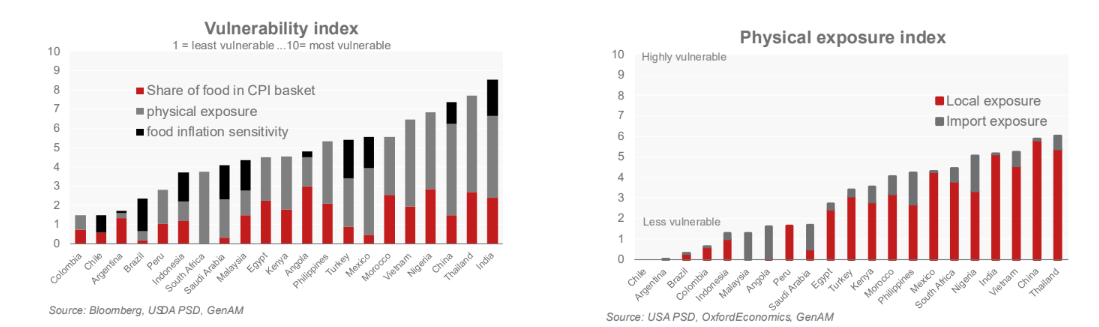
A country´s vulnerabilty depends both on its physical exposure to El Niño and on the weight of food in its consumption basket. We built an EM vulnerability index for 20 countries, adapting a methodology developed by Oxford Economics, mapping the effects by EM country and by crop to our sample. The index combines physical exposure through domestic crops and food imports, the weight of food in local CPI baskets, and the sensitivity of domestic food prices estimated in the previous section.
On physical exposure, the literature3 shows that, on average, El Niño tends especially strongly to weigh on maize, rice and wheat yields, and less so on soybeans. The effect can be negligible for crops raised in areas far from the Pacific Ocean such as wheat in Russia and Ukraine, but materially negative elsewhere, as in Australia. Domestic production is not the only relevant channel; the origin of food imports also matters. Mexico, for instance, is a large consumer of maize, but almost all its imports come from the US, where El Niño´s impact is broadly neutral.
For each country, we focus on the four main grain crops: rice, wheat, maize and soybeans. For each grain, we estimate at the country level one equation capturing the domestic effect of El Niño on crops and another measuring exposure through import sources.
Asian countries stand out because of their geographic proximity to the Pacific and sizeable production of rice crops. African countries are also among the most vulnerable because of their limited grain production, resulting in large imports from regions potentially heavily affected by El Niño. LatAm economies appear relatively more insulated, both domestically and through import sources, with Mexico the main exception, given the direct exposure of domestic production.
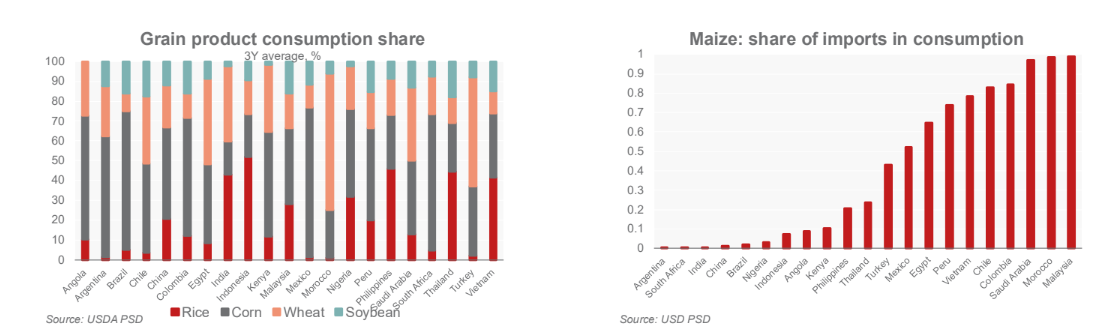
EM countries are generally rather sensitive to food-price shocks through CPI baskets, as food accounts for a large share of household spending. The pass-through from El Niño to headline inflation can therefore be mechanically larger than in DM economies. South Asian countries stand out, with Thailand´s food share in CPI close to 40 %. African countries such as Angola and Morocco are also highly exposed, while LatAm economies are relatively more insulated. In several countries, subsidies can partly cushion the inflationary effect, although potentially at a meaningful cost to fiscal balances.
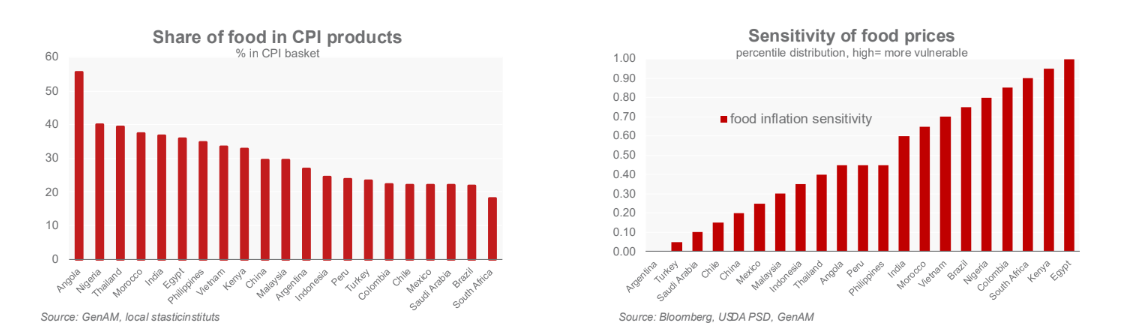
We also measure the sensitivity of local food prices to El Niño. The impact on global food prices is meaningful but delayed, while the first-round effects are often more localised and crop-specific. We use the results of the previous section´s econometric analysis and rank countries based on the highest impact of El Niño on local food prices through time. Sub-Saharan countries are the most vulnerable, given their heavy reliance on impacted, followed by Kenya and South Africa. South-East Asian countries appear less vulnerable.
Summing up, large Asian countries such as China, India and Thailand look particularly exposed through a combination of physical exposure and high food weights in CPI, while Nigeria stands out in Africa. Latin America is relatively more insulated, with Mexico the main exception because of the geographical exposure of its domestic production. The full impact on food prices depends largely on the timing of the temperature rise, with the highest impact when it peaks just before the harvest. Under the assumption used above, with Pacific Ocean temperature up by 2°C by year-end, EM domestic food prices could rise by as much as 7pp around the end of Q2 2027. Depending on the share of food in the consumption basket and given the larger incidence of domestic over global products, the hit to headline CPI could reach 3pp before waning within a few months.
EMs investment implications: a risk to monitor, not a thesis changer
El Niño´s effects vary significantly across countries, and so do the investment implications. In general, central banks tend to look through first-round food-price effects, but they may respond if the shock proves persistent or is amplified by other factors, such as FX moves, energy prices, or the fiscal stance. The current EM backdrop combines resilient activity with higher inflationary pressure linked to the Iran conflict. EM central banks have generally turned more cautious, although policy paths differ. Some are still cutting rates, including Brazil, Hungary and Poland, while others have turned more cautious and are in no rush to ease despite a more hawkish bias, including South Africa, India, Indonesia, Colombia and Turkey. Global policy rate expectations have gradually repriced higher, creating a risk that the most vulnerable countries face additional tightening pressure at the margin. The inflationary impulse from El Niño should not be immediate: it is likely to build gradually from late 2026, depending on the crop and region, with the full effect likely to be felt in H1 2027. The policy response will also depend on energy-price dynamics at that time. The fiscal response is even harder to gauge. Governments may introduce temporary subsidies, or contained and targeted measures, if food prices rise too sharply, particularly in countries where food accounts for the largest share of the CPI basket and in poorer economies. History suggests that the fiscal cost is usually small and temporary. The response to catastrophic events such as floods is more difficult to assess, as these are tail- risk events. For instance, severe floods in southern Brazil in 2023 triggered large-scale support amounting to 0.9% of GDP.
Overall, El Niño, given its temporary nature, does not alter our positive view on EM fixed income, which rests on structural macroeconomic improvements, better credit ratings and supportive technicals. For local debt, the risk is concentrated at the front end of the curve, where delayed easing would matter most. The belly and long end should be less affected unless the shock triggers a more persistent fiscal deterioration. We would avoid high-yielding countries with weak ratings and high vulnerability scores, such as Angola and Nigeria, as well as vulnerable countries outside our index, including Pakistan
and Sri Lanka.
For external debt, El Niño risk is difficult to express at the global index level and spread direction will remain driven mainly by global factors. The effect should be more limited because fiscal risk is localised and temporary, except in tail-risk events like catastrophic floods. Based on our vulnerability index, Asian countries are more exposed, but their solid IG status, relatively sound fiscal positions and access to external debt markets should limit spread underperformance. As with local debt, sub-Saharan African countries such as Nigeria, Kenya and Angola have weaker market access and so are more vulnerable to a deterioration of their fiscal outlook, even if it is temporary. Other Latin American countries, such as Ecuador and El Salvador, are also at risk. They have weak ratings with limited market access, and past El Niño episodes showed their vulnerability.