Users Flee as OpenClaw Stumbles Through Its Most Difficult Week Ever



Set Trending Topics as a preferred source on Google.
The open-source project OpenClaw is going through one of its most difficult phases since its founding. In an open statement, project founder Peter Steinberger acknowledges that recent releases have caused significant problems – and announces far-reaching structural changes. Particularly sensitive: the incident coincides with a phase in which Steinberger himself has moved to OpenAI and the project is increasingly being transitioned from a single person to a broader team.
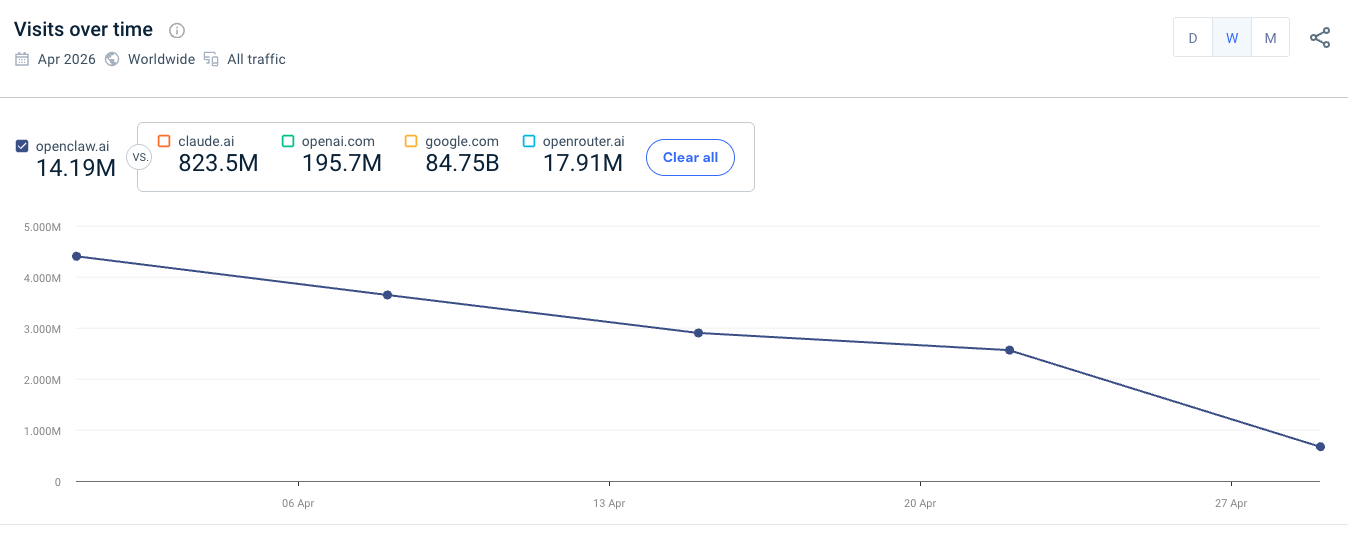
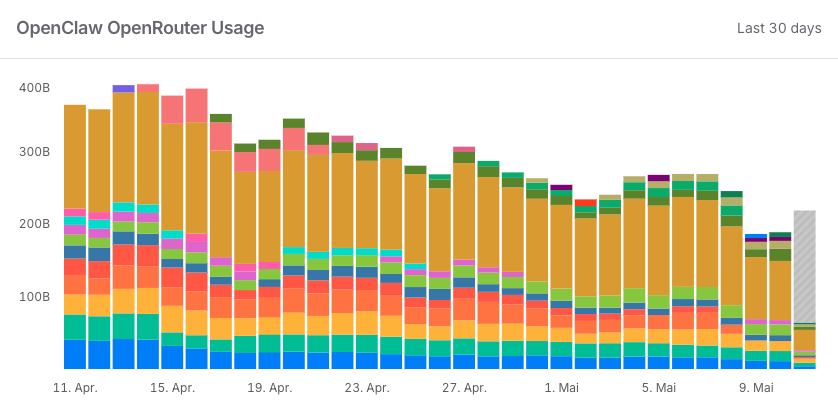
At the same time, user interest in OpenClaw is clearly declining. Currently, one can see via OpenRouter or SimilarWeb that usage of OpenClaw is dropping noticeably. OpenRouter tracks which AI models are used in combination with OpenClaw, while SimilarWeb measures usage of the website itself. Here are the charts showing the declining numbers over the past 30 days:
As has been reported in detail on multiple occasions, OpenClaw has captured the entire AI world. There are already numerous similar products and services from many other AI companies and large tech companies that promise similar functionality (more on that here).
What Happened
At the same time, it has become clear that there are also major challenges on the technical side. From April 24, 2026 onwards, problems with OpenClaw installations began to accumulate. By April 29, it was clear that these were not isolated cases. Among those affected were:
- slowed gateways,
- installations stuck in plugin dependency repair loops,
- malfunctions in connected channels such as Discord, Telegram, and WhatsApp.
Many users found themselves forced to roll back to older versions – with the corresponding time investment. According to Steinberger, this is not a single bug but a combination of several factors: the plugin dependency repair ran in both startup and update paths, bundled and external plugins were only partially separated, the artifact metadata of the new ClawHub was still in a stabilization phase, and too much work was being done in the gateway cold paths.
The Background: Restructuring into Infrastructure Software
The problems are not coincidental but rather the result of a strategic restructuring. OpenClaw is meant to become smaller, more secure, and more suitable for infrastructure use – moving away from a developer-driven playground toward software on which productive setups can reliably build. Concretely, this means: less magic in the core, fewer bundled dependencies, clearer plugin boundaries, and an improved security posture.
A key driver of this realignment is the recent supply chain incidents in the npm ecosystem. OpenClaw itself was not directly affected by the Axios incident, but the actual risk lies in the shape of the dependency graph: transitive packages, install-time behavior, postinstall scripts, and deeply nested dependency chains.
In response, channels, providers, heavy tools, parsers, and optional integrations have been gradually extracted from the core and moved to the new ClawHub (clawhub.ai). A public plugin inventory list documents what remains in the core, what is installed separately, and what is only available via source checkout.
Steinberger openly admits to having underestimated the effort involved in this restructuring. Across several releases, OpenClaw ended up in an unfavorable intermediate state: too much had already been shifted toward the plugin architecture, while at the same time too many plugins continued to be bundled, repaired, staged, or loaded – precisely at the points that users notice immediately.
Structural Problem: Too Much Depended on One Person
The crisis also exposes an operational problem that gains significance with Steinberger’s move to OpenAI: OpenClaw was previously too founder-driven. Releases, code reviews, packaging, and support were concentrated on Steinberger himself – a structure that is no longer compatible with the project’s growing professional ambitions.
Through the newly founded OpenClaw Foundation and with support from OpenAI, a real team is now to be built around the project. Adjustments to the release process are also planned, as well as the imminent announcement of an LTS (Long-Term Support) version running in parallel with the faster update cycles. Details are expected to follow in May.