$65bn vs $40bn: How Anthropic Overtook OpenAI on Revenue

Set Trending Topics as a preferred source on Google.
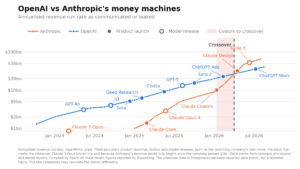
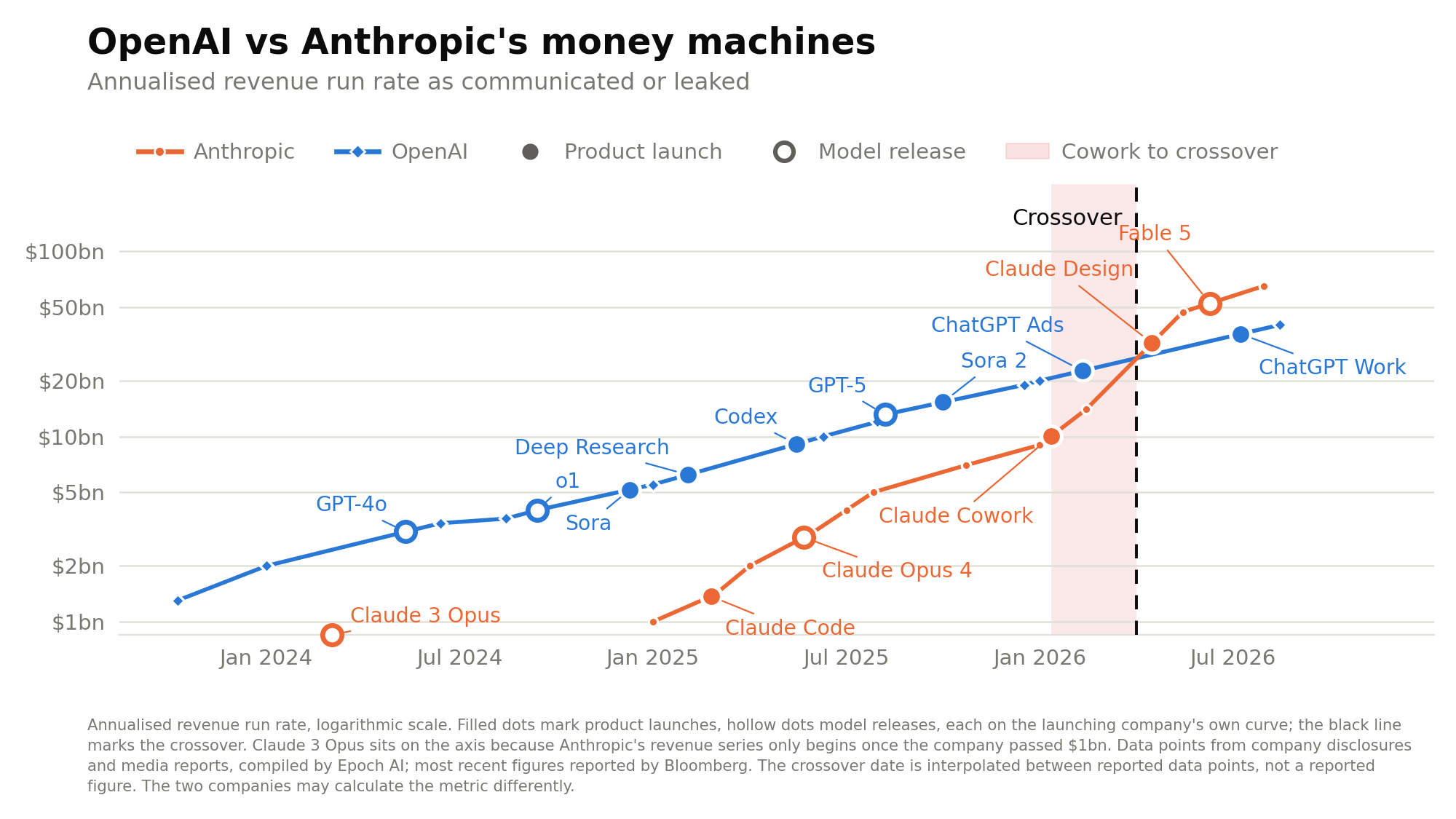
In the race between two of the largest Western AI providers, the balance of revenue has shifted. Anthropic is at an annualised revenue run rate of more than $65 billion, according to a Bloomberg report published just now — reached at the end of July and disclosed as part of a routine investor update. OpenAI stands at a run rate of more than $40 billion, according to Bloomberg information from last Thursday. Both figures come from people who asked not to be named, and both companies are preparing to go public.
Some context: a run rate is not an audited revenue figure but an extrapolation. It takes the earnings of a short period — usually a single month — and projects them across a full year. In fast-growing markets, that flatters the books considerably. Bloomberg also points out explicitly that Anthropic and OpenAI may calculate the metric using different methodologies. Comparing the absolute numbers therefore calls for caution — what carries real meaning is the slope of the curve.
The constellation is also delicate for personal reasons. Anthropic was founded by people who previously worked at OpenAI: Dario Amodei was its head of research, his sister Daniela Amodei ran operations. Among those who left with them were Tom Brown, who had led the development of GPT-3, along with Jared Kaplan, Sam McCandlish, Chris Olah, Ben Mann and Jack Clark. The break was triggered by differences over the company’s direction following Microsoft’s investment and over how to handle safety questions. What now reads as a contest between two corporations is at heart a dispute between two camps that once sat at the same table.
And the slope of the curve tells a story that has less to do with model quality than with the question of whom you sell an agentic product to first.
Anthropic: agents for developers who pay
Claude Code arrived in early 2025 as a research preview — at a point when Anthropic was running at roughly $1.4 billion. The product was not a chatbot with a code window but an agent that works through tasks autonomously in the terminal. The target group was narrow, technical and able to pay.
Developers are the first professional group for which the benefit of an agent can be expressed as a number: tickets closed, hours saved, and so on. Anyone who can measure that does not buy a subscription but seats for an entire team — and does not ask about the price as long as the maths works out. Anthropic thereby occupied the application layer, rather than selling models through the API and leaving the rest to others.
Cowork is Claude Code for non-programmers
The second step was to transfer the same recipe to everyone who does not write code. Claude Cowork launched in early 2026 and does with files, research and analysis what Claude Code does with repositories. Two weeks later, Anthropic followed up with eleven open-source plugins, each tailored to a professional function — sales, finance, legal, marketing, data analysis, customer support. This is how Anthropic described Claude Cowork at launch:
“Claude Code is a CLI-based tool designed primarily for developers, running in your terminal with full coding capabilities. Cowork brings the same agentic architecture to a graphical interface for non-technical users. Think of Cowork as ‘Claude Code for the rest of your work’ — same autonomous power, but accessible without command-line knowledge.”
The market’s reaction was drastic. Within a few trading days, software stocks lost roughly $285 billion in market capitalisation, and the S&P index for North American software fell 15 percent in January — its weakest month since 2008. Thomson Reuters dropped by double digits, Figma was down as much as 40 percent year-to-date. A strategist at the investment bank Jefferies coined the term “SaaSpocalypse” for it, which has shaped the entire debate about the future of subscription software ever since. Between the Cowork launch and the low point at the end of February, the S&P Software & Services Index lost a quarter of its value.
The fear behind it is a pricing question: when an agent takes over tasks that previously required a seat in a specialist application, value shifts from the tool to the outcome. Claude Design for creative work followed shortly afterwards — Figma lost seven percent on the day of the launch. In the revenue curve, this phase is the steepest stretch: roughly three months lie between the Cowork launch and the moment Anthropic passed OpenAI.
OpenAI: the consumer strategy as an expensive trap
OpenAI took the opposite route. After GPT-4o brought multimodality into the free tier, the focus was on reach in the consumer market. Sora arrived at the end of 2024 as a public video product, the dedicated Sora app in autumn 2025 — conceived as an AI version of TikTok, complete with a vertical feed and the option to scan your own face.
Success failed to materialise. According to a Wall Street Journal investigation, the user count peaked at around one million worldwide and then halved. Video generation for private users is a business with high variable costs and low willingness to pay — and the compute was needed elsewhere. In spring, OpenAI drew the consequence and shut Sora down: the app and web access were switched off, with the API to follow in autumn. The shutdown also ended a billion-dollar agreement with Disney. The freed-up compute has since been flowing into coding and enterprise products.
The second attempt at turning reach into money was advertising. The ad pilot started in winter, and the minimum budget was dropped in spring. Bloomberg now counts the build-out of the advertising business among the growth drivers — but as one of several, and advertising revenue per user naturally moves in a different order of magnitude than an enterprise seat.
The pivot into the business segment is correspondingly clear. Codex came four months after Claude Code, ChatGPT Work only this summer. Board chair Bret Taylor has acknowledged internally that the company had been playing catch-up in the coding market. And CFO Sarah Friar today names exactly three products as revenue drivers: the GPT-5.6 model series, ChatGPT Work and Codex. Consumer products are not among them.
The price of catching up
The doubling of OpenAI’s run rate since the end of last year is a strong figure in its own right. The comparison still comes out lopsided, because it ignores the cost side: in the 2025 full year, actual revenue of $13.07 billion stood against a net loss of $38.5 billion. Comparable audited figures from Anthropic are not currently available, but here too the losses must run into the billions.
In parallel, a new pecking order is taking shape. Anthropic’s IPO could happen at a valuation of a hefty $2 trillion, which would put even SpaceX in the shade. Meanwhile, it is an open question whether OpenAI will dare to go public in 2026 at all.