Green Light for America’s First Small Modular Reactor


Set Trending Topics as a preferred source on Google.
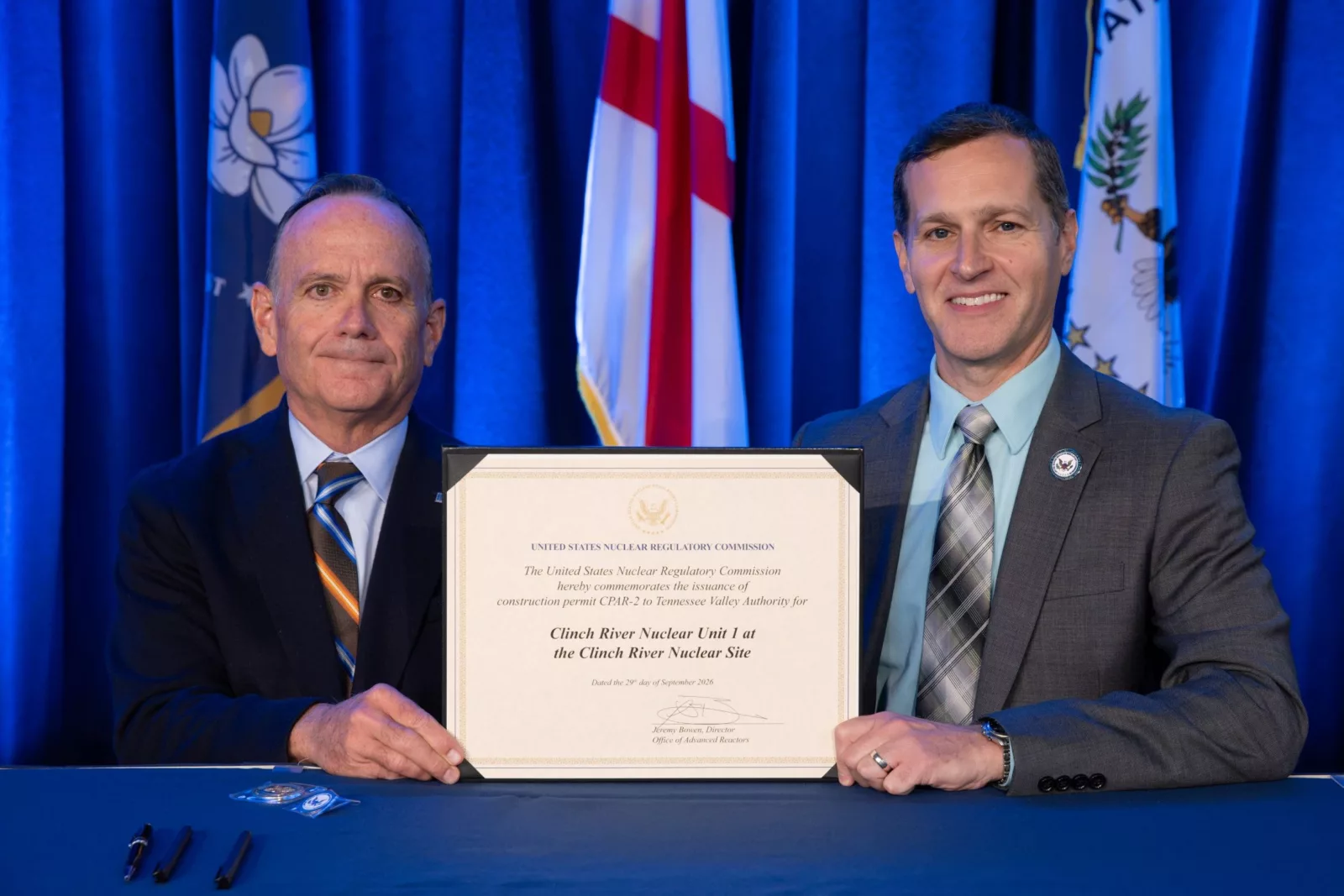
The United States is getting its first commercial small nuclear reactor, at least on paper. The Nuclear Regulatory Commission has just granted the Tennessee Valley Authority (TVA), the federally owned utility, a construction permit for a small modular reactor (SMR) at its Clinch River site in Oak Ridge, Tenn. The review took 14 months, four months less than planned. “Four months ahead of schedule is what the new NRC looks like,” said Ho K. Nieh, the NRC chairman. It is the agency’s second major reactor approval this year: in March, it cleared construction of TerraPower’s Natrium reactor in Wyoming.
What the Reactor Can Do
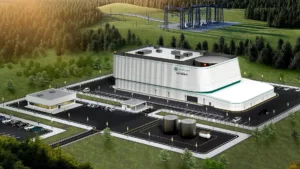
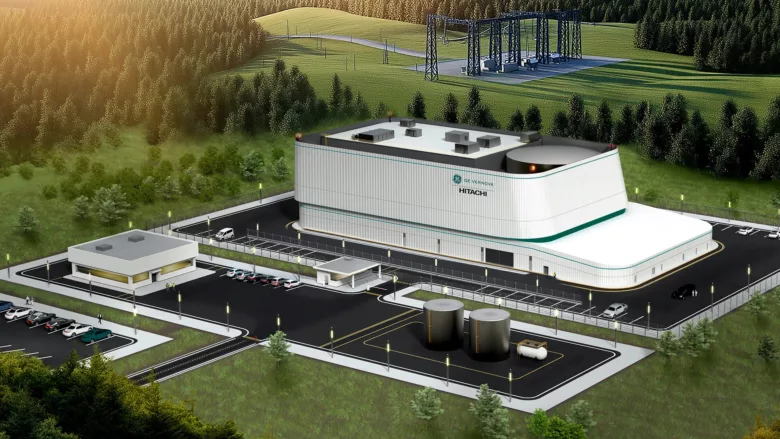
The plant will be a BWRX-300 from GE Vernova Hitachi Nuclear Energy, a joint venture of the U.S. company GE Vernova and Japan’s Hitachi. It is the first permit for this reactor type in the United States. The key specifications, according to GE Vernova:
- Output: 300 megawatts, enough for about 300,000 homes.
- Technology: A simplified version of the boiling-water reactor, a design proven over decades. In an emergency, it is meant to cool itself passively, without pumps or operator action.
- Footprint: According to the manufacturer, the plant fits on an area of about two soccer fields.
- Construction time: 24 to 36 months from first concrete to fuel loading, though only for later series-built units.
The construction permit does not yet allow the reactor to operate; TVA will need a separate operating license for that. TVA has not yet announced a construction start date, according to the Washington Examiner, and is aiming for commercial operation in the early 2030s. “This construction permit is more than a regulatory achievement — it’s foundational for America’s nuclear future,” said Mike Skaggs, TVA’s interim chief executive.
Who Is Behind It
TVA is a federally owned utility that supplies power to seven U.S. states. The U.S. Department of Energy is supporting the project with $400 million (about 342 million euros). The standard design is being developed jointly by GE Vernova Hitachi, TVA, the Canadian utility Ontario Power Generation (OPG) and the Polish company Synthos Green Energy. The engineering firms Bechtel and Sargent & Lundy are set to help with construction.
Canada shows what such a reactor costs: OPG is already building the world’s first BWRX-300 at its Darlington site. The first unit will cost 6.1 billion Canadian dollars (about 3.8 billion euros), and all four planned units together 20.9 billion (about 13 billion euros), according to World Nuclear News. It is expected to come online around 2030. TVA has not published an official cost estimate for Clinch River. Further BWRX-300s are planned in Poland and in Texas, where the company Blue Energy wants to pair the reactor with gas turbines.
Why SMRs Appeal to A.I. Data Centers
The timing is no coincidence. A.I. data centers are driving up electricity demand in the United States. According to a recent study by Lawrence Berkeley National Laboratory, data centers could consume around 12 percent of U.S. electricity by 2030, up from 4.4 percent in 2023. Demand is growing on TVA’s own grid, too: “We are projecting data center growth to double in our region by 2030,” Don Moul, TVA’s former chief executive, said earlier this year, according to Utility Dive. xAI’s Colossus supercomputer in Memphis is also located in TVA’s service area.
SMRs promise what data center operators are looking for: low-carbon power around the clock, smaller plants than conventional nuclear stations and, ideally, sites right next to the server halls. The big tech companies have already stocked up:
- Google: The company buys power from reactors built by the start-up Kairos Power. The Hermes 2 test reactor, also in Oak Ridge, is set to deliver up to 50 megawatts through TVA’s grid to two Google data centers.
- Amazon: The company invested in X-energy and plans to source more than 5 gigawatts from SMRs by 2039.
- Meta: Early this year, the company secured up to 6.6 gigawatts of nuclear power, including from TerraPower and Oklo.
- Microsoft: For the company, the shuttered Three Mile Island Unit 1 reactor is set to return to service as the Crane Clean Energy Center.
The Gas Boom Is Moving Faster
In the short term, however, the industry is betting mainly on gas, since new reactors will not deliver power for several years at the earliest. According to Global Energy Monitor, planned gas power capacity in the United States rose 50 percent in six months to 378 gigawatts. Half of that, 189 gigawatts, is intended for data centers. Manufacturers can barely keep up: GE Vernova has orders and reservations for 116 gigawatts of gas turbines on its books, according to its quarterly report, and Siemens Energy is booked out through 2028, according to S&P Global.
TVA itself is building new gas plants with a combined capacity of 3 gigawatts. For Meta’s Hyperion data center in Louisiana, the utility Entergy is building three gas plants totaling 2.26 gigawatts. How much of this will actually be built remains uncertain, however. According to Global Energy Monitor, historically only 20 to 30 percent of proposed gas plants have been completed. And according to the U.S. Energy Information Administration (EIA), gas accounts for only 7 percent of the new generating capacity planned for 2026, with most of it coming from solar, battery storage and wind.
The Criticism: Too Expensive, Too Slow
SMRs remain controversial. The most prominent project to date, a NuScale plant in Utah, was cancelled in 2023 after the expected power price rose from $55 to $89 (about 76 euros) per megawatt-hour. “A key argument from SMR proponents is that the new reactors will be economically competitive, but the on-the-ground experience with the initial SMRs that have been built or that are currently under construction shows that this simply is not true,” said David Schlissel of the energy think tank IEEFA. The costs of Canada’s first BWRX-300 are well above what the manufacturer originally promised, according to the World Nuclear Industry Status Report.
Manufacturers are counting on costs falling with series production. “Fleet deployment is essential to scaling nuclear energy in the United States,” said Jason Cooper, chief executive of GE Vernova Hitachi. A standard design, he said, makes it possible to carry technology, licensing experience and supply chains from one project to the next.