Iran War Sends Chinese Battery Stocks Surging Past Oil Giants


Set Trending Topics as a preferred source on Google.
The conflict in the Middle East has shaken global energy markets — and at the same time triggered a remarkable shift: while oil prices rose by 47 percent, Chinese battery and energy storage technology companies recorded an even stronger surge in share prices. In other words: investors are increasingly betting on renewable energy (in this case, storage for it) as a long-term response to geopolitical uncertainty.
Battery giants outpace oil majors on the stock exchange
Since the US-Israeli strikes on Iran at the end of February, China’s leading battery manufacturers have collectively added more than 70 billion US dollars in market capitalisation. Share price performance has been markedly more dynamic than that of the major oil companies, which, while benefiting from rising commodity prices, are lagging behind the energy transition stocks.
| Company | Sector | Price performance since the start of the war |
|---|---|---|
| BYD | Batteries / Electric vehicles | +21.9% |
| Sungrow | Energy storage | +19.4% |
| CATL | Batteries | +19.0% |
| BP | Oil and gas | +15.2% |
| Shell | Oil and gas | +8.3% |
| Chevron | Oil and gas | +8.0% |
| ExxonMobil | Oil and gas | +4.7% |
Analysts do not view this as a short-term phenomenon. However, the trend is not visible across all areas of renewable energy. Solar and wind energy companies, for instance, have so far been unable to benefit from the oil crisis.
Energy security as a driver of demand
The war has abruptly exposed the structural vulnerability of fossil fuel supply chains. Attacks on liquefied natural gas infrastructure in the Persian Gulf are hitting East Asia particularly hard, as it is heavily dependent on imported LNG.
Japan, South Korea, and Taiwan, alongside China, are considered potential primary beneficiaries of an accelerated energy transition. The pressure to break free from fossil fuel imports is likely to significantly increase investment in battery storage, electric mobility, and renewable energy across the entire region.
According to the research institute Mobility Foresights, the Chinese market for grid-connected battery storage is set to grow from 48 billion US dollars in 2024 to 199 billion US dollars by 2032. In 2025 alone, sales of storage batteries in China increased by more than 100 percent.
CATL: market leader with ambitions beyond the battery
CATL, the world’s largest battery manufacturer, is at the centre of this development. The company achieved a net profit of 72.2 billion CNY in fiscal year 2025 and, together with BYD, holds around 65 percent of the Chinese domestic market. Yet the Ningde-based group is not content with the role of component supplier.
New alliance with the Transfar Group
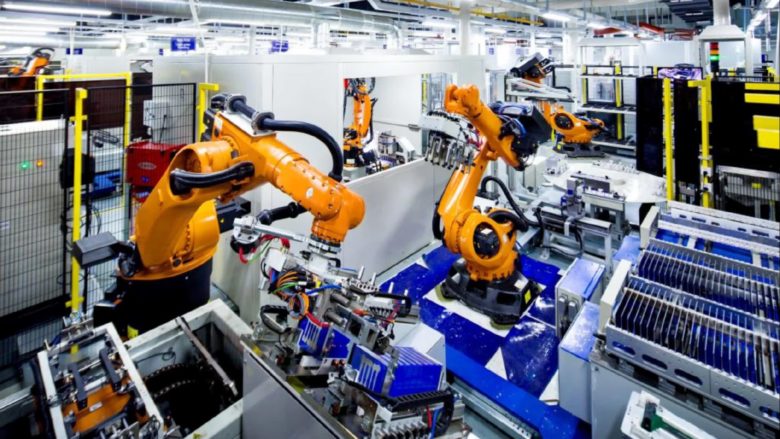
Through a strategic partnership with the Transfar Group, CATL is significantly expanding its business model. The cooperation covers three core areas: securing critical battery material supply chains, developing zero-emission solutions for energy storage and transport logistics, and integrating intelligent robots into new energy facilities. Initial pilot projects will launch in Hangzhou before an expansion to Zhejiang Province and the national market is to follow.
Market observers regard this move as a consistent response to the growing importance of flexible energy storage as core infrastructure for data centres and power grids. CATL is thereby positioning itself early for global demand for integrated energy and automation systems. The strategy is also in line with China’s 15th Five-Year Plan.
Solid-state batteries as the next technological leap
Alongside its market expansion, CATL is advancing the development of the next battery generation. A patent published in March 2026 by the World Intellectual Property Organization (WIPO) shows that the company is focusing on sulphide-based solid-state electrolytes. The targeted energy density is 500 Wh/kg, representing a significant increase over today’s lithium-ion cells.
According to industry reports, CATL is currently at Technology Readiness Level 4 and is aiming for levels 7 or 8 by 2027. This corresponds to the transition from laboratory prototypes to series-ready cells of automotive quality. A near-term goal is the step from 20 Ah samples to 60 Ah prototypes. To secure the subsequent production ramp-up, CATL has already reserved copper foil capacities worth around 8.4 billion euros from supplier Guangdong Jiayuan Technology for the period 2026 to 2028.
The cost question remains open: sulphide solid-state cells are currently three to five times more expensive than conventional lithium-ion cells. In October 2025, CATL acknowledged that, despite fundamental scientific problems having been resolved, technical hurdles still remain.
China’s coordinated industrial strategy
CATL is not acting alone in this. Under the state-initiated consortium China All-Solid-State Battery Collaborative Innovation Platform (CASIP), leading Chinese battery and automotive manufacturers have joined forces to jointly advance the commercialisation of solid-state batteries. The goal is to build a competitive supply chain by 2030.
- Participating battery manufacturers: CATL, CALB, EVE Energy, SVOLT, Gotion High-Tech, FinDreams Battery (BYD)
- Participating automotive manufacturers: several state-owned groups as well as BYD and Nio
- Further stakeholders: representatives from government, academia, and state-backed investment funds
China is determined not to let its market-leading position in electric vehicle batteries be jeopardised by the technological leap to solid-state batteries. The coordinated alliance of competitors demonstrates how seriously Beijing is taking this challenge.