Sign In With ChatGPT: Take Your A.I. Tokens to Other Apps


Set Trending Topics as a preferred source on Google.
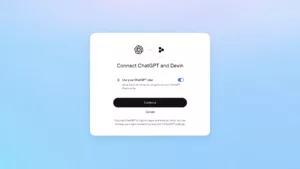
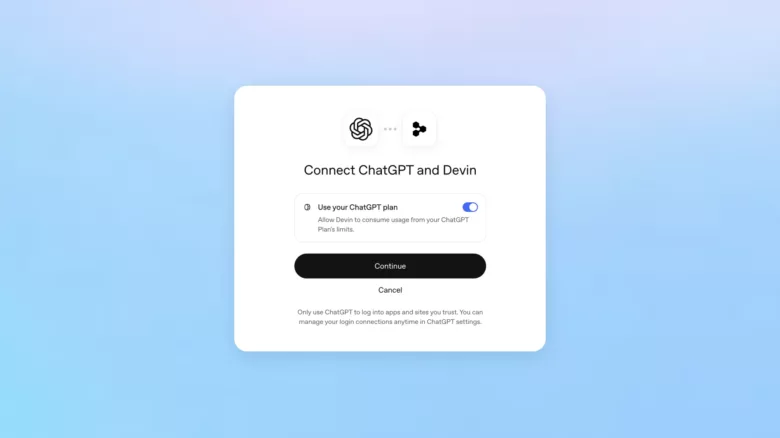
After Google, Apple and Facebook, OpenAI now wants to stand at the front door of other companies’ apps. With “Sign in with ChatGPT,” users can log in to other services with their ChatGPT account and, if they choose, bring their ChatGPT subscription along. Sam Altman showcased the feature on Tuesday at OpenAI’s DevDay developer conference in San Francisco, where the company had also introduced its new A.I. agents called dots. “I’ve wanted this one for years!” Mr. Altman said, as the developer Simon Willison noted in his live blog.
Who Is In
The feature itself is not brand-new. As OpenAI’s release notes show, the login launched in beta in July with Airtable, GitLab, HubSpot, Notion, Supabase and Vercel, and opened to all users two weeks ago. What is new at DevDay is mainly the second part: apps can now also draw on the usage allowance of a ChatGPT subscription. OpenAI named 16 launch partners for this, most of them A.I. coding tools. The New Stack lists Cognition’s Devin, Warp, Amp, Kilo Code, OpenCode, OpenClaw, T3, Notion and Vercel among them, with Lovable to follow soon. “We’re starting with these 16 launch partners today, and we’ll expand quickly,” OpenAI said.
Who Is Missing
The partner list is notable for who is absent: the big rivals. Grok from Elon Musk’s SpaceXAI, Anthropic’s Claude and Google’s services, from Gmail to Gemini, do not offer a ChatGPT login. That is hardly surprising, since they compete directly with OpenAI for the same subscribers. Mr. Musk has also been feuding with OpenAI for years and recently redirected the domain dot.com to his own agent, Grok Bot.
Anthropic has even taken the opposite approach with its own subscriptions. This year, the company explicitly barred third-party tools such as OpenClaw from using Claude subscriptions. “These tools put an outsized strain on our systems,” Anthropic told TechRadar. OpenClaw is now a launch partner of OpenAI, where its creator, Peter Steinberger, now works. Google likewise offers no official way to use Gemini subscriptions in outside apps, as developers have complained on a Google forum.
Who Gets Which Data
For a plain login, apps receive only a user’s name, email address and profile picture, according to OpenAI. Chat histories, memories, files, and billing and account data are not shared. Technically, OpenAI relies on the common standards OAuth 2.0 and OpenID Connect, which Google and Apple also use.
OpenAI, in turn, learns quite a bit. At login, the company processes account IDs, email addresses, app details, IP addresses, device identifiers and security signals, among other things, which it says are used for authentication and fraud prevention. That tells OpenAI which services its users rely on outside ChatGPT. This kind of knowledge is also what makes the Google and Facebook logins so valuable to their operators.
How to Take Your Subscription Along
The truly new part is called “Use your ChatGPT plan.” ChatGPT Plus and Pro subscribers can flip a switch to let an app bill A.I. requests to their own plan, instead of signing up for a second subscription there or entering their own API key. Usage is deducted from the existing allowance for ChatGPT Work and Codex, and connecting an app adds no extra volume. Users can set a separate limit for each app.
Once the allowance runs out, usage stops rather than switching automatically to the app’s own billing. Anyone who wants more has to buy extra credits and agree to that separately. The apps may still charge for their own services. In Business and Enterprise workspaces, an admin has to approve first. Plan sharing is currently open to open-source projects, locally running apps and selected partners, while commercial providers can join through a waitlist.
Who Wins and Who Loses
For developers and start-ups, the offer is tempting: they no longer have to cover the high computing costs of A.I. models themselves, because users bring those costs along through their ChatGPT subscriptions. Users, at best, can avoid paying for several A.I. subscriptions in parallel.
The biggest winner, however, is OpenAI itself. The ChatGPT account becomes a master key, and the ChatGPT subscription becomes a central A.I. budget that other apps draw from. The newsletter Latent Space sees it as an attempt to own companies’ A.I. budgets. Apple and Google show how powerful such logins can be: “Sign in with Google” and “Sign in with Apple” are used on countless websites and apps and anchor both companies deeply in their users’ daily lives, because switching accounts would then also affect access to many other services. OpenAI now wants to harness the same effect. TechCrunch also sees the feature as another way to reach customers outside Apple’s and Google’s app stores.
There is a catch for developers, too: relying on the ChatGPT login makes them dependent on OpenAI’s account system, rules and limits. For competitors, meanwhile, the feature is a direct attack on their own subscriptions.
An Idea That Has Been Around for a While
OpenAI has been working on the plan for a long time. As early as May 2025, TechCrunch reported on a web page where OpenAI gauged developers’ interest in logging in with a ChatGPT account. That same month, Plus and Pro subscribers could for the first time sign in to the coding tool Codex CLI with their ChatGPT account and use their subscription there. At its core, that was already the model OpenAI is now opening to outside apps. Since fall 2025, third-party apps have also run directly inside ChatGPT. The role models are older still: Facebook, Google and Apple turned their logins into a web standard over many years, most recently Apple with “Sign in with Apple” in 2019.