Austria’s University Cuts Could Hit A.I. Research and Start-Up Programs


Set Trending Topics as a preferred source on Google.
First the universities chipped in to fund Austria’s research pact, now the money they saved is being taken away for good. That is how Universities Austria (uniko), the umbrella group of the country’s public universities, reads the government’s new university budget. Last Saturday, the government settled on €16 billion for the years 2028 to 2030. By uniko’s calculations, the universities will have to cut spending by 10 to 15 percent, which could cost up to 6,800 jobs. This afternoon, students, researchers and rectors are taking to the streets: The Austrian Students’ Union (ÖH) and uniko have called for a mass demonstration outside TU Wien’s main building at Karlsplatz in Vienna.
The Research Pact Comes Back to Bite
Early this year, the government was still celebrating its new FTI pact for research, technology and innovation: €5.5 billion from 2027 to 2029, including more than €3 billion for basic research. At the time, the cabinet said it was of overriding importance for Austria to keep investing in the future.
The universities helped pay for it. In December, they agreed to give up part of their 2027 budget so the pact could go ahead, on the condition that the money go to the Austrian Science Fund (FWF), whose grants largely flow back to universities. Even then, uniko’s president, Brigitte Hütter, told the public broadcaster ORF that universities could not be expected to step in every time money ran short in the innovation sector.
That is exactly what uniko now fears. In its analysis of the budget decision, the group says the savings the universities made in the current period, both for budget consolidation and for the FTI pact, have now been deducted from their budget permanently, even though they had been promised, publicly, that this would not happen. According to uniko, the science minister, Eva-Maria Holzleitner of the Social Democrats, assured the universities that their €150 million contribution to the FTI pact would only be due for 2027. The finance minister, however, wants to turn it into a permanent subsidy from the universities, uniko says. The group is therefore asking whether universities will have to hand over a total of €450 million to non-university research institutions from 2028 to 2030.
New Costs Without New Money
Two items that were funded on top of the university budget in the current period are now supposed to come out of the €16 billion: the new IT:U university in Linz (€200 million) and the salaries of doctors at university hospitals (€270 million). For uniko, this amounts to a cut in nominal terms.
There is also no adjustment for inflation. The Austrian Institute of Economic Research (WIFO) expects prices to rise by about 10 percent over the three years, so the universities expect to save at least 10 percent and as much as 15 percent. With staff accounting for almost 70 percent of spending, employees will bear the brunt: Of the current 68,000 university staff, up to 6,800 positions would be affected. According to uniko, the effects will already be felt in 2027, because universities can no longer hire people or make investments that carry follow-up costs.
From Quantum Physics to Farm Vets
Uniko lists a long series of consequences it expects:
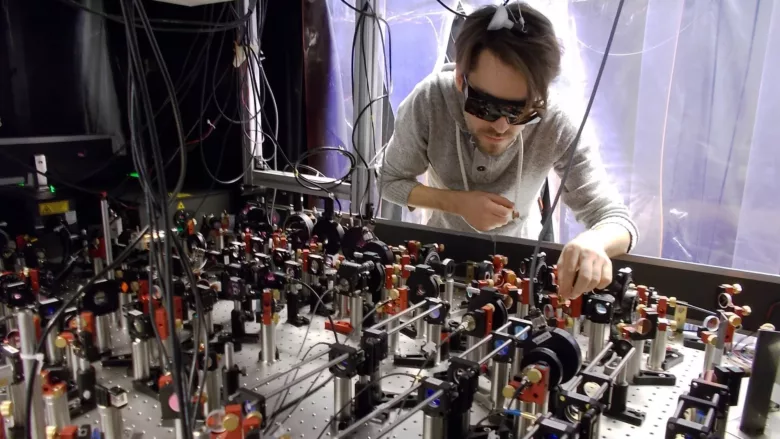
- Top research: Sought-after scientists in experimental and quantum physics cannot be hired as planned, and the first researchers from abroad have already turned down offers.
- Infrastructure: The new Center of Physics in Graz is under construction, but there is no money for modern research equipment, leaving a handsome building that will sit unused, uniko writes.
- E.U. funding: Without sufficient base funding, universities will be able to win less E.U. research money, and Austria’s clusters of excellence are coming under pressure.
- Start-ups: University start-up programs cannot be supported as planned.
- Skilled workers: A shortage of graduates looms for the government’s industrial strategy, but also among teachers and in orchestral and brass band music. The University of Veterinary Medicine Vienna will have to cut back on training for livestock vets.
- Studies: Degree programs will be closed, and student-to-staff ratios will get worse.
The debate over digital sovereignty will also become meaningless without enough young researchers and research opportunities, uniko warns. The senate of TU Wien made a similar case in a statement of its own: In A.I. systems and quantum technologies, TU Wien researchers are among the best in the world, the senate says. Without this research, Austria would be left to blindly use finished products from other countries. Almost an entire cohort of doctoral assistants could not be hired, and everyone in Austria would feel the consequences of this short-sighted policy within ten years at the latest, according to the senate. Like uniko, it is calling for €18 billion.
Government Says the Budget Is Stable
The government sees things differently. By its count, the current 2025 to 2027 period comes to €15.994 billion, compared with €16.003 billion for 2028 to 2030. The budget therefore remains stable in nominal terms and is €235 million higher than what was planned before the summer, it says. Ms. Holzleitner has described the funding as stable and pointed to the priority given to medical faculties. She says upcoming retirements, whose positions will not be refilled, along with more cooperation and less bureaucracy, should give universities room to maneuver. Once the federal budget is back in shape and the E.U.’s excessive deficit procedure against Austria has ended, more money will flow again, she has said. Chancellor Christian Stocker of the conservative People’s Party called the agreement an excellent solution and is demanding serious reforms from the universities.
Uniko wants that reform debate to take place within the ongoing higher education strategy process, and for the system as a whole: Rectors are responsible for their own institutions, but changes to the overall system are the minister’s job, the group says. The matter is not settled yet. The total amount has to be fixed by the end of October, and negotiations over the budgets of individual universities will then continue until the end of 2027.