Defense Tech Boom Pushes Defense Deals to a Record High


Set Trending Topics as a preferred source on Google.
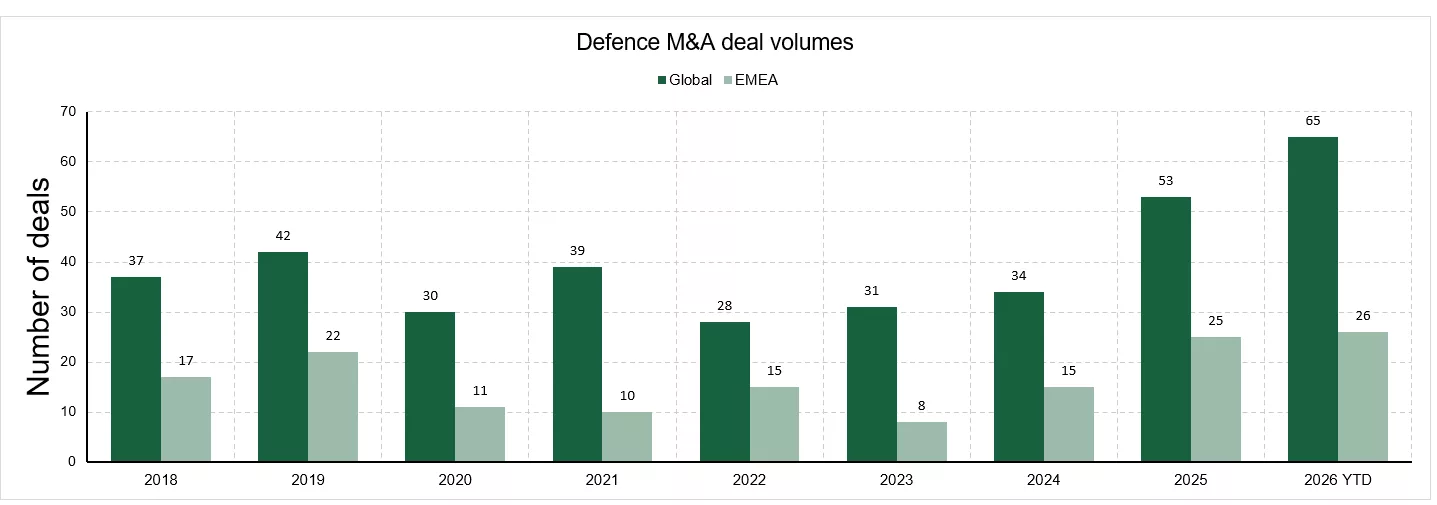
The defense tech boom has reached the M&A departments: Worldwide, 65 acquisitions and mergers in the defense sector were completed in the first nine months of the year, more than in all of last year and more than in any year since tracking began in 2018. That is according to data just released by the international law firm White & Case, compiled together with the data provider Mergermarket. Europe is catching up fast.
A Record Year After Just Nine Months
The 65 deals are about a quarter above the total for all of 2025 and 91 percent above the 34 deals in 2024. The value of the transactions reached $7 billion (about €6.2 billion), already matching the total for the whole of last year.
The third quarter was particularly active. Deal value rose sevenfold from a year earlier, from $0.6 billion to $4.2 billion (about €3.7 billion), while the number of deals grew 42 percent, from 12 to 17. That quarter alone accounts for 60 percent of the year’s value so far.
Europe Overtakes the U.S. in the Third Quarter
The biggest surprise comes from Europe, the Middle East and Africa (EMEA). The region recorded seven transactions worth $2.8 billion (about €2.5 billion) in the third quarter, twice as much as the United States, with $1.4 billion across six deals. That means EMEA’s third quarter alone was more than double its full-year total of $1.3 billion for last year.
Over the first nine months, the two regions are level on the number of deals, with 26 transactions each. By value, the United States is still slightly ahead at $3.6 billion, while EMEA reached $3.1 billion.
A current example from Austria shows how sought-after European defense suppliers are. The U.S. drone maker Red Cat wants to acquire the Upper Austrian specialty engine maker Steyr Motors for about €205 million (about $230 million), offering €39 a share in cash, almost 29 percent above the last closing price before the offer. Steyr Motors builds engines for military vehicles and ships as well as auxiliary power units for battle tanks; Red Cat is mainly interested in propulsion for uncrewed surface vessels. Production and development are to remain in Steyr. The deal is expected to close by mid-2027, pending approval by authorities in four countries.
“As military expenditure is set to soar, defence technology has become one of the most rapidly developing sectors for dealmaking and investment globally,” said Patrick Sarch, head of U.K. public M&A at White & Case. Companies are racing to acquire capabilities to develop new technologies and scale production, he said, while investors are competing for the most promising defense tech assets. Mr. Sarch attributed Europe’s jump to the push by Britain and the E.U. to build their own defense technology and reduce their reliance on other countries.
Billions for Defense Tech
The wave of acquisitions fits the investment boom in defense start-ups. The U.S. company Anduril is now worth $90 billion, and in Europe, the Portuguese drone maker Tekever was recently valued at €5.5 billion. According to an earlier White & Case survey, British defense companies and defense tech start-ups plan to invest £19.75 billion (about €23.5 billion) over the next 12 months, and 97 percent of them plan to raise significant external funding to do so.
“Private capital is looking for attractive opportunities in the sector,” said Michael Evans, a partner at White & Case. Investors want exposure to businesses benefiting from long-term growth that extends beyond current conflicts and even beyond defense itself, he said. The challenge for Britain and Europe now, he added, is to give their companies the research funding they need to compete globally.
The Flip Side of the Boom
Whether the high valuations will ultimately pay off remains open, however. According to an analysis by the venture capital firm Nexi based on Dealroom data, more than 85 percent of European defense tech capital in 2026 went into just seven funding rounds of more than $1 billion each. None of them has yet led to a sale. Because the defense sector has only a few large buyers, investors’ exit options are limited. In addition, 47 percent of the money for European defense start-ups came from U.S. investors.