DiLT Analytics: Graz Start-Up Raises Seven-Figure Sum to Find Faults in Buildings


Set Trending Topics as a preferred source on Google.
Leaky valves and ventilation systems running pointlessly at night cost building operators a lot of money every year without anyone noticing. The Graz-based Graz University of Technology spin-off DiLT Analytics tracks down exactly these kinds of faults with its software FaciliMind, and it has now closed a seven-figure funding round. The Vienna-based deep tech fund Noctua Science Ventures has joined as an investor, and the round is complemented by a grant from Austria Wirtschaftsservice (aws) under its Seedfinancing Deep Tech program.
A Deep Tech Fund and aws on Board
Noctua Science Ventures is a joint venture between Speedinvest and Austria’s technical universities and invests at the pre-seed stage in spin-offs whose products are based on years of research. Last year, it emerged that the energy company Verbund also plans to invest in the fund (in German). The aws grant requires a project to offer a clear technological leap over existing solutions.
“With Noctua Science Ventures, we have found a partner that understands both the technical challenges of a deep tech product and the path to commercialization,” said Theresa Kohl, DiLT’s chief executive. Philipp Stangl, managing director of Noctua, praised a “credible, technically differentiated approach” and a team that real estate professionals like working with.
One Device, a Few Days, Thousands of Data Points
Large buildings and campuses generate thousands of data points from their heating, ventilation and air-conditioning systems. Building management systems do flag when limits are exceeded, but many faults still go unnoticed in daily operations. Energy costs rise, systems perform worse over the years, and there is a lack of time and skilled staff for systematic checks.
FaciliMind is designed to close that gap. The software finds faults and optimization potential, identifies possible causes and gives the technical team a list of measures sorted by severity. Installation requires only a single device connected to the existing building management system. Thanks to a knowledge graph, the software builds the digital model of the systems largely automatically within a few days; with other solutions, according to DiLT, that takes months of manual work for hundreds of systems. Depending on the building, FaciliMind reveals potential energy savings of 5 to 30 percent.
Customers include Graz University of Technology, TU Wien, the federal real estate company Bundesimmobiliengesellschaft (BIG), IG Immobilien and several industrial companies. BIG sees “clear added value in operational use” in the automated fault detection.
From the Lecture Hall to a Start-Up Competition
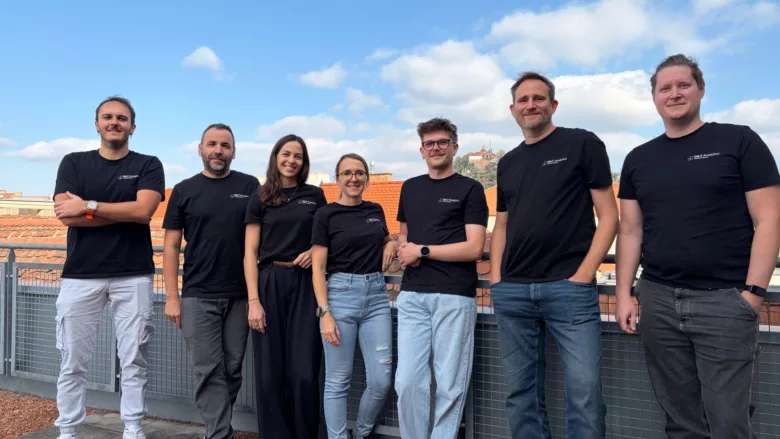
DiLT Analytics was founded at the end of 2021 by the professors Franz Wotawa and Gerald Schweiger as a spin-off of the Institute of Software Technology at Graz University of Technology. Through its research arm, DiLT Research, the start-up is involved in more than 20 research projects with over 15 partners. Today it is led by Theresa Kohl (chief executive), Christopher Gray (business development and strategy), Thomas Hirsch (chief technology officer), Reinhard Pertschy (chief product officer) and Thomas Schwengler (head of software).
DiLT is no stranger to Trending Topics. At the #glaubandich CHALLENGE 2025, organized by Erste Bank, Sparkasse and Trending Topics, the start-up won the city pitch (in German) in the Energy & Climate Protection category and made it to the final. In our podcast (in German), Ms. Kohl described how research at Graz University of Technology turned into a company. In 2025, DiLT went on to win the DREA Award and the ÖGUT Environmental Award, and since September it has also been ISO 27001 certified.
Competition From Cologne and Canada
DiLT is not alone with its idea. The Cologne-based start-up aedifion also offers a platform for optimizing building systems, and the Canadian company BrainBox AI, which uses A.I. to control heating and air-conditioning, was acquired by the U.S. climate technology group Trane Technologies. DiLT, by contrast, focuses on automated root-cause diagnosis and rapid setup for large, manufacturer-independent portfolios.
More Staff, More Systems
A large share of the new money will go into the team: DiLT is hiring in building services engineering and software development. At the same time, FaciliMind is to be rolled out to more operators of large portfolios in the German-speaking region, including the public sector, airports, industry, pharmaceuticals and health care. As its next feature, DiLT plans an estimate of the economic benefit of each measure so that asset managers can prioritize repairs in their budgets. The start-up also plans to release a translation tool for the building data standard BACtwin as open source.
In the long term, heat pumps, chillers, solar panels and battery storage are to be included in the diagnosis as well. “A building portfolio outlasts its service providers and often its most experienced employees,” Ms. Kohl said. The goal, she added, is for decisions to be based on verified data rather than gut feeling and memory.