Down-round for Groq: AI Chip Pioneer Turns Into an Inference Cloud – Valuation Cut in Half


Set Trending Topics as a preferred source on Google.
It is one of the most striking valuation drops of the current AI boom: Groq, for years seen as the most promising challenger to Nvidia in the market for AI inference chips, has raised fresh capital on markedly weaker terms. As Bloomberg has just reported, the company collected $350 million led by existing investor Disruptive – at a valuation of $3.5 billion. Last year, that figure still stood at $6.9 billion, off the back of a $750 million round.
The valuation has thus almost halved. Unlike most down rounds, however, what sits behind it is not a collapsing business but a restructuring with few parallels in the industry.
The Nvidia deal as a turning point
The starting point was an agreement struck last December: Groq entered into a non-exclusive licensing deal with Nvidia covering its inference technology. Founder and CEO Jonathan Ross, president Sunny Madra and further parts of the leadership team moved to Nvidia, while then-CFO Simon Edwards stepped up to the top job. According to reporting by CNBC, Nvidia paid roughly $20 billion in cash for Groq assets – the largest purchase in Nvidia’s history. Neither side has officially confirmed the sum. Analysts criticised the structure, arguing that it amounts to an acquisition in economic terms while formally not being one.
For existing investors, this was no write-off: they were paid out in cash through the Nvidia deal. As Axios reported in spring, those same backers were then invited to invest pro rata into what is effectively a new company – referred to internally as “Groq 2.0”. Disruptive and Infinitum committed to backstopping the targeted amount of up to $650 million themselves if needed.
That round was announced by Groq in June: $650 million in new growth capital, led by Disruptive and Infinitum, “with participation from investors who elected to reinvest in the company”. The company did not disclose a valuation at the time. How the $350 million cited by Bloomberg relates to that figure – whether it represents the share of genuinely new money, a tranche, or a separate round – remains unclear.
From chip designer to neocloud
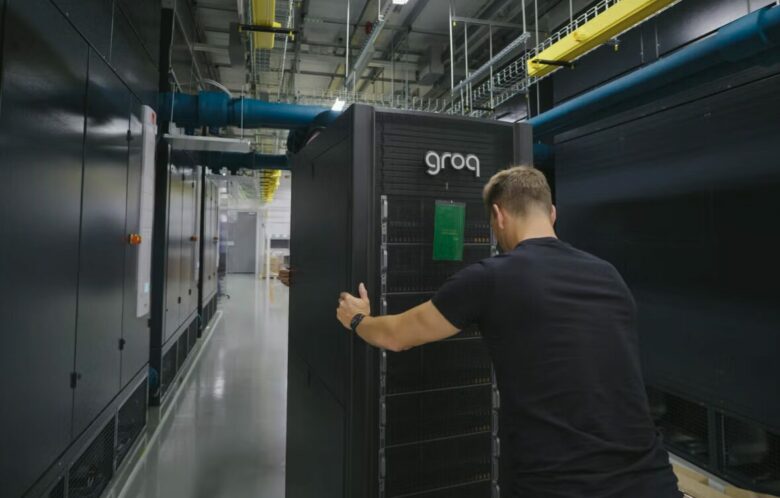
What remains of Groq is no longer a semiconductor company but a cloud operator. According to its own figures, it runs 13 data centres across North America, Europe, the Middle East and Asia-Pacific, serves more than five million developers and processes trillions of AI tokens each week. Capacity is set to grow to 200 megawatts by the end of 2027. Groq is present in Europe as well, among other things with a data centre in Helsinki; its earlier backers include a European investor in Deutsche Telekom Capital Partners.
What stands out is the reversal of roles vis-à-vis Nvidia: the LPX platform unveiled at GTC is built on the licensed Groq technology – and Groq now intends to install those very systems in its own data centres. The competitor has become a customer.
The company is now led by CEO Adam Winter, who joined Groq in 2024 and previously ran its international business, alongside CFO Matt Eng. Alan Rice serves as COO, having come from xAI and Meta’s data centre operations; they are joined by CTO Sinclair Schuller and chief product officer Rakesh Malhotra, who previously built Apprenda and Nuvalence together. The board is chaired by Alex Davis, founder and CEO of lead investor Disruptive.
Groq frames the strategic bet behind all this in confident terms: running models will over time require many times the compute needed to train them. Most existing AI clouds, the argument goes, are built for training, and no clear leader in inference has emerged yet. Whether Groq can fill that gap without the team that designed its own chip architecture is the central open question – and it is reflected in the new valuation.