How Uber Is Quietly Financing Its Future Delivery Rivals in 14 Markets


Set Trending Topics as a preferred source on Google.
A side deal is drawing attention in Uber’s multibillion-euro takeover of Delivery Hero. Delivery Hero is selling its operations in 14 countries, including Spain, Austria and Poland, separately to the U.S. investment firm SSW Partners rather than to Uber. One aim is to ease antitrust concerns that the acquisition could make Uber too powerful.
The catch: SSW’s purchase of the 14 country businesses is largely financed by Uber itself. That is according to documents Uber filed with the U.S. Securities and Exchange Commission (SEC).
As for the deal as a whole, Uber is offering 41.50 euros per Delivery Hero share in a voluntary public takeover offer. According to Uber’s investor presentation, that values Delivery Hero’s equity at 14.8 billion U.S. dollars. Uber already holds an economic stake of around 37 percent, and the deal is expected to close in the second half of 2027. At the same time, Uber is pushing ahead with a corporate restructuring that will cut 3,300 jobs.
At its core, the Uber and Delivery Hero deal is about further consolidation in food delivery. Besides Uber Eats and Delivery Hero, the main players are Just Eat Takeaway (majority-owned by Prosus and itself the product of a merger) and DoorDash (which owns Wolt and Deliveroo). If the Delivery Hero deal goes through, the four major players in the Western world will shrink to three.
14 Markets Go to SSW Partners
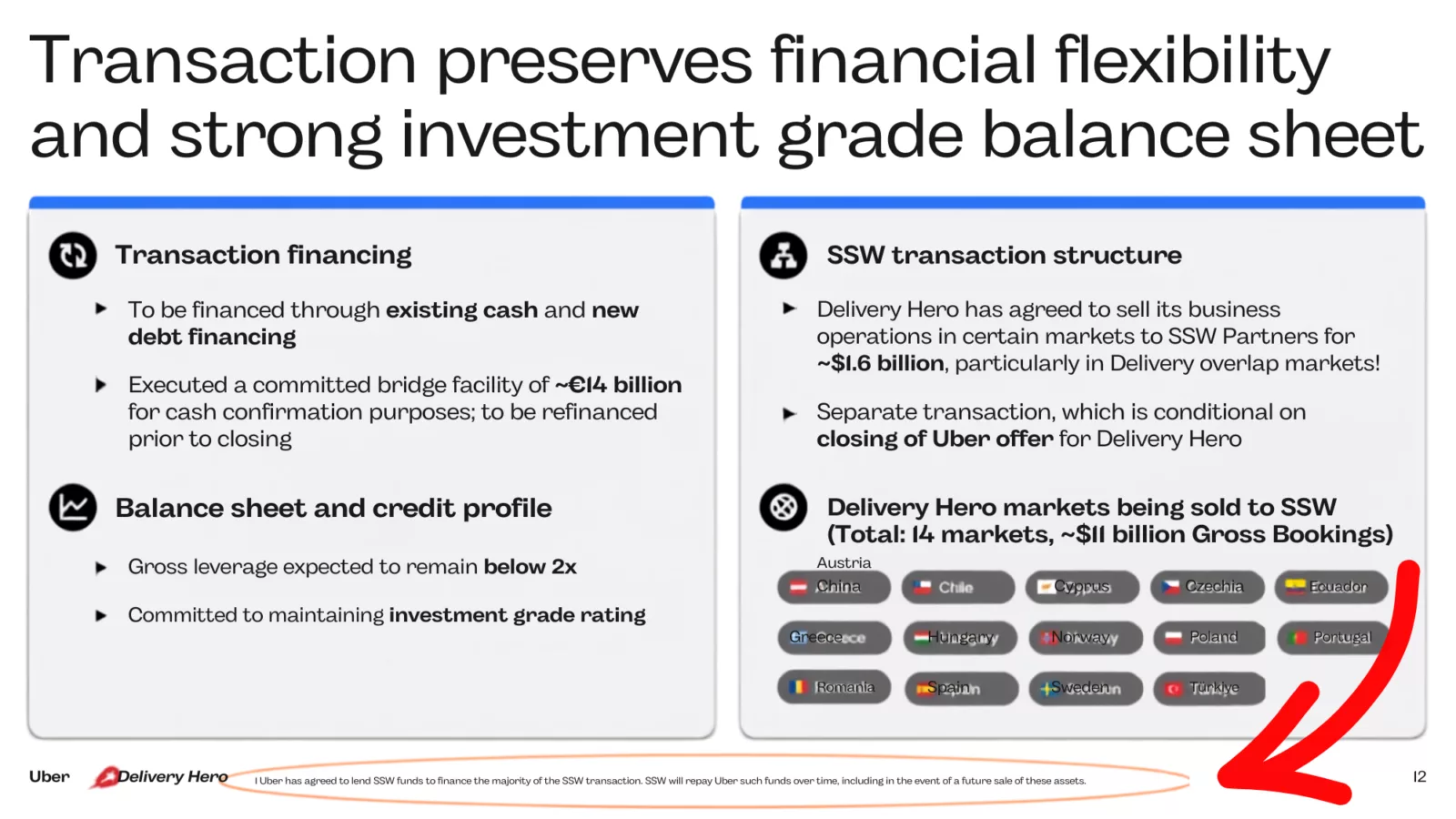
In its investor presentation, Uber describes the sale as follows: “Delivery Hero has agreed to sell its business operations in certain markets to SSW Partners for ~$1.6 billion, particularly in Delivery overlap markets.” That is roughly 1.4 billion euros. Uber calls it a “separate transaction, which is conditional on closing of Uber offer for Delivery Hero.”
According to the presentation, the markets involved are Spain, Sweden, Turkey, Austria, Chile, Cyprus, the Czech Republic, Ecuador, Greece, Norway, Poland, Portugal, Romania and Moldova. Together they account for gross bookings of around 11 billion U.S. dollars. In Austria, the sale covers the Foodora brand; in Spain, the delivery service Glovo.
Uber Finances Most of the Purchase Price
The key detail sits in a footnote, which reads:
“Uber has agreed to lend SSW funds to finance the majority of the SSW transaction. SSW will repay Uber such funds over time, including in the event of a future sale of these assets.”
In other words, Uber is providing the buyer with a loan covering most of the purchase price. SSW is to repay it over time, including from any later resale of the businesses. The documents do not disclose the exact size of the loan or its terms.
SSW Partners is a comparatively small investment firm. According to its SEC filing (Form ADV), it has five employees and manages around 646 million U.S. dollars. SSW has said it intends to look for long-term owners for the acquired businesses. With a staff of five, running 14 companies in markets as different as Austria, Ecuador and Moldova would hardly be easy. SSW Partners is therefore likely to be only a temporary owner for Foodora and Glovo.
Approvals Needed in Austria, Spain and Poland
The main transaction chiefly requires approval from the European Commission for the European Economic Area, plus clearances in Jordan, Saudi Arabia, the United Arab Emirates and Argentina. South Korea only comes into play if its competition authority, the KFTC, requires a filing. No review by Germany’s Federal Cartel Office is planned.
Under Clause 1.2(c) of the business combination agreement, the SSW sale needs separate approval in “(i) Austria; (ii) Spain; (iii) Poland,” as well as in Ecuador. The parties explicitly anticipate a scenario in which Brussels takes over, naming the “European Commission, in case the Asset Purchaser Transaction becomes notifiable to the European Commission instead of Austria, Spain and Poland, e.g., through a referral request.” In the agreement, “Asset Purchaser Transaction” refers to the SSW sale.
If the deal fails because regulatory conditions are not met, another clause requires Uber to pay Delivery Hero a “Regulatory Reverse Fee” of 700 million euros. The takeover offer has a minimum acceptance threshold of 50 percent plus one share, with Uber’s existing stake counting toward it. The long-stop date is set for November 2027. It can be extended only with permission from BaFin, Germany’s financial regulator, and according to the agreement “in no event” beyond May 2028.
Spain Is the Most Sensitive Market
Spain is under particular scrutiny. According to figures from the EU merger review of Prosus and Just Eat Takeaway, Uber Eats held a market share of 20 to 30 percent there, and Delivery Hero, through Glovo, 50 to 60 percent. That makes Spain the European market where the two companies overlap most. Spain’s competition authority, the CNMC, is responsible for reviewing the SSW sale there.
There is also a history. Last year, the European Commission fined Delivery Hero and Glovo a total of 329 million euros. According to the Commission, the companies had divided up markets, agreed not to poach each other’s employees and exchanged sensitive information, conduct made possible by Delivery Hero’s minority stake in Glovo.
A Test for EU Merger Control
The specialist news service MLex sees the structure as a test of how far European merger control reaches. In a piece titled “Uber’s breakup of Delivery Hero likely to test limits of EU merger jurisdiction,” the authors write: “How smooth a ride Uber’s $14 billion acquisition of Delivery Hero gets from EU merger regulators will likely depend on SSW Partners.”
The key open question is whether regulators will treat the SSW sale as a standalone transaction or, given Uber’s financing and its contractual consent rights, review it together with the main takeover. BaFin must first approve the offer document, and the acceptance period will only begin once it has been published.