Huawei’s New Ascend Chips Still Way Behind of Nvidia’s Rubin Chips


Set Trending Topics as a preferred source on Google.
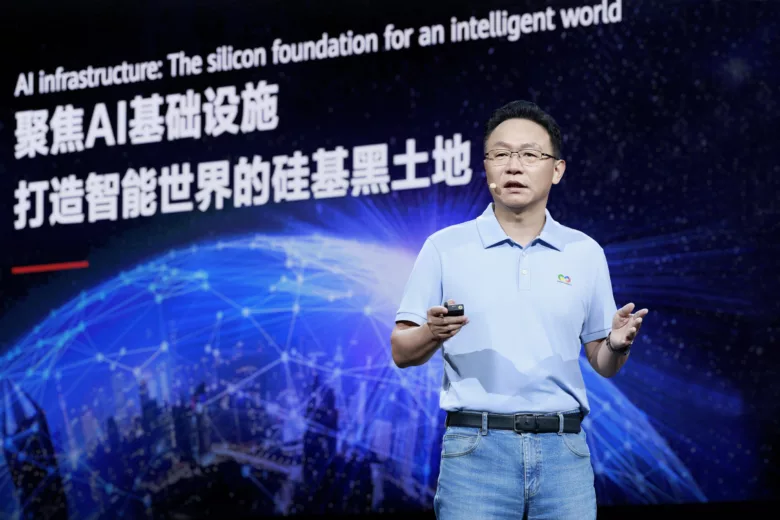
At Huawei Connect in Shanghai, the Chinese group recently moved up its next generation of AI accelerators. The Ascend 960DT and Ascend 960PR processors are set to arrive in the first and third quarter of 2027, roughly three quarters earlier than originally planned. Alongside them comes the Atlas 960E SuperPoD, a computing system that ties up to 4,096 of these chips into a single unit.
The context: AI is moving from applications that react to individual prompts toward agents that plan and carry out tasks on their own. That raises demand for compute, memory and fast networking. Huawei answers with a systems approach spanning eleven in-house chips for compute, storage, networking and management, held together by its own UnifiedBus interconnect.
“At Huawei, we are committed to building powerful AI infrastructure and to developing computing ecosystems through open source and open system approaches,” said David Wang, Rotating Chairman at Huawei. “We will continue to support native training of mainstream foundation models on Ascend and actively promote a broad range of models and applications.”
Two Chips for Two Different Jobs
Huawei splits the generation into a training and an inference variant. The Ascend 960DT, due in the first quarter of 2027, delivers 2 PFLOPS at FP8 and 4 PFLOPS at FP4 according to the company. It carries 288 GB of high bandwidth memory at 9.6 TB/s, with 2.2 TB/s of chip-to-chip bandwidth. The memory comes from Huawei’s own HBM development, a central point of the roadmap given US export restrictions on memory chips.
The Ascend 960PR follows in the third quarter of 2027 and targets inference, meaning the day-to-day serving of models. According to Tom’s Hardware it also reaches 2 PFLOPS at FP8, but 8 PFLOPS at FP4, double what the original roadmap promised. Its memory is smaller and slower at 192 GB and 2.4 TB/s, which suffices for inference workloads with shorter contexts.
Behind that sits an annual cadence: the Ascend 970 is slated for 2028, the Ascend 980 for 2029.
A Computing System Built From 4,096 Processors
With the Atlas 960E SuperPoD, Huawei presented the matching system. It connects up to 4,096 AI processors so that software sees them as one large machine, including a jointly addressable memory pool. Huawei cites 8 EFLOPS at FP8 and up to one petabyte of high bandwidth memory. Against its predecessor, the Atlas 950, the company claims 2.3 times the training throughput, 2.5 times the inference throughput and 70 percent lower latency.
More than 40 AI models have already been pretrained natively on Ascend hardware, according to Huawei. Recent proof that this works in practice came from the open source model GLM-5, which was trained solely on Chinese Huawei chips.
Moving Optics Closer to the Chip Saves Power
For thousands of processors to compute together, they have to exchange very large volumes of data. Huawei relies on near-packaged optics (NPO), which moves optical transmission closer to the processor. Around 5,500 newly developed Hi-ONE units at 7.2 Tbit/s each do the job. Conventionally, roughly 48,000 optical 800G modules would be required.
The effect: system power draw falls by more than 550 kilowatts according to Huawei, uninterrupted operating time doubles, and the company puts system availability at 99.8 percent. Energy efficiency is an important lever for Huawei, because manufacturing in China has to work without the most advanced lithography, which makes the chips draw more power per operation than Western competitors.
Comparing With Nvidia: Well Behind at the Chip Level
The obvious yardstick is Nvidia’s Rubin generation, which lands just ahead of Huawei’s Ascend 960. According to Tom’s Hardware, the Rubin accelerator R200, the core of the Vera Rubin platform, is the counterpart to the Ascend 960DT, while the context-focused Rubin CPX matches up with the Ascend 960PR.
| Huawei Ascend 960DT | Huawei Ascend 960PR | Nvidia Rubin R200 | Nvidia Rubin CPX | |
|---|---|---|---|---|
| Focus | Training | Inference | Training and inference | Inference, context phase |
| Available from | Q1 2027 | Q3 2027 | Q4 2026 | Q4 2026 |
| FP8 | 2 PFLOPS | 2 PFLOPS | approx. 16 PFLOPS | n/a |
| FP4 | 4 PFLOPS | 8 PFLOPS | approx. 50 PFLOPS | approx. 30 PFLOPS |
| Memory | 288 GB HBM | 192 GB HBM | 288 GB HBM4 | 128 GB GDDR7 |
| Memory bandwidth | 9.6 TB/s | 2.4 TB/s | approx. 13 TB/s | n/a |
| Chip-to-chip | 2.2 TB/s | 2.2 TB/s | 3.6 TB/s (NVLink 6) | integrated in NVL144 CPX |
Per chip, the gap is wide: Nvidia delivers roughly eight times the FP8 and more than ten times the FP4 throughput of an Ascend 960DT, and it does so a year earlier. The two are level on memory capacity, which determines how much of a model fits onto a single chip.
At the System Level, Huawei Closes In
That is precisely why Huawei argues consistently at the system level. There, the comparison reads differently:
| Huawei Atlas 960E SuperPoD | Nvidia Vera Rubin NVL144 | Nvidia Rubin Ultra NVL576 | |
|---|---|---|---|
| Available from | Q3 2027 | Q4 2026 | H2 2027 |
| Compute units | 4,096 NPUs | 144 GPU dies (72 packages) | 576 GPU dies (144 packages) |
| FP8 | 8 EFLOPS | n/a | n/a |
| FP4 | approx. 16 EFLOPS | approx. 3.6 EFLOPS | approx. 14.4 EFLOPS |
| Pooled memory | up to 1 PB HBM | approx. 20.7 TB HBM4 | approx. 144 TB HBM4e |
| Power draw | n/a | n/a | approx. 600 kW |
At this level the systems sit in the same order of magnitude. The price for that is unit count: to match total throughput, Huawei needs many times the chips, racks, floor space and energy. Its strength lies in the interconnect and in coupling a great many weaker units efficiently. The group has pursued this approach since the Atlas 950 system, with which Huawei set out to take on the market for AI supercomputers.
DeepSeek as the Benchmark
How far Huawei has actually come is best read off its most prominent Chinese customer. DeepSeek has ordered at least 160,000 Ascend 950DT chips for a data center in Ulanqab, Inner Mongolia, according to media reports. For its latest model, V4 and the V4-Pro that followed, Huawei pledged “full support”: the entire Ascend SuperNode product line was adapted for inference by launch day.
That is where the distinction lies. The large order and the adaptation work both concern serving models in production. DeepSeek has kept training its models on Nvidia hardware, after an earlier attempt to train the R2 model on Ascend chips ran into stability problems in distributed training and caused delays. The Ascend 960DT is Huawei’s answer to that, and whether Chinese labs will train their frontier models entirely at home will be decided on this generation. Zhipu AI showed with GLM-5 that it is possible in principle.
It is also worth noting that all figures cited here are vendor claims and theoretical peak values. Independent benchmarks exist for neither generation, and achievable utilization depends heavily on software, model architecture and networking. Then there is the ecosystem factor: Nvidia’s CUDA is the de facto standard, while Huawei’s CANN platform is still catching up. The company says 61 percent of CANN contributions now come from external developers and that more than 90 open source projects are supported, among them PyTorch, vLLM and Triton.
Manufacturing remains the practical constraint. Analysts see the supply of high bandwidth memory as the tightest bottleneck for Huawei’s Ascend ramp, more so than logic fabrication alone.
Huawei Expects a Hundred-Thousandfold Rise in Token Demand
Huawei describes how sharply demand could grow in its parallel report “Intelligent World 2035: Turning Vision into Action”. Global annual AI token processing could rise 100,000 fold by 2035, with more than 90 percent of data traffic attributable to AI agents. The report names ten development fields, from increasingly autonomous AI through new compute, storage and networking technology to devices, autonomous driving, energy supply and data protection.
The Global Digitalization and Intelligence Index 2026, compiled together with the Institute of Economics at Tsinghua University, puts the cumulative economic value of AI over the next five years at more than 27 trillion US dollars. Global investment in digital and intelligent infrastructure could climb above four trillion US dollars by 2030.