Nscale IPO: Europe’s AI Hope Hinges on Two U.S. Giants


Set Trending Topics as a preferred source on Google.
British AI infrastructure company Nscale has filed its IPO prospectus with the U.S. Securities and Exchange Commission and plans to list on the New York Stock Exchange under the ticker NSCL. The document describes a company that went from renting out bitcoin mining capacity to becoming one of Europe’s most closely watched providers of AI compute in roughly two and a half years. It also shows how much of that business still rests on contracts that have yet to be delivered.
A Targeted Valuation of Around $30 Billion
How much Nscale intends to raise remains open. The price range, the share count and the expected net proceeds appear as blanks throughout the filing and will be added in later amendments. According to a CNBC report cited by Reuters, the company is aiming for a valuation of about $30 billion. In its most recent private round, in which Nscale raised two billion dollars, it was valued at $14.6 billion. Goldman Sachs, J.P. Morgan and Morgan Stanley are leading the offering.
Shortly before filing, Nscale secured a further $3.1 billion through convertible notes. One of the subscribers is Nvidia, whose stake converts automatically into non-voting shares once the offering completes. That makes the company’s most important supplier one of its largest financial backers as well.
Revenue Up Twelvefold, Losses Above a Billion
Nscale generated $140.6 million in revenue in the first half of 2026, up from $10.4 million a year earlier, an increase of 1,252 percent. For all of last year, the company reported $33.0 million.
Against that sits a net loss of $1,020.1 million for the six month period alone. A large share of it comes from fair value adjustments on convertible notes, warrants and similar instruments, which account for $457.1 million and should fall away once the company goes public. The operating loss stands at $492.0 million. The cost structure of the core business is the more telling number: direct costs of revenue came to $189.6 million, more than the revenue itself, and that figure excludes $174.0 million in depreciation. Nscale is currently selling compute below what it costs to deliver.
The Order Book Is 97 Percent Future
The headline figure in the Nscale story is a contracted value of $103.4 billion. The prospectus breaks it down: $2.6 billion sits with contracts that are already running, and the remainder covers capacity that has been signed but is not yet live. At the end of last year, those figures stood at $0.5 billion and $38.0 billion.
The same ratio runs through every operational metric. Nscale operates roughly 25,000 GPUs and has committed to 461,000. Of the 1.37 gigawatts of data center capacity listed as active and contracted, the larger part sits at sites still under construction. Five sites are live and twelve more are under contract. On top of that comes a pipeline of about ten gigawatts of potential capacity, much of it at the recently acquired Monarch Compute Campus in West Virginia.
Two Contracts Carry Almost the Entire Business
Customer concentration is pronounced. A single buyer accounted for 52 percent of revenue in the first half of 2026, 73 percent the year before, and effectively all revenue the year before that. Nscale expects its largest customer to drop below 20 percent this year.
That does little to change the order book. Statements of work with Microsoft provide for payments of up to $43.8 billion through 2033, and the agreements with Anthropic for up to $44.6 billion. Together that is roughly $88 billion of the $103.4 billion total. Both are conditional on Nscale meeting the agreed delivery and availability requirements.
The Anthropic deal carries an additional caveat. The prospectus states that Nscale has secured no binding commitments for the financing needed to build that capacity. Contractually, the company is only obliged to use best efforts to obtain it.
Capital Needs and a Going Concern Note
Outstanding purchase commitments for technology equipment not yet delivered stood at $24.0 billion, with a further $3.5 billion for construction work, most of it due this year and next. Available liquidity at the half year mark was just under $1.5 billion.
The notes to the accounts address this directly. Management’s funding forecast relied on debt and equity financing that had not been committed, which initially raised “substantial doubt” about the company’s ability to continue as a going concern. The prospectus resolves that doubt by pointing to management’s ability to defer, reduce or cancel capital expenditure if the financing fails to arrive.
Operating cash flow of positive $1.69 billion in the first half came almost entirely from $1.6 billion in customer prepayments. Over the same period, $3.29 billion flowed out into investments.
Dependence on a Handful of Suppliers
Procurement is similarly concentrated. Three suppliers accounted for 53, 37 and 10 percent of purchases of Nvidia GPUs and related infrastructure in the first half. Nscale depreciates these assets over five to six years and flags in its own risk section that this useful life could prove too long in a market moving this fast.
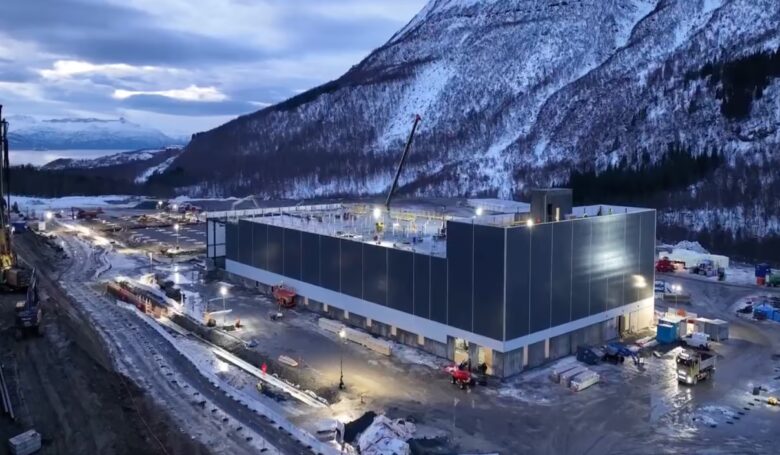
There is also a setback from earlier this year that the filing discloses: OpenAI withdrew from the joint Stargate Norway and Stargate UK projects, after which Microsoft took over the freed up capacity in Norway. Nscale names CoreWeave, Nebius, Crusoe and Lambda as competitors, along with SpaceX.
What Investors Are Weighing
Nscale positions itself in the prospectus as Europe’s answer to the question of AI sovereignty, arguing that its British domicile makes it a “natural, trusted partner” for European customers. The listing is going to New York regardless. The company is run by founder Josh Payne, who at 32 also serves as chair of the board. Sheryl Sandberg, Nick Clegg, former OpenAI executive Fidji Simo and Aker chief executive Øyvind Eriksen sit on that board. Payne’s total compensation last year came to $23.2 million, of which $479,915 was base salary and $242,253 a bonus, with the remainder consisting of option awards worth $22.5 million.