OpenRouter Raises $113M to Become AI’s Most Powerful Routing Layer



A three-year-old Silicon Valley startup has quietly become the most important infrastructure in the AI industry. OpenRouter, which describes itself as a marketplace for AI models, has just closed a funding round of $113 million, as reported by the New York Times. The valuation: approximately $1.3 billion. That is more than double the value from the last round. The round is led by CapitalG, the investment arm of Alphabet, Google’s parent company.
What OpenRouter Actually Does
The idea sounds simple but is technically demanding: companies that use AI models no longer have to commit to a single provider. OpenRouter offers a unified API through which developers can access more than 400 different models. These include models from OpenAI, Anthropic, and Google, as well as open-source systems from China such as DeepSeek and Tencent’s models.
CEO Alex Atallah likes to compare his company to Stripe, the payments giant that bundles all transactions through a single access point. The key difference from cloud giants like Amazon or Microsoft: OpenRouter presents itself as neutral. It does not prioritize its own models, but automatically routes requests to the best provider in each case.
The Numbers That Are Turning Heads
OpenRouter now processes, by its own account, 25 trillion tokens per week. Six months ago, it was still five trillion. Tokens are the basic unit of AI computation, comparable to syllables or word fragments. The fivefold increase within half a year is a clear signal of how rapidly the use of AI models in companies is growing.
The annualized revenue rate is also pointing sharply upward: according to reports, OpenRouter has surpassed the 50 million euro mark, a fivefold increase compared to October 2025. The company officially does not wish to confirm financial details.
Why Cost Pressure Is Driving OpenRouter
The boom has a concrete reason: AI is becoming expensive. Companies that are increasingly relying on AI agents that independently complete tasks are consuming enormous amounts of tokens. Atallah warns that uncontrolled AI use can become an “infinite cost center.”
A widely noted example was recently provided by Uber’s Chief Technology Officer: the company had already exhausted its entire AI budget for 2026 just a few months into the year. Such experiences are driving companies to use models more smartly. OpenRouter’s “Auto Exacto” feature automatically routes requests to the most efficient provider, depending on latency, cost, and quality.
Open-source models that are free to use are particularly popular. Last week, Chinese open-source models from DeepSeek and Tencent topped the usage statistics on the platform, ahead of Anthropic’s high-end Claude 4.7 Opus.
The Seismograph of the AI World
OpenRouter’s usage data is more than business figures. It is a real-time reflection of which models the industry is actually using. The fact that Chinese models temporarily surpassed American ones in usage shows how significantly the global AI balance of power has shifted. Alibaba’s Qwen series and MiniMax models, for example, rapidly gained ground thanks to their excellent price-to-performance ratio — including among Western companies.
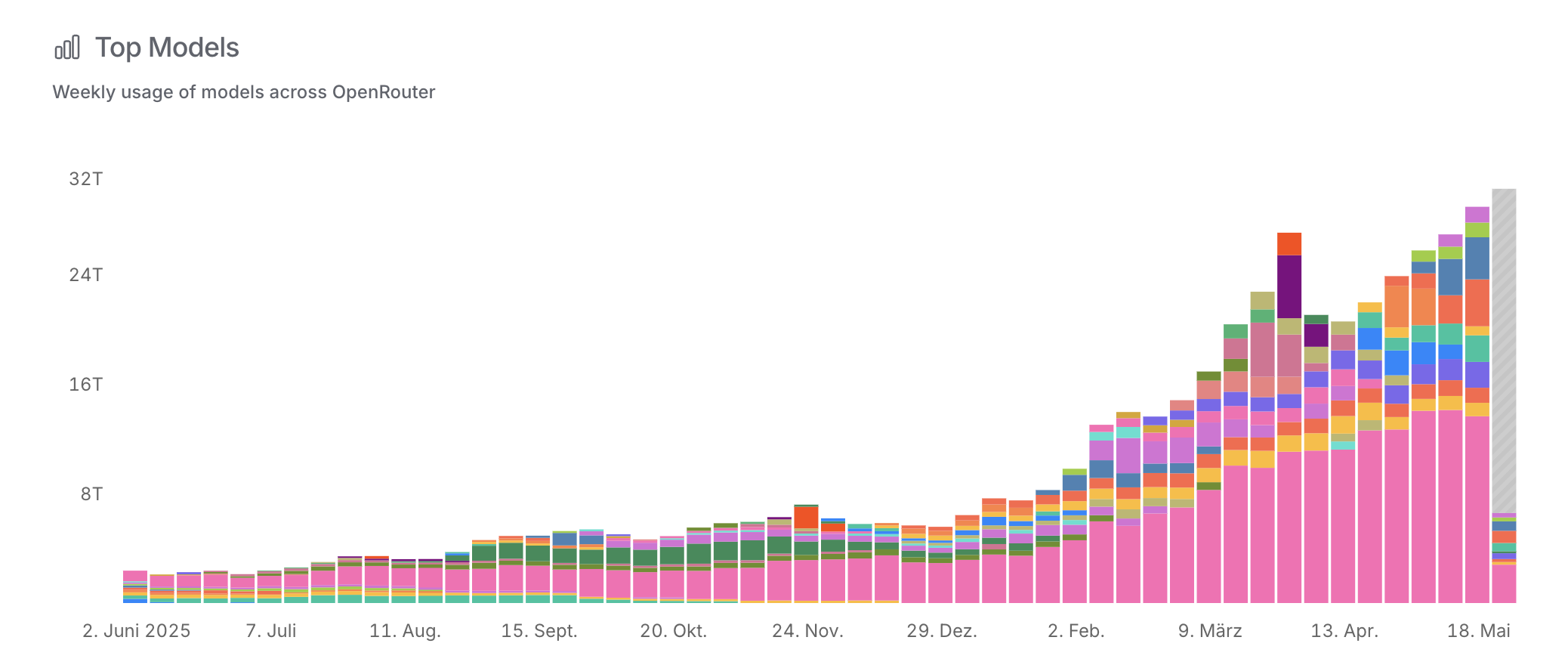
The platform thus reflects a structural shift: AI inference is becoming a commodity. More and more labs are releasing open-source models that compete with proprietary systems. The real value is shifting away from the models themselves toward the orchestration layer — that is, to companies like OpenRouter that maintain an overview and route intelligently.
Google’s Bet on Neutrality
The fact that CapitalG, the investment arm of Alphabet, is leading the round is noteworthy. Google is itself one of the world’s largest AI model providers. Yet the company is investing in a platform that offers Google’s own models on equal footing alongside the competition.
Other investors in the round include the venture capital arms of Nvidia, ServiceNow, MongoDB, Snowflake, and Databricks, as well as existing backers Andreessen Horowitz and Menlo Ventures. OpenRouter had not actively sought the round.
What Comes Next
The fresh capital is intended to flow primarily into growth: more engineers, new products, and a broader model selection. OpenRouter also plans to further expand its developer ecosystem. The strategy is tried and tested: free models such as StepFun’s Step 3.5 Flash lower the barrier to entry for startups and researchers. Those who scale up typically switch to paid frontier models such as Google’s Gemma 4 series.
OpenRouter is therefore not just an infrastructure provider. It is an early warning system for where the AI industry is heading, which models will prevail, and where the next cost shock may be lurking. Anyone who wants to understand what is really happening in the AI world looks at OpenRouter’s routing tables.