Putin’s Longevity Experiments With Mini Pigs Devour $26 Billion Through 2030


Set Trending Topics as a preferred source on Google.
While Russia is imposing higher taxes and cuts to health care and education on its citizens, the Kremlin is pouring billions into a vision that sounds like science fiction: defeating aging. Under the name “New Health Preservation Technologies,” about $26 billion (about 22 billion euros) is flowing into gene therapies, 3D-printed organs and genetically modified mini pigs through 2030, The Wall Street Journal reports. That amounts to roughly 2 trillion rubles. Officially, the program is meant to save 175,000 lives by the end of the decade.
What the Program Funds
The program has been declared a national research priority and has several focal points:
- Gene therapy: Treatments that target the aging of cells.
- Bioprinting: Living tissue from a 3D printer that is eventually meant to replace entire organs. Specific targets have been set for 2030.
- Xenotransplantation: Human organs are to be grown inside genetically modified mini pigs.
- Cryotherapy: Treatments in cold chambers at extremely low temperatures.
Denis Sekirinsky, a deputy science minister, has called gene therapy one of the most promising approaches to fighting aging. Experts are skeptical: There are hardly any international peer-reviewed publications from the program. “If there are no publications then there are no real results, and their statements should probably be taken as aspirations, not to say dreams,” the Russian scientist Alexander Ostrovskiy told The Wall Street Journal.
Putin’s Confidants in Charge
What stands out is who is driving the program. Putin’s daughter Maria Vorontsova, an endocrinologist, oversees state genetics programs. The physicist Mikhail Kovalchuk, head of the prestigious Kurchatov Institute, is seen as its intellectual architect. He is the brother of Yury Kovalchuk, one of Putin’s closest confidants, who is under Western sanctions because of his ties to the Kremlin. The gerontologist Vladimir Khavinson, who died in 2024, long shaped the debate as well, promoting peptide therapies against aging and arguing that life spans of 120 years were possible.
How interested the Kremlin leader himself is in the subject was already evident in 2018. At a meeting with Austria’s then chancellor, Sebastian Kurz, Putin showed openness to cryotherapy in cold chambers, according to The Wall Street Journal.
“At 70, You Are Still a Child”
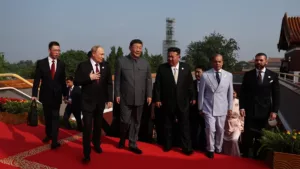
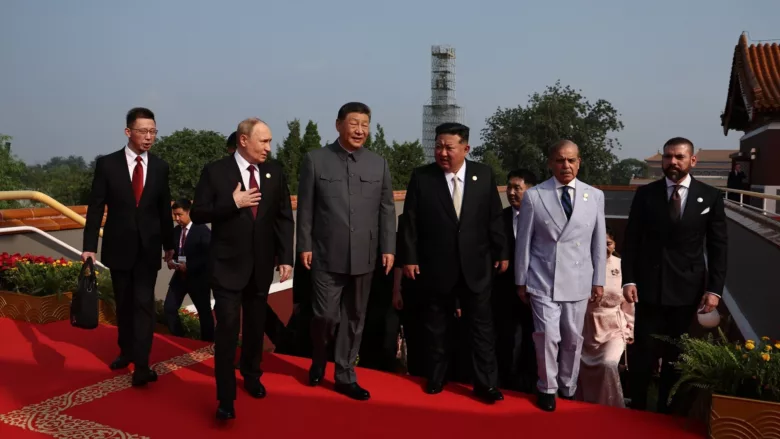
Putin’s fascination with a long life became known worldwide through a recording from Beijing. At the big military parade in September of last year, Putin, China’s leader Xi Jinping and North Korea’s leader Kim Jong-un walked together to the viewing stand at Tiananmen Square. A hot mic of the Chinese state broadcaster CCTV picked up a conversation about immortality.
“In the past, people rarely lived past 70, and these days at 70 you are still a child,” Mr. Xi said through his interpreter. Mr. Putin’s interpreter then translated: “Biotechnology is continuously developing. Human organs can be continuously transplanted. The longer you live, the younger you become, and you can even achieve immortality.” Mr. Xi replied: “Some predict that in this century humans may live to 150 years old.”
Record Spending on the War
The contrast with the situation in the country could hardly be starker. For 2027, the government plans record military spending of 17.1 trillion rubles, up from 12.1 trillion this year, Reuters reports. A single year’s defense budget is thus more than eight times as large as the entire anti-aging program through 2030.
The population is meant to foot most of the bill. Social spending is being cut by 7 percent, education by 6 percent and health care by 6.8 percent. At the same time, taxes keep rising. Value-added tax was already raised from 20 to 22 percent this year, and the Finance Ministry is planning further increases for 2027, The Moscow Times reports:
- Investment income: Interest, dividends and gains from real estate and securities would be taxed on a progressive scale of 13 to 22 percent. About four million high-income Russians would be affected; military personnel are exempt.
- Online shopping: Purchases from abroad would be subject to 22 percent VAT and a customs fee of 100 rubles per package.
- Commodities: Mining and metals companies would pay a 30 percent tax on windfall profits.
Even so, a hole remains in the budget. This year’s deficit is expected to reach about 3 percent of economic output, nearly double what was planned. The cost of interest on government debt is also rising sharply. So while the Kremlin is putting billions into the hope of a longer life, Russians themselves are being made to pay for a war that has already left hundreds of thousands dead and wounded.