Quantum Systems Raises $1.2 Billion, Now Valued at Around $8 Billion


Set Trending Topics as a preferred source on Google.
Munich-based drone manufacturer Quantum Systems has closed one of the largest funding rounds in the history of European defence tech. The company announced on Wednesday that it has signed a Series D round worth $1.2 billion, lifting its post-money valuation to approximately $8 billion – more than double its previous valuation. As recently as late 2025, the company, founded in 2015 and headquartered in Gilching near Munich, was valued at around €3 billion following a €180 million round.
The round is co-led by Blackstone, Noteus, Airbus and Advent, joined by a consortium of crossover and long-term institutional investors including BOND, Fidelity Management & Research Company, Wellington Management, A.P. Moller Holding and Elephant Lake Ventures. Existing backers such as Balderton and HV Capital also participated again. Morgan Stanley acted as exclusive financial advisor and placement agent for the transaction.
What the Capital Will Be Used For
According to the company, the funds will flow into four areas: expanding production capacity, securing supply chains, scaling delivery infrastructure in allied markets, and advancing software and artificial intelligence. Quantum Systems currently operates production sites in Germany, Ukraine, the United States, Australia, Romania, the United Kingdom and the Baltic states.
Strategically, the company wants to accelerate the transition from standalone unmanned platforms to an interoperable family of systems, connected through its proprietary mission software MOSAIC UXS. Co-CEO and co-founder Florian Seibel has stated his ambition to build a “next-generation neo-prime” – a new type of defence contractor positioned to compete with established primes such as Rheinmetall or Lockheed Martin. CFO Jonas Jarosch points to triple-digit revenue growth and double-digit profitability; the company describes itself as profitable.
As part of the round, Airbus Defence and Space and Quantum Systems are also deepening their strategic collaboration. The two companies plan to combine their capabilities in architecture, software and AI to accelerate the development of sovereign European defence technologies. Airbus Defence chief Michael Schöllhorn sees this as a step beyond the role of a classic defence prime towards actively shaping networked defence ecosystems.
The Products Quantum Systems Already Has
Quantum Systems has made its name with vertical take-off reconnaissance drones (eVTOL) spanning both civilian surveying and military intelligence applications:
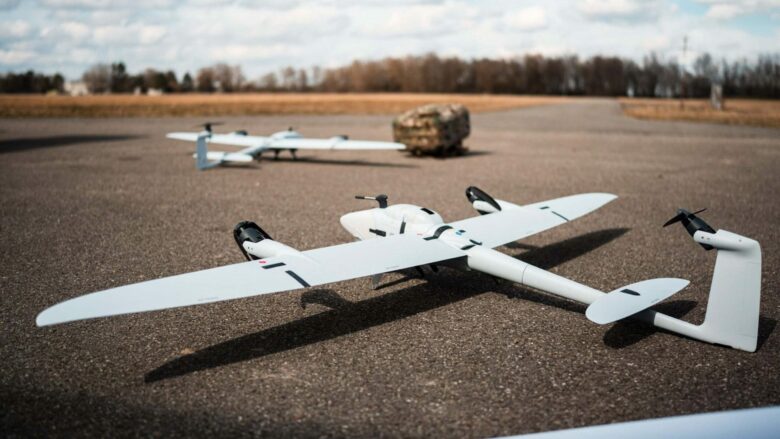
Vector is the company’s flagship: a vertical take-off and landing reconnaissance drone with a wingspan of around 2.8 metres, up to 180 minutes of flight time and a range of up to 60 kilometres. The portable system can be deployed within minutes and delivers high-resolution real-time video for ISR missions (intelligence, surveillance, reconnaissance). A newer variant, “Vector AI”, uses artificial intelligence for navigation, control and reconnaissance. Customers include Ukraine, the German Bundeswehr, Spain, Australia and Romania.
Scorpion is a multicopter configuration of the Vector: the wings and tail are removed and replaced with booms, allowing the same base system to be used for different mission profiles.
Twister is a lighter short-range reconnaissance system with a take-off weight of 3.8 kilograms, 90 minutes of flight time and a range of around 15 kilometres. Designed for special forces, among others, it can also be launched from the so-called Drone Port – a container from which three drones can take off fully automatically and operate in swarms.
Trinity Pro is the company’s civilian mapping and surveying drone. On the market since 2018, the platform has logged more than 75,000 flight hours and can cover around 700 hectares per flight. It carries interchangeable sensors ranging from RGB and multispectral cameras to LiDAR, and is used in land surveying, mining, agriculture and infrastructure inspection.
Strila is the newest project: an interceptor drone designed to counter jet-powered attack drones, developed in cooperation with Ukrainian manufacturer WIY Drones. Quantum Systems is taking the system into series production – in March 2026, Ukraine ordered the delivery of 15,000 Strila interceptors for its National Guard.
On top of this comes the software layer: alongside the MOSAIC UXS mission software, which is meant to connect the various platforms into a networked overall system, the portfolio includes the QBase 3D ground control software and the company’s own Skynode autopilot.
Proving Ground Ukraine
The war in Ukraine has significantly shaped the company’s trajectory. Quantum Systems has been supplying Vector drones to the Ukrainian armed forces since April 2022, now operates its own production sites in the country, and says its systems flew more than 19,000 missions there in 2025 alone. This battle-proven track record is widely seen as a key driver of international demand – and was likely a central argument for the investors in the current round as well.
Blackstone Senior Managing Director David Kaden points to the “structural shift” in the European defence market and the resulting need for capital. Indeed, since Russia’s invasion and the debate over European defence capabilities, significantly more venture capital has been flowing into defence tech – alongside Helsing, Quantum Systems is the most prominent German example of this boom.