SoftBank puts $200M Into New European Unicorn Gravis Robotics


Set Trending Topics as a preferred source on Google.
Swiss robotics startup Gravis Robotics has just announced a Series A round of $200 million (around €172 million). Japan’s SoftBank Group is the sole investor. According to the company, it is the largest Series A in construction robotics to date; the post-money valuation stands at roughly $1 billion, as reported by EU-Startups. That makes Gravis Europe’s newest robotics unicorn.
Until now the company had raised considerably smaller sums: this past November it took in $23 million, co-led by IQ Capital and Zacua Ventures, with participation from Pear VC, Sunna Ventures, Armada Investment and building materials group Holcim. SoftBank’s interest had leaked in advance – Bloomberg had reported on talks that would have valued the startup at more than $500 million.
A retrofit kit instead of a new machine
Gravis Robotics was founded in 2022 as a spin-off from ETH Zurich, specifically out of the Robotic Systems Lab. It is led by co-founder and CEO Ryan Luke Johns and co-founder and CTO Dominic Jud; ETH robotics professor Marco Hutter is a co-founder and board member. Alongside its Zurich headquarters, the company has offices in Austin, Texas, and Oxford.
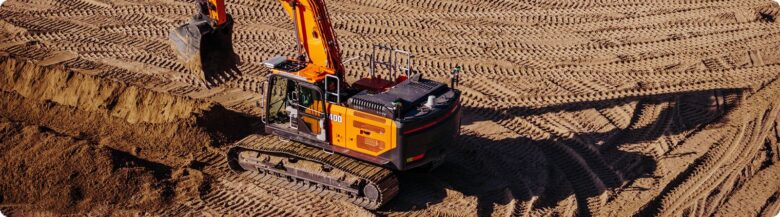
Its approach differs from manufacturers building autonomous construction equipment from scratch: Gravis retrofits existing excavators and other earthmoving machines. The core product is the Gravis Rack, a kit combining sensors, computing hardware and software that, according to the company, has already been installed on machines from Caterpillar, Case, Develon, John Deere, JCB, Hitachi, Sumitomo, Yanmar and Volvo – ranging from roughly ten-tonne equipment to considerably larger models. The reasoning is the fragmentation of the market: by the company’s account, around two thirds of global demand sits outside the three largest manufacturers, so contractors should not be locked into a closed ecosystem.
Technically, Gravis relies on models trained in simulation and then transferred to real jobsites. Unlike self-driving cars or warehouse robots, an excavator actively reshapes its environment, CTO Dominic Jud argues in the company announcement: the software processes machine telemetry to react to changing soil conditions and hydraulic resistance.
The software supports several operating modes – from a copilot with 3D guidance and hazard detection, where the operator stays in the cab, through to fully autonomous operation in which one person supervises multiple machines. Tasks the company says can be automated include driving, trenching, bulk excavation, truck loading and stockpile management. Gravis puts the productivity gain over manual operation at up to 30 percent – a figure that so far rests on its own project data.
Rollout across four continents
The systems are currently deployed on four continents, according to the company, with customers and partners including Holcim, contractor Taylor Woodrow and HD Hyundai. In the UK, Gravis also leads a government-backed CAM Pathfinder project worth $8 million together with plant hire firm Flannery Plant Hire, retrofitting six excavators. The fresh capital is earmarked for hiring, entering additional international markets and increasing the number of autonomous machines running commercially.
For SoftBank, the investment fits a broader shift toward robotics and physical AI. The group has bundled around 20 robotics holdings into a company called Robo HD, is acquiring ABB’s industrial robotics division for $5.4 billion, and plans a new AI and robotics entity called Roze to be listed in the US. It recently sold its remaining stake in Boston Dynamics to Hyundai.