Windows Gets Open-Weight A.I. Like China’s DeepSeek and Nvidia’s Nemotron


Set Trending Topics as a preferred source on Google.
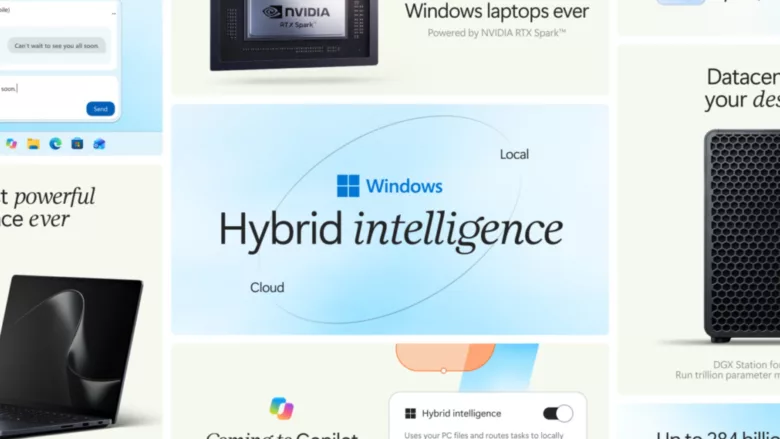
A fresh start after the A.I. hangover: After Microsoft struck out with many users over Recall, Copilot buttons in every app and the “Copilot+ PC” brand, the company is now declaring Windows a platform for “hybrid intelligence.” A.I. agents are meant to run either locally on the PC or in the cloud, depending on the task, protected by built-in security features. Alongside that comes the Surface Laptop Ultra, a notebook with Nvidia’s new RTX Spark chip that is available for preorder now.
Agents in a Sandbox
At the core of the announcement is the idea that Windows should be the most secure environment for A.I. agents. Agents run around the clock, use tools, write code and access files, often without anyone watching every step, Pavan Davuluri, Microsoft’s head of Windows, argues in the company’s announcement. To that end, Microsoft Execution Containers (MXC) are now generally available on Windows 11. These are sandboxes built into the operating system that let companies define which files and networks an agent can access. Every agent has to identify itself so that I.T. departments can tell its actions apart from those of the user. Rules can be rolled out across a company via Intune and Agent 365, although Microsoft concedes in the fine print that governance at scale may require additional services.
MXC is already supported by OpenAI’s Codex, GitHub Copilot, OpenClaw, Replit, LM Studio, Nvidia’s OpenShell and Unsloth. Anthropic’s Claude Code, Perplexity, Manus, Box and Raycast are among those set to follow. Meta’s agent Muse is also coming as a native Windows app with MXC integration. For mini PCs, which many people now use as always-on machines for agents, Microsoft promises setup in a few clicks instead of tedious configuration in the terminal, starting with OpenClaw.
Large Models Right on the Laptop
“Hybrid intelligence” is meant to send computing work wherever it makes the most sense, saving tokens and therefore cloud costs. To do that, Microsoft is bringing large, heavily compressed models to the PC:
- MAI Code 1.1 Flash: Microsoft’s own coding model, with 137 billion parameters (6.8 billion of them active), runs locally at 3-bit precision, making it almost 80 percent smaller, and supports a context window of 256,000 tokens.
- Nvidia’s Nemotron: An upcoming model with more than 70 billion parameters is expected to need just over 20 GB of memory at 2-bit precision.
- DeepSeek V4 Flash: The Chinese model with 284 billion parameters is also set to run locally on RTX Spark devices.
There is also GitHub’s HydraFusion, which automatically routes each task to the right model and will now include local models. For the time being, though, it will be available only as an experimental preview in the GitHub Copilot app, GitHub Copilot CLI and Visual Studio Code, later in October. Developers will also be able to tap open-source models more easily through llama.cpp in Windows ML.
What stands out is which model is missing from the list: OpenAI’s GPT. Microsoft’s move away from its longtime partner is advancing further. Since restructuring its partnership with OpenAI, Microsoft has been building its own MAI models, has also turned to Anthropic models in Microsoft 365 Copilot and is now bringing more alternatives to the PC with DeepSeek and Nemotron. For Windows, that means routing will decide which model handles a task, and OpenAI is just one provider among many.
Copilot Gets Access to Local Files
Copilot itself is getting more powers across all three of its areas: Home, Code and Autopilot. With the user’s permission, the assistant will be able to access local files and recent activity, carry out tasks in Windows, such as organizing files or fixing problems, and use on-device models to do so. In a demo, Copilot gathered tax documents, renamed them, zipped them and drafted an email to an accountant that had to be approved before sending, according to Tom’s Hardware.
The limits: The features are coming only to Copilot+ PCs and are set to roll out over the coming months. Microsoft has not said when which feature will arrive on which device in which country. Windows Search on the taskbar is also new: Commands such as “switch to dark mode,” “dim my screen” or “minimize all my windows” are carried out directly. The actions are rolling out now to Windows Insiders in the experimental channel, and an optional Copilot integration in Search will follow later this year, initially in select markets.
Surface Laptop Ultra and New Devices
On the hardware side, Microsoft is betting on Nvidia. The Surface Laptop Ultra with the RTX Spark chip, the most powerful Surface yet according to Microsoft, offers up to 128 GB of unified memory and a 15-inch touchscreen, and is meant to run A.I. models with more than 120 billion parameters locally. The key details:
- Surface Laptop Ultra: from $2,599 (about €2,310), according to Tom’s Hardware, shipping from Friday of next week.
- Surface RTX Spark Dev Box: from $5,999 (about €5,330), shipping in November and initially only in the United States.
- Partner devices: The Asus ProArt P16 and P14, Dell XPS 16 Creator Edition, HP OmniBook Ultra 16, Lenovo Yoga 9n and MSI Prestige N16 Flip AI+ are also available for preorder and ship from Friday of next week as well. Mini PCs and more dev boxes with RTX Spark will follow later this year.
- DGX Station for Windows: Nvidia’s desktop supercomputer, with the GB300 chip, up to 748 GB of memory and 20 petaflops of A.I. computing power, is set to come with Windows later this year, from Dell and HP among others. It is meant to run models with up to one trillion parameters and serve a whole team with more than 32 agents in parallel. Microsoft has not given prices.
Compared with a 16-inch MacBook Pro with M5 Pro, Microsoft promises that RTX Spark devices deliver up to 2.1 times faster first responses from language models, 4.3 times faster image generation and 6.2 times faster video generation. The figures, however, come from tests commissioned or run by Microsoft and Nvidia themselves, using preproduction devices. For gamers, Microsoft announced that Call of Duty will come to RTX Spark in 2027. “We’ve reinvented the personal computer completely,” Nvidia’s chief executive, Jensen Huang, said at the presentation.
The Setbacks of Recent Years
The big show is also meant to make people forget how bumpy Microsoft’s A.I. push on the PC has been so far. Recall, the memory feature, had to be delayed by a year after heavy criticism over privacy and security and is internally considered a failure in its original form, according to Windows Central. When Mr. Davuluri announced last fall that Windows would become an “agentic OS,” thousands of mostly negative replies poured in. Later, Microsoft announced plans to scale back Copilot features in apps such as Notepad and Paint. And just recently, Microsoft and Qualcomm quietly dropped the “Copilot+ PC” brand on new devices because hardly anyone wanted an “A.I. PC.”
In its announcement, Microsoft nevertheless defends the device category: More than two trillion A.I. inferences run locally on Copilot+ PCs every month, it says, and more than 40 percent of business laptops being built today are Copilot+ PCs. Still, the new strategy looks like a lesson learned from the missteps: fewer A.I. buttons in everyday use, more control and security for businesses, and agents that act only after confirmation. Whether that dispels the skepticism depends on whether users are willing to give agents access to their files.
Apple and Google Follow Suit
Microsoft is not alone with this idea. Apple Intelligence also relies on a mix of on-device models and Apple’s own cloud. Since a multiyear deal with Google at the start of the year, however, Apple has been drawing on licensed Gemini models, which it may distill into smaller versions that run directly on the Mac and iPhone. MacBooks with M5 chips are considered a strong platform for local A.I., which is why Microsoft aimed its benchmarks squarely at the MacBook Pro. Google, meanwhile, is building Gemini deep into Chrome, Android and ChromeOS and is also working on agents that complete tasks in the browser.