Austrian Cloud Atlas Puts the Country’s Data Centers on a Map


Set Trending Topics as a preferred source on Google.
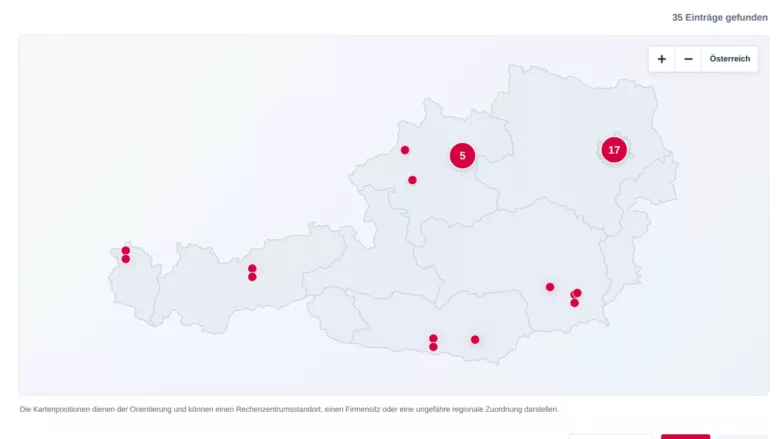
Anyone who wants to know where in Austria their data could be stored now has a map for it: The IT industry association UBIT of the Austrian Economic Chamber and the Association of Austrian Software Innovations (VÖSI) have launched the Austrian Cloud Atlas. The interactive map aims to offer the first structured overview of data centers and digital infrastructure providers in the country. “Companies need to know where their data is stored and which technologies they depend on,” Wilfried Drexler, chairman of UBIT, said in a press release.
35 Data Centers at Launch
At launch, the atlas lists 35 data centers, most of them in Vienna and around Linz, with others in cities such as Graz, Klagenfurt, Villach and Innsbruck. They include sites operated by A1, ACP, Anexia, CANCOM, Raiffeisen Rechenzentrum, Linz AG and eww ITandTEL, as well as colocation providers such as Digital Realty and NTT in Vienna. The data is based on voluntary submissions and is set to be expanded continuously, and operators can submit their own sites.
Users can filter the entries and compare them directly:
- Type: colocation, edge, hyperscale, sovereign cloud or HPC and research, among others
- A.I. readiness: from “not suitable” to “high-performance GPU operation”
- Resilience: Tier I to Tier IV
- Capacity: from under 100 kilowatts to more than 10 megawatts
- Connectivity: from a single carrier to full carrier neutrality
Digital Sovereignty as a Location Factor
The launch comes amid a debate about Europe’s dependence on cloud providers outside the E.U., fueled by geopolitical tensions, cyber risks and the expansion of A.I. “Digital sovereignty means being able to decide for ourselves which technologies we use,” said Peter Lieber, vice president of VÖSI. To do so, infrastructure, software and A.I. need to be considered together, he said. The atlas complements Austria’s A.I. map and VÖSI’s DigSOV model.
Not every entry is sovereign in the strict sense, however. Alongside Austrian operators, the map includes sites run by international companies such as the U.S. colocation giant Digital Realty and Japan’s NTT, as well as an entry labeled “by AWS.” Anyone looking specifically for providers under European control still needs to look closely.
Criticism: Austria Lacks a Strategy
The industry itself makes clear that a map alone is not enough. “What is missing is a coordinated national vision,” said Martin Madlo, president of the Austrian Datacenter Association. While many European countries have already presented national data center strategies, Austria is increasingly seeing a patchwork of rules at the level of its federal states, he said. Vienna recently decided not to apply to host one of the E.U.’s planned A.I. gigafactories.