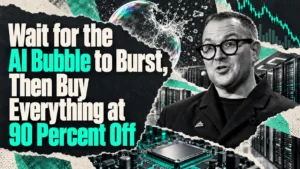
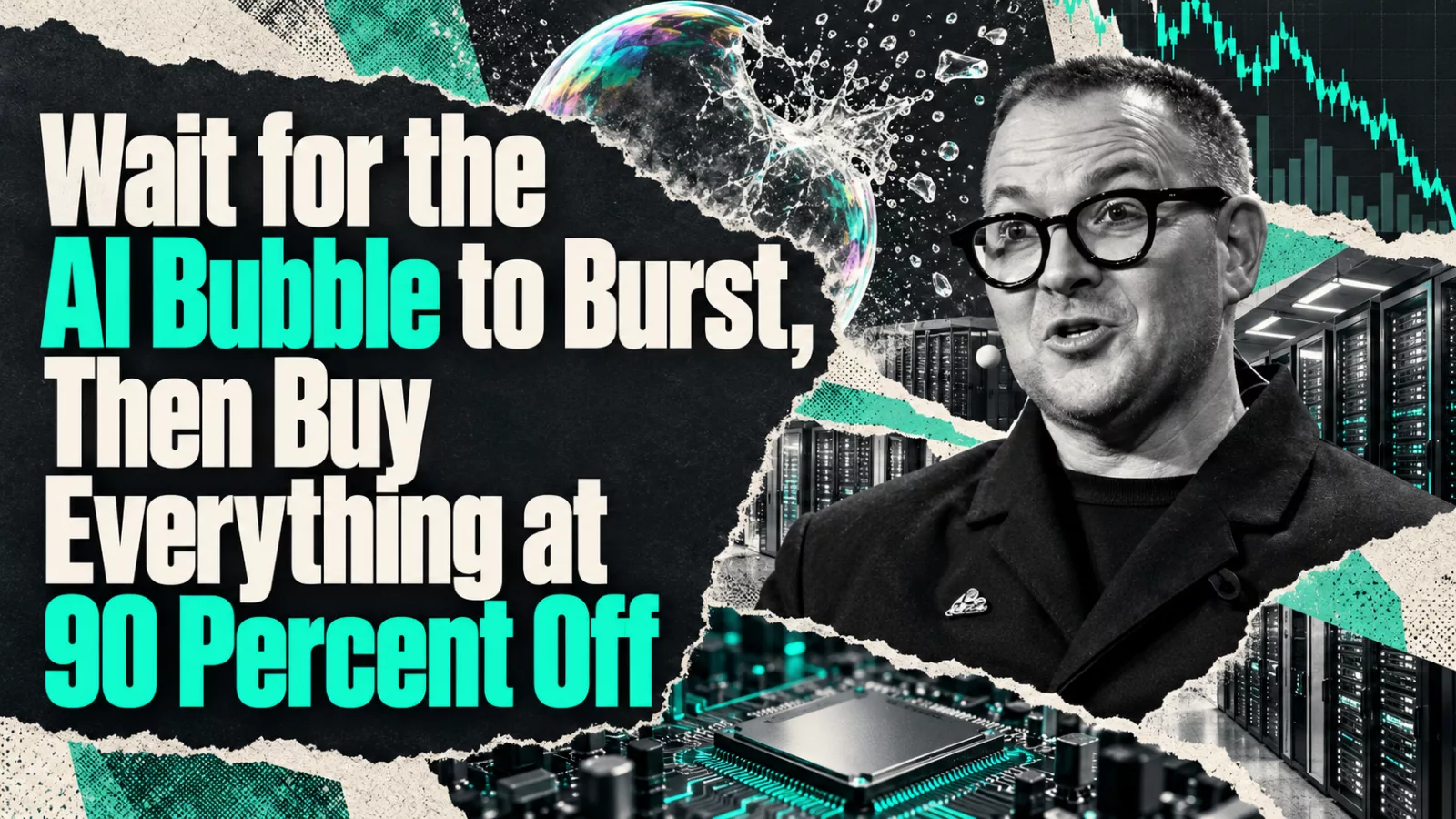
“Wait for the AI Bubble to Burst, Then Buy Everything at 90 Percent Off”


Set Trending Topics as a preferred source on Google.
Europe’s best AI strategy is patience: That is the advice of Cory Doctorow, Canadian science fiction author, activist and one of Big Tech’s fiercest critics. The man who coined “enshittification” to describe the slow decay of digital platforms sees the AI boom as a business that loses money with every new customer and could drag ordinary investors’ retirement savings down with it when it crashes. In an interview with Trending Topics, he talks about the economics of AI models, Anthropic’s IPO, protests against data centers and what Europe should do now.
“We Are Not Going to Get Superintelligence”
You are known for your critical stance on Big Tech. How do you see AI and large language models?
Cory Doctorow: I think you can do quite a few things with statistical inference, but not enough to justify the trillions being invested this year. The idea that these word-guessing programs will wake up one day strikes me as pretty funny. It’s like believing that if you keep breeding horses to be faster and faster, one of them will eventually give birth to a locomotive. We are not going to get superintelligence.
What worries me is something else: 35 percent of the S&P 500 is made up of seven AI companies. Six of them are losing money on AI, and the seventh is Nvidia. The ones losing money are burning hundreds of billions of dollars, and according to the Wall Street Journal there are hundreds of billions more off their balance sheets. When that bursts, we will see what we have seen again and again over the past 25 years: An economic crash is followed by austerity, and austerity drives people toward fascists. Those fascists then come to power after we have used up our administrative and productive capacity on data centers that no longer run. And all of that in the middle of a geopolitical crisis and a climate crisis with heat waves, floods, crop failures and huge numbers of refugees. Instead of competent administrations and a productive country, we would have fascists and a ruined country. I think that is an existential risk to our civilization. It has nothing to do with AI waking up.
So you are very pessimistic. Is there no optimistic point at all?
Cory Doctorow: I hope we build institutions of solidarity that help us take in our neighbors when they lose their homes, and that a better state rises from the ashes. Our prime minister, Mark Carney, said in Davos that the old system is broken, but that it wasn’t good either. That’s true: The old system was not good, and the current one isn’t either. It produced the AI bubble. I would wish for a soft landing, but the worst thing would be to live through the crash and then do nothing.
I don’t like predictions. Predictions mean we have no agency. Of course some things are fixed. If you put a lot of heat into the oceans, the polar ice melts. But what happens then? Do we take people into our cities, or do we turn on each other? History doesn’t decide that, we do. That is where I put my hope: that we can build movements of solidarity. And the most important thing is that it doesn’t matter whether it’s possible. It’s what you have to do. When your ship sinks, you tread water. You don’t know whether you’ll be rescued, but everyone who was ever rescued trod water first.
A Business That Gets Worse With Every Customer
Are you 100 percent sure the AI bubble will burst soon?
Cory Doctorow: I don’t know how you put a trillion dollars into a product with bad unit economics. Unit economics means how much money you make from each new customer. Every new customer of an AI product costs the company money, and every time they come back, the company is worse off. Every generation of AI has worse unit economics than the last, and the improvements are getting smaller. Going from GPT-4 to GPT-5 cost a lot more money than going from GPT-1 to GPT-2, but the difference between GPT-1 and GPT-2 was much bigger than the difference between GPT-4 and GPT-5. Every year we spend more and get less back. The sector loses money on every customer, and it gets worse the more customers it has and the further the technology advances.
It’s as if someone said: We’ve figured out how to lay track, now the trains run and make money. Except the track costs more than the trains bring in. Remember when OpenAI released a new model, and then Anthropic released the new Claude, and everyone switched right away. It’s like laying the last piece of track, turning around, and there’s already a new set of tracks behind you, the trains are running faster, and you have to start all over again. What do you do then? It’s illegal for everyone to sit down at a table and agree to spend less on R&D, that would be a cartel. Maybe the government will allow it at some point. And then you ask whether you can also ban China from doing R&D.
Anthropic’s IPO: Ordinary Investors as Exit Liquidity
In a few weeks Anthropic goes public. In its prospectus, the company points out that it is becoming profitable.
Cory Doctorow: But not under generally accepted accounting principles. I can fly too, as long as you don’t look too closely at how far I am from the ground. Nobody has ever been so profitable that they had to invent new accounting methods to show how profitable they were. “We’re profitable if you do the math so that certain costs don’t count,” that’s not profitable. If your costs don’t count, everyone is profitable.
I think that, like Elon Musk, they will sell their shares to retail investors who have been told for years that they need private retirement savings if they don’t want to starve in old age. Your parents and grandparents will put their retirement savings into these shares, and the insiders will disappear. Just like with Elon Musk, the stock will end up underwater.
So is the Anthropic IPO peak AI?
Cory Doctorow: Whether they pull it off is an interesting question. Because the big question is whether they get the same deal Elon Musk got. Musk got straight into the index. In financial literacy class, you learn that you shouldn’t buy individual stocks, you should buy an index, because that protects you against volatility and risk. An index is a bet on the whole market. Normally, exchanges don’t add companies to an index just because they are among the largest, they wait a few quarters. Companies have to show stability, because firms often get a big pop at the IPO that falls away again once more information reaches the market and a more realistic valuation sets in.
The problem is this: If you manage a fund tracking the S&P 500, the FTSE 100 or the Nasdaq 100, you are legally obliged to hold the stocks in the index. If SpaceX makes up 3 percent of the Nasdaq 100, then 3 percent of your portfolio has to be SpaceX shares, at any price. Normally there are also lock-up periods for insiders, because insiders know when a stock is overvalued. If they have to wait 60 or 90 days before selling, they need a real business. But the Nasdaq let Musk’s insiders sell on day one, including those who had lent him money for Twitter and to build Grok. So you had fund managers who had to buy at any price, a company with very few freely tradable shares, and insiders who were allowed to sell. Ordinary investors with their retirement savings and index funds suddenly became exit liquidity for investors from the Emirates and Silicon Valley billionaires who had lent Elon Musk money for Grok. The risk is that Anthropic gets the same deal. If it does, we will expose a lot of people to serious financial risk. If it doesn’t, its IPO will struggle, because that is exactly what made Musk’s IPO so successful.
Protests Against Data Centers and the Rage at Oligarchy
In the U.S. and in Austria, there are protests against new data centers. Will that become another major lever against AI?
Cory Doctorow: My friend James Boyle likes to explain how the word “ecology” became part of our vocabulary. Before that, people didn’t know they were fighting for the same thing. Some cared about forests, others about noise in the ocean, still others about charismatic nocturnal birds or the composition of the upper atmosphere. It was very hard to change anything for these individual causes. What “ecology” did was turn these causes into a movement, bring them under one umbrella.
We are in that kind of pre-ecology moment right now, only it’s about rage at oligarchy. Sometimes it shows up in how people vote, sometimes as Occupy, sometimes as fights over data centers or over Big Data and surveillance. We still lack the unifying idea.
You can see it with antitrust. The anti-monopoly movement in the U.S. was strong under the first Trump administration, even though Trump himself didn’t lift a finger for it. Then came Canada: Our competition bureau was the worst in the world. In its entire history, it brought only three cases to court and never won. Then Justin Trudeau, who isn’t exactly known for cooperation, gave it more powers than any other regulator in the world. In the U.K., the Competition and Markets Authority did more in five years than its predecessors did in 40, and under Conservative governments at that. Here in the EU there’s the Digital Markets Act and the Digital Services Act. But regulators in Germany, France, Spain, South Korea, Japan, Singapore, Australia and even China are also going after monopolies.
That’s crazy, because any political scientist will tell you that politics delivers what billionaires want. And no billionaire wants antitrust, because they make their money from monopolies. Yet governments of every political stripe are enforcing antitrust. They just don’t realize they are on the same side as the people from Occupy or the people fighting data centers. That is the funnel we can use to win people over to a broad project against oligarchy. I understand why people don’t want a data center in their backyard. But if the data center doesn’t come, something else will, a wildfire for example, because we aren’t doing anything about climate change. And that’s just as bad as a data center in your backyard when your house burns down.
Nationalize Office 365, Not OpenAI
Some argue that companies like Anthropic or OpenAI should be partially nationalized. Is that a way forward?
Cory Doctorow: I understand why people want to nationalize some companies, but not these. They don’t do anything important. If you switched off the chatbots in Austria, every government agency and every company would keep working, the kids would just have to do their own homework. Office 365 is different. If you switched off Office 365 in Austria, every agency and every company would go down, all the hotels and restaurants would have to close. The country would cease to exist.
I hope not.
Cory Doctorow: Microsoft has bowed to the wishes of the Trump administration. They shut down the account of the chief prosecutor at the International Criminal Court, and in Brazil the account of the prosecutor investigating Jair Bolsonaro. So Microsoft is an instrument of the United States. It’s like a neutron bomb: What everyone “loved” about the neutron bomb during the Cold War was that it kills all the people but leaves the buildings standing. This is the new Trump bomb. You can switch off a country as an administrative and economic system. If you turn off Office 365 and Outlook, the ministries can’t even organize meetings anymore, because they use Outlook for that. That is the structural risk. Nationalizing Office 365, or opening it up so we can get all our data out and move it into European systems, that makes sense. But OpenAI’s chatbots don’t do anything important. Why would you nationalize a company that is running the biggest losses in human history? No company has ever lost as much money as the AI companies, more than the tulip bubble, the South Sea bubble and the railroad bubble, even in today’s prices. It’s like seeing a drowning man and saying: We should tie him to our legs. Let him learn to swim on his own first, then maybe we can take something over.
The Recession After the Crash
If the AI bubble bursts, will the U.S. economy slide into a recession?
Cory Doctorow: I don’t know how you can lose 35 percent of the S&P 500 without sliding into a recession. Apollo Capital has already published an analysis that splits the S&P 500 into the “S&P 493” and the “Magnificent 7.” The S&P 493 are already in a recession, so the U.S. economy is too. And we are tying up productive capacity that could actually make things. Solar panels, batteries and seawalls generate the same economic activity and need the same critical minerals and the same workers as building data centers, but they are far more useful and far cheaper.
Without AI, the U.S. is already in a recession. If the bubble bursts, it will slide into a very deep recession. I don’t think the contagion will spread that far, though, because the EU isn’t that exposed, it’s mainly U.S. finance. Still, Trump is doing everything he can to prevent that by alienating the world with his isolationism and his tariffs. Comrade Trump has done more to wean the world off the U.S. dollar, the U.S. internet and oil than Greta Thunberg, Yanis Varoufakis and I combined. Kind of interesting.
Europe’s Chance: Buy the Servers, Tear Down the Walls
In Europe there is a lot of debate about digital sovereignty and AI. Is this a chance for Europe to build its own AI models?
Cory Doctorow: I don’t know why you would build your own AI models. If you want AI, wait for the bubble to burst and buy everything at 90 percent off. When I lived in San Francisco before the dot-com crash, I wanted a Steelcase Leap office chair that cost $1,500. Then the bubble burst, and I drove out to a warehouse where a guy sat like in those pictures from 1929 of a millionaire selling apples next to his Rolls-Royce on Wall Street. He had all the servers, and he had a hall full of Steelcase Leap chairs wrapped in plastic, at $25 apiece. I bought six of them and used them as dining chairs for ten years. Today, the AI servers and the AI engineers are the Steelcase Leap chairs.
There is a big debate about digital sovereignty, and sovereignty mainly means independence from American services. There is an answer to that, and part of it is already well underway. European infrastructure consortia are building data centers. It’s not hard to raise capital for data centers, everyone wants to be a landlord for compute. Programmers to rebuild the American apps aren’t hard to find either. Trump has driven a lot of programmers out of America who spent ten years building nonsense, fake companies designed to be bought by Big Tech or to increase the number of ad clicks. They want to build something real.
The hard part is getting the data out of the servers. Because under Article 6 of the 2001 Copyright Directive, it is illegal to modify these apps so that you can get your data out of the Microsoft cloud. Microsoft certainly won’t help. The only reason we have Article 6 of the Copyright Directive is that the U.S. told us: If you don’t introduce it, we will put tariffs on your exports. Congratulations, Liberation Day: Trump has hit us with tariffs anyway, for the crime of not protecting his apps well enough. Now we can throw off our digital shackles.
Of course Apple won’t allow a real alternative app store, because they pretend to be Irish and all the money flows to Ireland and on from there. But we could allow European companies to jailbreak iPhones. Then you could buy a little dongle for 99 cents at the checkout at Lidl or Aldi that unlocks your phone and installs a European app store. That Apple has the right to hold Europe in check and forbid European companies from selling things to European people in Europe is crazy policy. As long as we don’t make it possible to get data off the old servers, or to reach your Facebook contacts from a European Bluesky, it’s like building beautiful public housing like Vienna’s in West Berlin, but for the people in East Berlin. No matter how good the building is, nobody is going to move in. We have to tear down the wall. We know how to do that. In Europe we did it in 1989, and we can do it again.
Last question: So would you advise Europe to wait for the AI crash, perhaps triggered by the Anthropic IPO?
Cory Doctorow: Yes, or just buy the servers. Use the Chinese models and spread them, distill their weights and build European models for what you need them for. But those are just a few plug-ins. You can do good things with statistical inference, but it isn’t the beginning and end of a new world. If you look at what a new world could look like, the potential lies in people building the technology for themselves, instead of five companies in Silicon Valley doing it. That is a really exciting future.
Trending Topics: Thank you for the interview.
Cory Doctorow: Thanks very much, bye.