Yann LeCun and Mistral’s Chief Invest in Zurich Robotics Start-Up Enact


Set Trending Topics as a preferred source on Google.
Seeing alone is not enough; to drive in a screw, a robot also has to feel it: The Zurich-based physical A.I. start-up Enact Intelligence has just emerged from stealth mode and announced a $30 million (about €27 million) pre-seed round. Alongside the investors redalpine, Notion Capital and firstminute capital, prominent angel investors are on board: the A.I. pioneer Yann LeCun and Arthur Mensch, the founder of Mistral.
Robots With a Delicate Touch
Enact wants to solve a fundamental problem in robotics. Today, most robots rely almost entirely on cameras. Even with plenty of training data, they therefore grasp objects unreliably and perform inconsistently in the real world. Tasks that require a delicate touch remain manual work: plugging in a cable, fitting a seal, starting a screw that catches. Solutions with a sense of force and touch do exist, but according to Enact, they are usually too expensive and too fragile for the factory floor.
That is why Enact is rethinking the robot from the ground up, from the A.I. models and data streams to its own actuators and sensors. The result is meant to be a “nervous system” that senses force throughout the entire body, down to the fingertips, and a “cortex” that turns those signals into a sense of the body and controls its movements. The technology is designed to fit any form factor, from a simple robotic arm to a humanoid. Enact relies heavily on existing A.I. models, such as video models, and adapts them to output robot movements. “We are tackling the crucial bottlenecks: the ability to learn efficiently from experience and to perform tasks reliably,” said Manuel Yves Galliker, the chief executive.
A Founder From 1X and Physical Intelligence
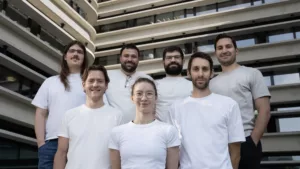
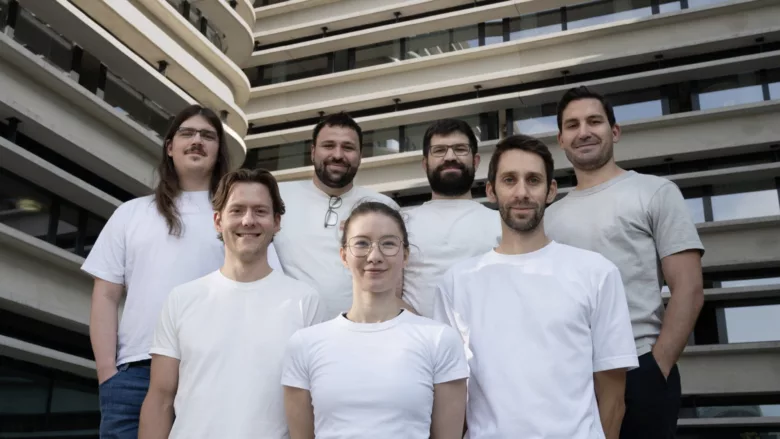
Enact was founded only in March, around Mr. Galliker. He previously led the team at the humanoid robot maker 1X that taught its NEO robot to walk and then worked at the U.S. robotics lab Physical Intelligence. The 12-person team comes from companies including Google DeepMind, 1X, Amazon Robotics, the defense A.I. company Helsing and Physical Intelligence. Also on board is Philip Kneis, previously a deep tech investor at redalpine, who is now responsible for Enact’s growth.
Enact has attracted prominent names among its angel investors. Mr. LeCun was Meta’s chief A.I. scientist for many years and has since founded his own A.I. company, AMI Labs. Mr. Mensch runs Mistral, Europe’s best-known A.I. start-up. They are joined by Andrew Lonsberry, founder of the U.S. welding robot maker Path Robotics.
The Factory’s Last Mile
The first applications are the final steps of assembly, where plugs are inserted, clips snapped into place and screws driven in, often in many variants and small batches. That is exactly where robots are still rare: In Germany, only 4.6 percent of small and midsize companies use robots, compared with 24 percent of large companies, according to Enact. “China wins on volume; we win on variety,” Mr. Galliker said. Instead of having every task programmed individually, Enact’s robots are meant to learn by being shown what to do.
With the money, Enact plans to quintuple its team by the end of 2027, accelerate hardware development and research and deploy its first robots with industrial partners. Talks with European companies in manufacturing, infrastructure, retail and food processing are already underway. The team deliberately chose Zurich for its base because of ETH Zurich, the robotics cluster that has grown up in the Limmat Valley and the proximity to industrial customers.
Strong Competition on Touch
Enact is not alone in trying to give robots a delicate touch. Just this week, the U.S. start-up Eka Robotics, whose model combines vision and force, raised $150 million at a $1.45 billion valuation. There are also well-funded robotics labs such as Physical Intelligence in the United States. In Europe, Neura Robotics, RobCo and Agile Robots are among the active players, and in Switzerland, the construction robotics specialist Gravis Robotics recently became a unicorn. How well Enact’s approach works in practice remains to be seen: The start-up has not yet disclosed concrete performance data or customers.