Physical A.I.: Arda and Eka Raise a Combined $380 Million


Set Trending Topics as a preferred source on Google.
A.I. money is moving from the chat window to the factory floor: Two U.S. start-ups working on so-called physical A.I., meaning A.I. that controls machines and robots in the real world, have just become unicorns. Arda, founded by OpenAI’s former research chief Bob McGrew, has raised $230 million (about €205 million) at a valuation of $1.5 billion (about €1.34 billion). Eka Robotics has raised $150 million (about €134 million) at a valuation of $1.45 billion (about €1.29 billion).
Arda: A.I. for Manufacturing Engineering
Arda develops A.I. software and agents for engineers in manufacturing. They are meant, for example, to speed up the programming of assembly lines, which still requires a lot of manual work. The round is led by Altimeter Capital, Accel and Khosla Ventures, according to CNBC. The first publicly known customer is the defense tech company Anduril. Mr. McGrew was OpenAI’s head of research until 2024, when he left the company on the same day as Mira Murati, its former chief technology officer.
Eka: A Robot That Can Feel
Eka Robotics is taking a different approach from many rivals. Most robotics models combine images and language with movement. Eka is instead building a model that combines vision with force: The camera provides a rough idea of where an object is, while the robot handles the actual grasping through force sensors in its special hand. That is supposed to let it pick up a raspberry without crushing it. According to Eka, the robot handles about 1,500 objects weighing up to one kilogram per hour, compared with about 600 for a human, with a success rate of more than 95 percent.
Eka was founded by Pulkit Agrawal, a professor at M.I.T., and Tuomas Haarnoja, a former Google DeepMind researcher. The round is led by Andreessen Horowitz and F-Prime. The model is trained mainly in simulations in which the robot is said to gain thousands of hours of experience in minutes. Confidential pilot projects are underway with several industrial customers, according to TechCrunch.
Europe Is in the Game
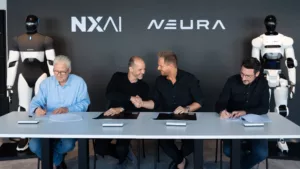
The physical A.I. hype has long since reached Europe as well. Just this week, Nvidia took a stake in the Munich-based robotics company Agile Robots, among others, while the robotics unicorn Neura Robotics from Metzingen, Germany, has unveiled its own A.I. model and is working with the Linz-based start-up NXAI on a memory for robots. The Munich start-up RobCo became a unicorn in early October.
The Open Questions
Whether the technology justifies the valuations remains to be seen. Kris Hauser, a robotics professor at the University of Illinois, praises Eka’s demo for its “wow factor” but asks whether the robot can run reliably on real assembly lines for a year and whether the technique works beyond picking up and placing objects. There is also room for improvement on durability: Eka’s gripper is rated for 5 million motion cycles, while the industrial standard is 20 million. And Arda has so far publicly named only one customer.