EU Inc: Startups, Notaries and Unions Lobby Lawmakers in 300+ Meetings


Set Trending Topics as a preferred source on Google.
How many meetings does it take to shape a new law for startup incorporation? At least 300. That is how many appointments lobbyists have held on the planned EU Inc since the end of 2024 with members of the European Parliament and the top levels of the Commission: 275 meetings with MEPs and at least 33 at Commission level. An analysis of official databases shows who is knocking loudest on the doors in the battle over the new European legal form: startups, notaries and trade unions.
The Commission’s proposal for the so-called 28th regime is meant to give founders a single legal form for the entire single market. Trending Topics reported on the core idea: incorporation for 100 euros, without a bank account, without minimum capital and without a notary. That last point is where opinions split.
Startups Want Speed
The startup scene has been pushing for an "EU Inc" for years, and Trending Topics followed the broad startup coalition from early on. In its position paper, the German Startup Association calls above all for ambition: a regulation instead of a directive, one legal form for all companies rather than only for startups, incorporation within 48 hours for a maximum of 100 euros, no minimum capital and a fully digital process. Flexible share classes and tax-friendly employee ownership are part of the package. On the contentious issue of co-determination, the association backs the compromise that leaves the rules to the member states. It takes a critical view of the option for member states to keep notarial checks, arguing that this brings delays and extra costs.
Notaries Warn of Abuse
The notary profession does not reject the idea outright. The German Federal Chamber of Notaries supports the goal of a uniform European legal form, but warns of straw-man incorporations, hostile company takeovers and new gateways for money laundering. In its view, the EU Inc would raise costs for founders rather than lower them, and it demands substantial improvements to the draft. At EU level, the umbrella organization CNUE leads the line, backed by national bodies in France, Italy, Spain and the Netherlands.
At the core, notaries want to keep playing a role in company formation. In the journal of the Federal Chamber of Notaries, German notaries argue that sovereign identity checks and a preventive legality review provide key safeguards. The regulation would rule out this advance check, and entries in the commercial register would lose their function as a source of trust. The Austrian Chamber of Notaries took its position even before the Commission’s proposal. In the magazine Report, it explicitly backed the idea of a 28th regime. President Michael Umfahrer wants notaries to act as a central point of contact that guides founders through every step, from identity checks and drafting the contract to the review before registration. In the chamber’s view, the Austrian model of incorporation within 24 hours via notaries could be transferred to the European level.
Unions See Workers’ Rights at Risk
For the trade unions, co-determination is at stake. The titles of their events, registered in the meeting list of rapporteur René Repasi (S&D), show how bluntly they put it: the European Trade Union Confederation invited MEPs to a debate on a "Trojan horse" for workers’ rights and tax rules, and the Hans Böckler Foundation to a breakfast on a threat to co-determination and social partnership (see Repasi’s meeting list). The concern is that companies could incorporate wherever workers’ rights are weakest and sidestep national co-determination rules.
The Numbers Side by Side
What the Two Data Sources Show
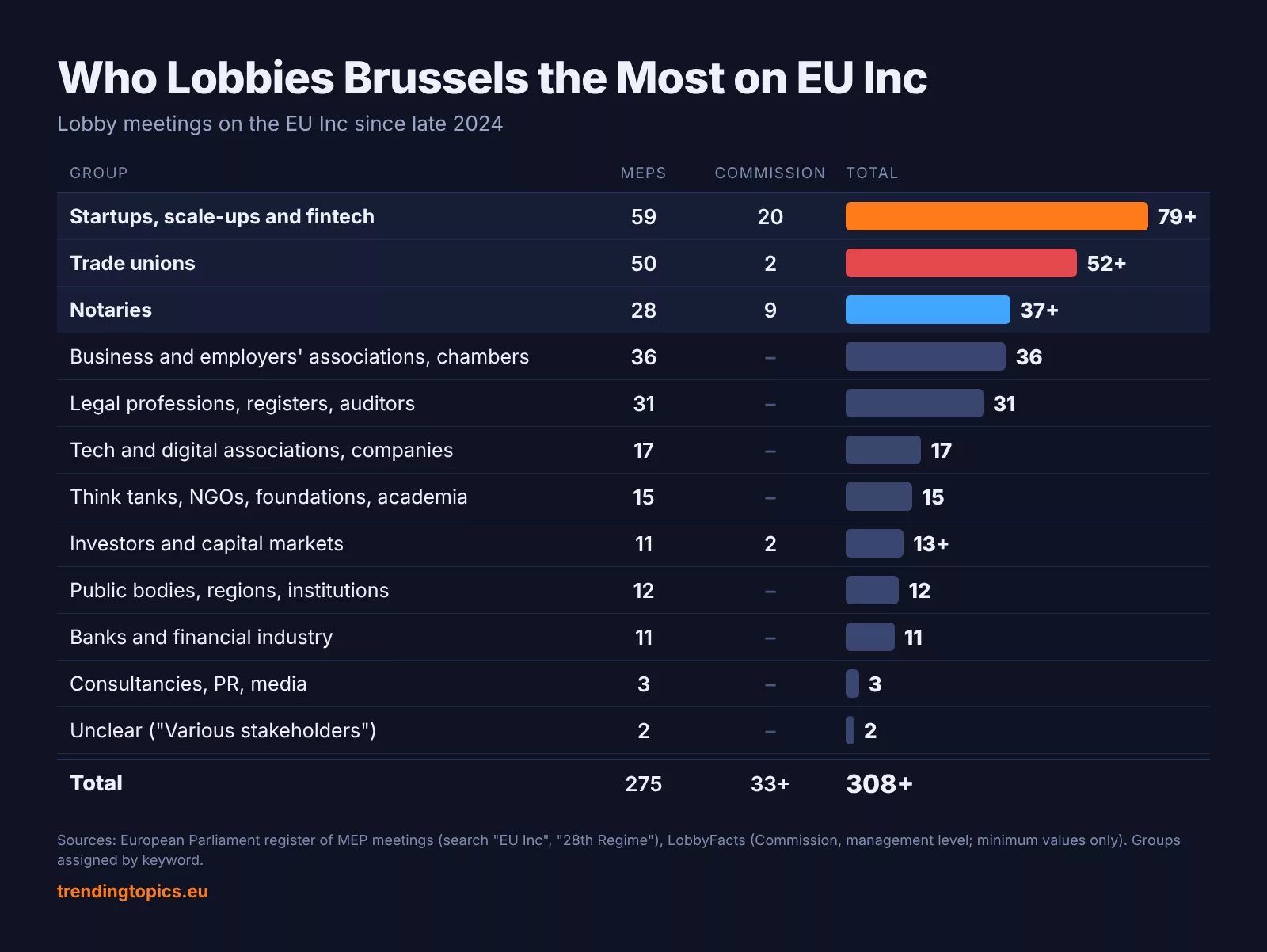
The first source is the register of MEP meetings kept by the European Parliament. Members must disclose meetings with interest representatives, but the entries are self-reported. All entries mentioning "EU Inc" or "28th Regime" were counted, with each meeting counted once. The second source is LobbyFacts from Corporate Europe Observatory and LobbyControl, which compiles Commission meetings at management level (commissioners, cabinets, directorates-general). Only the three big camps and investors were evaluated here, so the figures are minimum values.
In Parliament, the three camps are closer together than one might expect: 59 meetings for the startup side, 50 for the unions and 28 for the notaries. The unions concentrate on the rapporteur, accounting for 20 of his 61 meetings. The notaries rely on individual MEPs: Austrian EPP member Lukas Mandl alone met the Austrian Chamber of Notaries seven times. The startup side approaches many MEPs, most often Renew shadow rapporteur Pascal Canfin, who with 64 appointments is the most visited MEP in the dataset.
In the Commission, the picture is clearer. The startup side tallies at least 20 recorded appointments, the notaries 9 and the unions 2. The handover of the EU Inc petition to several cabinets in early 2025, long before the legislative proposal, accounts for nine appointments on a single day, which puts the number into perspective. The unions, in turn, focus on Parliament, where the law will now be decided. Around 60 percent of the Parliament meetings fall in the period since the Commission’s proposal, 164 of 275.
The largest block is formed by the remaining interest groups, with 127 meetings. Business and employers’ associations (36) and the legal professions (31) stand out here, including bar associations and the French commercial court clerks, who, like notaries, are affected by registry processes. MEPs hardly discuss EU Inc with the big tech companies: Stripe, Klarna and Delivery Hero appear only sporadically. Organizations were assigned to groups by keyword, so borderline cases may differ.
The DSA as a Yardstick
For the Digital Services Act, one of the most heavily lobbied EU laws, the Corporate Europe Observatory counted 613 meetings with MEPs in just under two years. With 275, EU Inc reaches almost half of that, even though the legislative proposal has been on the table for only a little over half a year. The pattern differs as well: in the DSA fight, individual corporations dominated, with Google (23), Facebook (16), Amazon (15) and Microsoft (12) accounting for 66 meetings between them. In the EU Inc debate, it is mainly associations that make their case in Brussels and Strasbourg. The two counts are only partly comparable, because search terms and periods differ and many MEPs report meetings incompletely.
When the Decisions Are Due
Things are getting serious. This Thursday, October 8, the Parliament’s Legal Affairs Committee is scheduled to vote on René Repasi’s report, according to the current timeline, and the plenary could follow later in the month if the committee gives the green light. The report has drawn 1,418 amendments, with co-determination, advance checks at incorporation and the model for employee stock options among the most contested points. In the Council, a general approach is still missing. The Irish presidency has already tabled two compromise texts, the first of which dropped the insolvency chapter and the central register, and the working group meets until November. Trilogue negotiations between Parliament, Council and Commission are planned for late autumn, with a political agreement targeted by the end of the year. The rules would then apply twelve months after entry into force.